
VEŠTAČKA INTELIGENCIJA KAO POKRETAČ INOVACIJA U MODERNIM FINANSIJSKIM SISTEMIMA

Apstrakt
Veštačka inteligencija (AI) postala je značajan pokretač inovacija i digitalne transformacije savremenih finansijskih sistema. Cilj ovog rada je empirijsko ispitivanje obrazaca primene veštačke inteligencije u ključnim bankarskim funkcijama i različitim geografskim regionima, primenom deskriptivne i komparativne analize sekundarnih kvantitativnih podataka iz savremenih industrijskih izveštaja i tržišnih analiza. Rezultati pokazuju da je primena AI najzastupljenija u otkrivanju prevara (60–65%) i upravljanju rizikom (oko 60%), dok je u kreditnom skoringu relativno niža (45–50%). Regionalna analiza ukazuje na značajne razlike, pri čemu Severna Amerika beleži najvišu stopu primene (65%), a Afrika i Bliski istok najnižu (40%). Rezultati takođe ukazuju na rast investicija i tržišta, potvrđujući strateški značaj AI za finansijske inovacije. Rad doprinosi razumevanju savremenih obrazaca transformacije finansijskih sistema zasnovane na AI, uz naglašavanje potrebe za odgovornom primenom, regulatornim prilagođavanjem, zaštitom podataka i transparentnim upravljanjem AI.
Članak
Introduction
The accelerated development of digital technologies has fundamentally transformed modern economic and financial systems (Savić, 2025). Recent studies confirm that the integration of AI in financial services, including credit scoring, fraud detection, and risk management represents one of the most significant evolutions in financial research and practice (Vuković et al., 2025). Within this transformation, artificial intelligence (AI) has emerged as a crucial factor driving innovation and reshaping traditional financial practices. The increasing availability of large volumes of data, combined with advanced computational capabilities, has enabled the application of AI-based solutions across various segments of the financial sector (Ionescu & Diaconita, 2023).
Modern financial systems operate in an environment characterized by high uncertainty, complexity, and rapid change. In such conditions, artificial intelligence provides powerful tools for data processing, pattern recognition, and predictive analysis, allowing financial institutions to improve efficiency, accuracy, and responsiveness. AI technologies are increasingly used in areas such as credit scoring, risk assessment, fraud detection, algorithmic trading, and personalized financial services, contributing to more informed and timely decision-making (Oko-Odion, 2025).
Despite the significant benefits, the integration of artificial intelligence into financial systems also raises a number of challenges. Issues related to data privacy, cybersecurity, transparency of algorithms, and ethical considerations have become central topics in both academic and policy debates (Chevuri, 2025). Moreover, the rapid adoption of AI requires the development of appropriate regulatory frameworks and institutional capacities to ensure its responsible and sustainable use.
The aim of this paper is to empirically examine the patterns of artificial intelligence adoption in modern financial systems, with particular emphasis on its application in risk management, fraud detection, and credit scoring. The study also analyzes regional differences in AI adoption and recent investment and market trends in order to assess the role of artificial intelligence as a driver of innovation in the financial sector.
Accordingly, the study addresses the following research questions:
RQ1: What are the dominant patterns of AI adoption across key financial functions, particularly risk management, fraud detection, and credit scoring?
RQ2: What regional differences characterize the adoption of artificial intelligence in the banking sector?
Literature review
The role of artificial intelligence in modern financial systems has been extensively discussed in contemporary academic and professional literature. Early studies on digital transformation in finance emphasize the importance of information and communication technologies in improving the efficiency and competitiveness of financial institutions (Tebenko et al., 2024; Rashwan & Kassem, 2021; Dašić et al., 2024). With the advancement of machine learning and data analytics, recent research has increasingly focused on artificial intelligence as a key enabler of innovation in the financial sector (Gojković et al., 2025; Bučalina Matić et al., 2025).
Numerous authors highlight the application of AI in financial decision-making processes, particularly in credit scoring, risk management, and financial forecasting. According to several studies, machine learning models outperform traditional statistical methods in predicting credit risk and identifying complex patterns in large datasets (Bello, 2023). Recent systematic reviews further confirm that machine learning techniques significantly improve predictive performance in financial credit scoring and enhance model robustness compared to traditional approaches (Ayari et al., 2026). These findings suggest that artificial intelligence contributes to more accurate assessments and reduces information asymmetry in financial markets.
A significant body of literature also addresses the use of artificial intelligence in fraud detection and cybersecurity. Research indicates that AI-based systems are capable of real-time monitoring and detection of anomalous transactions, thereby enhancing the resilience and security of financial systems. In addition, the growing adoption of AI-powered algorithms in algorithmic trading and portfolio management has been analyzed as a factor influencing market efficiency and volatility (Olanrewaju, 2025).
Beyond technical and economic benefits, recent studies increasingly examine the ethical, legal, and regulatory implications of artificial intelligence in finance. Issues such as data privacy, algorithmic bias, transparency, and accountability are frequently discussed as major challenges accompanying the widespread implementation of AI technologies (Rustandi & Arifin, 2024). Scholars emphasize the need for appropriate regulatory frameworks and governance mechanisms to ensure trust and sustainability in AI-driven financial systems.
Overall, the existing literature confirms that artificial intelligence plays a transformative role in modern financial systems by fostering innovation and improving performance (Sargiotis, 2024). Recent systematic reviews further confirm the accelerating integration of artificial intelligence across financial services, highlighting its growing impact on risk management, fraud detection, and digital transformation processes in banking institutions (Limajatini et al., 2025). However, it also points to the necessity of balancing technological advancement with ethical standards and regulatory oversight, particularly in the context of the evolving information society.
Methodology
The research is based on an empirical, descriptive, and comparative analysis of secondary quantitative data on the adoption of artificial intelligence in the financial sector. The analysis focuses on three key areas of AI application in banking—risk management, fraud detection, and credit scoring—as well as on investment trends, market growth projections, and regional differences in AI adoption.
Secondary data were obtained from recent industry reports and market analyses covering AI applications in financial institutions. The selected indicators include the share of banks using AI in key financial functions, the level of investment in AI technologies, projected market values, and regional AI adoption rates.
Descriptive analysis was used to identify the main patterns of AI adoption, while comparative analysis was applied to examine differences between financial functions and geographical regions. The analysis provides the empirical basis for answering the research questions and assessing the role of AI as a driver of innovation in modern financial systems.
In addition to the quantitative indicators, the results are interpreted in relation to recent academic literature on AI-driven financial innovation, risk management, digital transformation, and regulatory challenges.
Data
The data used in this study were obtained from recent industry reports and market analyses, providing an overview of artificial intelligence (AI) adoption and its economic impact in the financial sector. The dataset focuses on several key dimensions of AI implementation, including its use in risk management, fraud detection, and credit scoring, as well as financial investments and market growth projections for AI and FinTech solutions.
Regarding AI adoption in operational processes, approximately 60 percent of financial institutions utilize AI to improve risk management, enabling predictive analytics, automated monitoring, and faster decision-making. In fraud detection, around 60–65 percent of banks employ AI models and real-time analytics to reduce false positives and enhance transaction monitoring. For credit scoring, AI integration in about 45–50 percent of banks allows for more objective, data-driven assessments of borrowers, improving efficiency while minimizing human bias.
In terms of financial investments, the sector has allocated significant resources toward AI development, with total investments reaching approximately USD 22.6 billion in 2023. Market projections indicate substantial growth, with the global AI in finance market expected to reach USD 99 billion by 2030, and the broader AI FinTech market projected to expand to around USD 60.63 billion by 2033. These figures reflect the strategic significance of AI for modern financial institutions and its potential to reshape the financial ecosystem.
The effectiveness of AI models in banking processes can be evaluated using Accuracy, which measures the proportion of correctly classified cases relative to the total number of observed cases:
Introduction
The accelerated development of digital technologies has fundamentally transformed modern economic and financial systems (Savić, 2025). Recent studies confirm that the integration of AI in financial services, including credit scoring, fraud detection, and risk management represents one of the most significant evolutions in financial research and practice (Vuković et al., 2025). Within this transformation, artificial intelligence (AI) has emerged as a crucial factor driving innovation and reshaping traditional financial practices. The increasing availability of large volumes of data, combined with advanced computational capabilities, has enabled the application of AI-based solutions across various segments of the financial sector (Ionescu & Diaconita, 2023).
Modern financial systems operate in an environment characterized by high uncertainty, complexity, and rapid change. In such conditions, artificial intelligence provides powerful tools for data processing, pattern recognition, and predictive analysis, allowing financial institutions to improve efficiency, accuracy, and responsiveness. AI technologies are increasingly used in areas such as credit scoring, risk assessment, fraud detection, algorithmic trading, and personalized financial services, contributing to more informed and timely decision-making (Oko-Odion, 2025).
Despite the significant benefits, the integration of artificial intelligence into financial systems also raises a number of challenges. Issues related to data privacy, cybersecurity, transparency of algorithms, and ethical considerations have become central topics in both academic and policy debates (Chevuri, 2025). Moreover, the rapid adoption of AI requires the development of appropriate regulatory frameworks and institutional capacities to ensure its responsible and sustainable use.
The aim of this paper is to empirically examine the patterns of artificial intelligence adoption in modern financial systems, with particular emphasis on its application in risk management, fraud detection, and credit scoring. The study also analyzes regional differences in AI adoption and recent investment and market trends in order to assess the role of artificial intelligence as a driver of innovation in the financial sector.
Accordingly, the study addresses the following research questions:
RQ1: What are the dominant patterns of AI adoption across key financial functions, particularly risk management, fraud detection, and credit scoring?
RQ2: What regional differences characterize the adoption of artificial intelligence in the banking sector?
Literature review
The role of artificial intelligence in modern financial systems has been extensively discussed in contemporary academic and professional literature. Early studies on digital transformation in finance emphasize the importance of information and communication technologies in improving the efficiency and competitiveness of financial institutions (Tebenko et al., 2024; Rashwan & Kassem, 2021; Dašić et al., 2024). With the advancement of machine learning and data analytics, recent research has increasingly focused on artificial intelligence as a key enabler of innovation in the financial sector (Gojković et al., 2025; Bučalina Matić et al., 2025).
Numerous authors highlight the application of AI in financial decision-making processes, particularly in credit scoring, risk management, and financial forecasting. According to several studies, machine learning models outperform traditional statistical methods in predicting credit risk and identifying complex patterns in large datasets (Bello, 2023). Recent systematic reviews further confirm that machine learning techniques significantly improve predictive performance in financial credit scoring and enhance model robustness compared to traditional approaches (Ayari et al., 2026). These findings suggest that artificial intelligence contributes to more accurate assessments and reduces information asymmetry in financial markets.
A significant body of literature also addresses the use of artificial intelligence in fraud detection and cybersecurity. Research indicates that AI-based systems are capable of real-time monitoring and detection of anomalous transactions, thereby enhancing the resilience and security of financial systems. In addition, the growing adoption of AI-powered algorithms in algorithmic trading and portfolio management has been analyzed as a factor influencing market efficiency and volatility (Olanrewaju, 2025).
Beyond technical and economic benefits, recent studies increasingly examine the ethical, legal, and regulatory implications of artificial intelligence in finance. Issues such as data privacy, algorithmic bias, transparency, and accountability are frequently discussed as major challenges accompanying the widespread implementation of AI technologies (Rustandi & Arifin, 2024). Scholars emphasize the need for appropriate regulatory frameworks and governance mechanisms to ensure trust and sustainability in AI-driven financial systems.
Overall, the existing literature confirms that artificial intelligence plays a transformative role in modern financial systems by fostering innovation and improving performance (Sargiotis, 2024). Recent systematic reviews further confirm the accelerating integration of artificial intelligence across financial services, highlighting its growing impact on risk management, fraud detection, and digital transformation processes in banking institutions (Limajatini et al., 2025). However, it also points to the necessity of balancing technological advancement with ethical standards and regulatory oversight, particularly in the context of the evolving information society.
Methodology
The research is based on an empirical, descriptive, and comparative analysis of secondary quantitative data on the adoption of artificial intelligence in the financial sector. The analysis focuses on three key areas of AI application in banking—risk management, fraud detection, and credit scoring—as well as on investment trends, market growth projections, and regional differences in AI adoption.
Secondary data were obtained from recent industry reports and market analyses covering AI applications in financial institutions. The selected indicators include the share of banks using AI in key financial functions, the level of investment in AI technologies, projected market values, and regional AI adoption rates.
Descriptive analysis was used to identify the main patterns of AI adoption, while comparative analysis was applied to examine differences between financial functions and geographical regions. The analysis provides the empirical basis for answering the research questions and assessing the role of AI as a driver of innovation in modern financial systems.
In addition to the quantitative indicators, the results are interpreted in relation to recent academic literature on AI-driven financial innovation, risk management, digital transformation, and regulatory challenges.
Data
The data used in this study were obtained from recent industry reports and market analyses, providing an overview of artificial intelligence (AI) adoption and its economic impact in the financial sector. The dataset focuses on several key dimensions of AI implementation, including its use in risk management, fraud detection, and credit scoring, as well as financial investments and market growth projections for AI and FinTech solutions.
Regarding AI adoption in operational processes, approximately 60 percent of financial institutions utilize AI to improve risk management, enabling predictive analytics, automated monitoring, and faster decision-making. In fraud detection, around 60–65 percent of banks employ AI models and real-time analytics to reduce false positives and enhance transaction monitoring. For credit scoring, AI integration in about 45–50 percent of banks allows for more objective, data-driven assessments of borrowers, improving efficiency while minimizing human bias.
In terms of financial investments, the sector has allocated significant resources toward AI development, with total investments reaching approximately USD 22.6 billion in 2023. Market projections indicate substantial growth, with the global AI in finance market expected to reach USD 99 billion by 2030, and the broader AI FinTech market projected to expand to around USD 60.63 billion by 2033. These figures reflect the strategic significance of AI for modern financial institutions and its potential to reshape the financial ecosystem.
The effectiveness of AI models in banking processes can be evaluated using Accuracy, which measures the proportion of correctly classified cases relative to the total number of observed cases:

Accuracy is calculated as a proportion and multiplied by 100 to obtain the percentage value.
Where:
· TP (True Positives) – the number of correctly identified positive cases (e.g., actual fraud detected by AI)
· TN (True Negatives) – the number of correctly classified negative cases (e.g., legitimate transactions identified as safe by AI)
· FP (False Positives) – the number of incorrectly classified positive cases (e.g., legitimate transactions mistakenly flagged as fraud)
· FN (False Negatives) – the number of incorrectly classified negative cases (e.g., actual fraud not detected by AI)
Accuracy represents an important performance measure for evaluating AI-based classification models in financial applications, particularly in fraud detection and risk assessment. However, the percentages presented in this study refer to AI adoption rates among financial institutions rather than to the predictive accuracy of individual AI models. The Accuracy formula is therefore presented as a methodological framework for understanding how the performance of AI-based classification systems can be evaluated in financial applications.
The dataset also includes a regional perspective on AI adoption, highlighting that AI technologies are most widely adopted in North America and Europe, moderately adopted in Asia-Pacific, and at earlier stages in Latin America and Africa & the Middle East. This regional data allows for the assessment of geographical disparities in technology adoption, which is critical for understanding opportunities for investment, regulatory support, and capacity-building initiatives.
The data were obtained from recent industry reports and market analyses (ElectroIQ, 2025; CoinLaw, 2025a; CoinLaw, 2025b; AIFreaksHQ, 2025). These sources provide quantitative indicators of AI adoption, investment trends, market projections, and regional differences in the financial sector. The selected data form the basis for the descriptive and comparative analysis conducted in this study and support the assessment of current patterns of AI-driven transformation in modern financial systems.
Results of the Research
The adoption of artificial intelligence (AI) in the financial sector is accelerating rapidly, impacting core banking functions and the broader FinTech market.
The economic value of AI investments can be expressed using the Return on Investment (ROI) formula:

· ROI (%) – Return on Investment, expressed as a percentage. It measures the economic benefit obtained from implementing AI relative to the cost of the investment.
· Gains from AI Implementation – the total financial benefits, savings, or additional revenue generated by applying AI technologies in financial processes. For example, improved fraud detection, reduced credit losses, or efficiency gains in operations.
· Cost of AI Implementation – the total expenses required to develop, acquire, and integrate AI solutions, including software, hardware, training, and maintenance.
· Subtraction (Gains − Cost) – represents the net profit or net benefit generated from the AI investment.
· Division by Cost of AI Implementation – calculates the return relative to the initial investment.
· Multiplication by 100 – converts the ratio into a percentage, showing how much return is gained for each unit of investment.
In the context of AI adoption in the financial sector, the ROI framework provides a useful analytical basis for evaluating the potential economic efficiency of investments in AI technologies. Although the available aggregate market data do not allow for a direct calculation of ROI at the institutional level, the substantial investment volume of approximately USD 22.6 billion in 2023, together with projected market growth, indicates the increasing economic relevance of AI implementation. The ROI framework is therefore used in this study as a conceptual indicator for interpreting the relationship between AI investment, potential efficiency gains, and long-term economic benefits.
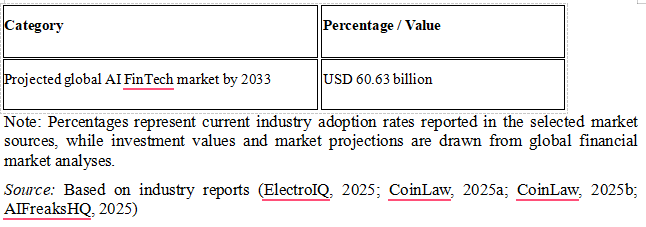
Table 1 summarizes the key metrics on AI usage, investment levels, and market projections in the financial industry based on recent industry reports and market analyses.
Table 1. AI Adoption and market data in the financial sector
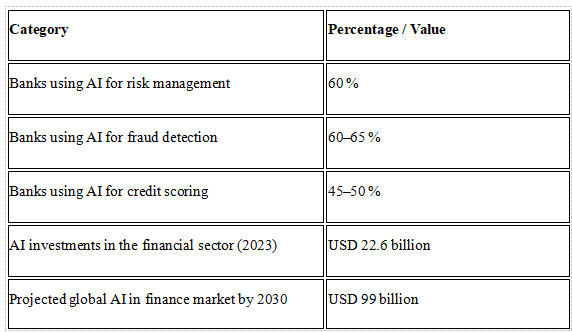
The data show that AI is becoming a central tool for improving efficiency and decision-making in financial institutions. Around 60% of banks employ AI in risk management, enabling predictive analytics and better assessment of operational and financial risks. Similarly, AI has proven valuable in fraud detection, with approximately 60–65% of banks adopting machine learning and real-time data analytics to detect fraudulent activities and reduce false positives.
In the credit scoring domain, about 45–50% of banks use AI models to improve accuracy, reduce bias, and enhance decision speed. These adoption rates indicate that AI is not limited to experimental or pilot projects; it has become integral to core financial operations.
Investment trends also highlight the strategic importance of AI: in 2023, financial institutions invested roughly USD 22.6 billion in AI technologies. The market for AI in finance is expected to grow to USD 99 billion by 2030, and the broader AI FinTech market is projected to reach USD 60.63 billion by 2033. These figures demonstrate the long-term economic potential of AI in both traditional banking and emerging FinTech sectors.
A comparative analysis of the adoption rates reveals differences in the intensity of AI implementation across financial functions. AI adoption is highest in fraud detection (60–65%) and risk management (approximately 60%), while credit scoring records a comparatively lower adoption rate of 45–50%. The difference between the highest and lowest observed adoption rates therefore ranges from approximately 10 to 20 percentage points. These findings suggest that financial institutions currently prioritize AI applications related to transaction security and risk control over its application in credit assessment.
Overall, these results suggest that AI is a major driver of innovation in modern financial systems, enabling enhanced operational efficiency, better risk management, and improved financial decision-making. The combination of high adoption rates and significant investments indicates that AI will continue to reshape the financial industry over the next decade.
Table 2. Regional adoption of AI
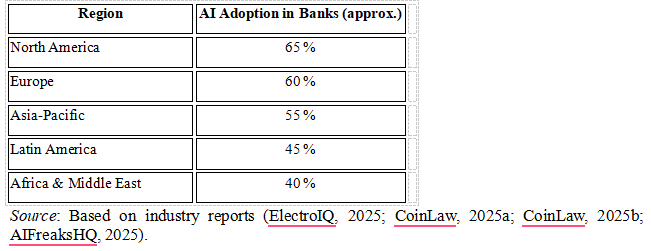
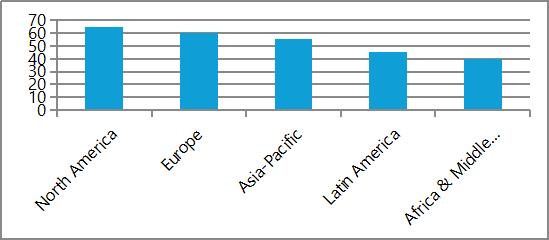
Table 2 and Chart 1 illustrate the regional distribution of artificial intelligence (AI) adoption in banks across the world. The data show that AI integration is most prevalent in North America and Europe, where a majority of financial institutions have incorporated AI into key processes such as risk management, fraud detection, and credit scoring.
Graph 1. Regional Adoption of AI
Source: Based on industry reports (ElectroIQ, 2025; CoinLaw, 2025a; CoinLaw, 2025b; AIFreaksHQ, 2025).
In the Asia-Pacific region, AI adoption is slightly lower, reflecting emerging implementation trends, while Latin America and Africa & the Middle East exhibit more moderate adoption rates, suggesting that these regions are still in earlier stages of AI integration.
The comparative analysis reveals a 25-percentage-point gap between North America, which records the highest observed AI adoption rate (65%), and Africa & the Middle East, which records the lowest rate (40%). The difference between North America and Europe is relatively small at 5 percentage points, while the gap between Europe and Latin America reaches 15 percentage points. These results indicate substantial geographical disparities in the diffusion of AI technologies across banking systems and suggest that AI adoption remains uneven across regions.
Overall, the table and chart highlight significant regional variations in AI utilization, providing a global perspective on how different markets are approaching the digital transformation of financial systems. These insights can help identify opportunities for growth and investment in regions with lower adoption rates and underscore the strategic importance of AI in modern banking worldwide.
Discussion
The findings from Table 1 clearly indicate that artificial intelligence (AI) is becoming a transformative force in the financial sector. The widespread adoption of AI in risk management, fraud detection, and credit scoring reflects a growing recognition among banks and financial institutions of its ability to improve operational efficiency, accuracy, and decision-making quality.
The use of AI in risk management (~60% adoption) enables financial institutions to predict potential risks, automate monitoring, and respond more quickly to market changes (Leo et al., 2019). This aligns with global trends showing that AI enhances the robustness of risk assessment frameworks, helping institutions mitigate both operational and financial exposure.
Similarly, AI’s role in fraud detection (~60–65% adoption) demonstrates its effectiveness in real-time anomaly detection and predictive modeling (West & Bhattacharya, 2016). Financial institutions leveraging AI for fraud prevention report reduced false positives and faster identification of suspicious transactions, which not only minimizes losses but also improves customer trust and satisfaction.
In credit scoring, AI models (~45–50% adoption) provide more objective and data-driven evaluations of borrowers, reducing human bias and increasing the efficiency of lending decisions (Bussmann et al., 2021). This highlights AI’s potential to promote financial inclusion, as automated models can consider alternative data sources that traditional scoring methods might overlook.
Investment and market projections underscore the economic importance of AI in finance. With AI investments totaling around USD 22.6 billion in 2023 and the global AI in finance market expected to reach USD 99 billion by 2030, it is evident that financial institutions view AI as a strategic priority rather than a supplementary technology. The projected growth of the AI FinTech market to USD 60.63 billion by 2033 further emphasizes the expansion of AI-driven innovations beyond traditional banking, opening new opportunities for digital financial services, personalized products, and fintech startups.
Regional differences, as illustrated in Table 2 and Chart 1, provide additional insights into the global landscape of AI adoption. North America and Europe show the highest levels of AI integration, with approximately 65% and 60% of banks implementing AI technologies, respectively. This reflects well-established digital infrastructures, regulatory support, and higher availability of AI expertise. The Asia-Pacific region shows moderate adoption (~55%), while Latin America (~45%) and Africa & the Middle East (~40%) are still in earlier stages of AI integration. These regional disparities highlight opportunities for growth and targeted investment in areas where AI adoption is lower, as well as the need for capacity-building initiatives and regulatory frameworks tailored to local market conditions.
These trends collectively suggest that AI is not merely a technological tool but a key driver of innovation and competitive advantage in modern financial systems. However, it is important to note that challenges remain, including data privacy concerns, regulatory compliance, and the need for explainable AI models to ensure transparency and accountability. Future research could explore the impact of regulatory frameworks on AI adoption, as well as the long-term economic effects of AI integration in both traditional and emerging financial markets.
The findings provide clear answers to the research questions formulated in this study. Regarding RQ1, the comparative analysis shows that AI adoption is most pronounced in fraud detection and risk management, with adoption rates of approximately 60–65% and 60%, respectively, while its application in credit scoring remains comparatively lower at 45–50%. This pattern indicates that financial institutions currently prioritize AI applications related to transaction security and risk control. Regarding RQ2, the results reveal substantial regional differences in AI adoption. North America and Europe record the highest adoption rates, while Latin America and Africa & the Middle East show considerably lower levels of AI integration. The observed 25-percentage-point gap between the highest and lowest regional adoption rates confirms that the diffusion of AI technologies across banking systems remains geographically uneven.
The findings confirm that AI adoption in finance is extensive and strategically significant, particularly in risk management, fraud detection, and credit evaluation. Regional differences indicate varying levels of adoption and demonstrate that the integration of AI technologies remains uneven across global financial markets, while their growing application reinforces the strategic importance of AI for innovation and competitiveness.
Conclusion
The analysis of secondary quantitative data, including both global adoption patterns (Table 1) and regional distribution (Table 2 and Chart 1), shows that AI is widely used in risk management, fraud detection, and credit scoring, with adoption rates ranging from approximately 45% to 65%. These applications enhance operational efficiency, decision-making accuracy, and customer trust, while mitigating risks and reducing human bias in critical financial processes.
Regional analysis reveals that North America and Europe lead in AI adoption, reflecting mature digital infrastructures, regulatory support, and access to AI expertise. The Asia-Pacific region shows moderate adoption, while Latin America and Africa & the Middle East are still in earlier stages of integration. These regional differences highlight opportunities for targeted investment, capacity-building, and regulatory guidance to accelerate AI adoption in underrepresented markets.
The financial sector has made substantial investments in AI, with around USD 22.6 billion invested in 2023, signaling strong commitment to digital transformation. Market projections indicate continued growth, with the global AI in finance market expected to reach USD 99 billion by 2030 and the broader AI FinTech market projected to reach USD 60.63 billion by 2033, emphasizing both the economic potential and strategic importance of AI technologies.
While AI offers significant advantages, challenges such as data privacy, regulatory compliance, and explainability of AI models remain critical considerations. Addressing these challenges is essential to ensure responsible and sustainable deployment of AI in finance.
The contribution of this study lies in the comparative analysis of recent secondary quantitative data on AI adoption across key financial functions and geographical regions. By integrating functional, investment, market, and regional indicators within a unified analytical framework, the study provides a structured perspective on current patterns of AI-driven transformation in modern financial systems. The findings contribute to a better understanding of differences in the intensity and geographical distribution of AI adoption in the financial sector.
The study is subject to certain limitations. The analysis relies on secondary data obtained from different industry and market sources, which may apply different methodologies, samples, and reporting periods. Therefore, the findings should primarily be interpreted as indicators of current AI adoption patterns rather than as evidence of causal relationships. Future research could extend the analysis by using longitudinal datasets, institution-level data, and additional quantitative methods to examine the determinants and economic effects of AI adoption in financial institutions.
AI integration in the financial sector is transformative, reshaping risk management, fraud detection, credit evaluation, and financial services. This study confirms that AI is a key driver of innovation and competitive advantage, with growing importance in the future development of global financial systems.
Reference
2.AIFreaksHQ. (2025). AI in finance / Industry report 2025: Market size and adoption. Retrieved from https://aifreakshq.com/reports/ai-in-finance/
3.Ayari, H., Guetari, P. R., & Kraïem, P. N. (2026). Machine learning powered financial credit scoring: A systematic literature review. Artificial Intelligence Review, 59, 13. https://doi.org/10.1007/s10462-025-11416-2
4.Bello, O. A. (2023). Machine learning algorithms for credit risk assessment: An economic and financial analysis. International Journal of Management Technology, 10(1), 109-133. https://doi.org/10.37745/ijmt.2013/vol10n1109133
5.Bučalina Matić, A., Stanojević, Lj., & Milić, S. (2025). Uticaj generativne veštačke inteligencije na proces kreiranja digitalnih sadržaja. Društveni horizonti, 5(10). https://drustveni-horizonti.fdn.edu.rs/storage/articles/pdfs/VnIBGrkCIYvvspVsMfwdwAyrCRco3zao7jgnSl0o.pdf
6.Bussmann, N., Giudici, P., Marinelli, D., & Papenbrock, J. (2021). Explainable machine learning in credit risk management. Computational Economics, 57, 203–216. https://doi.org/10.1007/s10614-020-10042-0
7.Chevuri, R. R. (2025). The role of explainable AI in promoting transparency in financial decision-making. World Journal of Advanced Research and Reviews, 26(1), 1294–1301. https://doi.org/10.30574/wjarr.2025.26.1.1160
8.CoinLaw. (2025a). AI in fintech market statistics 2026: Growth, trends & innovations. Retrieved from https://coinlaw.io/ai-in-fintech-market-statistics/
9.CoinLaw. (2025b). AI in banking statistics 2026: Adoption, savings & customer impact. Retrieved from https://coinlaw.io/ai-in-banking-statistics/
10.Dašić, B., Pavlović, N., & Savić, M. (2024). Technological progress and digitization in the function of the development of e-education in Serbia. Akcionarstvo, 30(1), 257-280. https://doi.org/10.65772/ak2024112
11.ElectroIQ. (2025). AI in finance statistics, trends and facts 2025: Adoption, use cases and market overview. Retrieved from https://electroiq.com/stats/ai-in-finance-statistics/
12.Gojković, B., Obradović, Lj., Kecman, A. V., & Stojanović, M. (2025). The impact of artificial intelligence on contemporary business: A scoping review. Oditor, 11(3). https://doi.org/10.59864/Oditor92503BZ
13.Ionescu, S. A., & Diaconita, V. (2023). Transforming financial decision-making: The interplay of AI, cloud computing and advanced data management technologies. International Journal of Computers Communications & Control, 18(6), Article 5735. https://doi.org/10.15837/ijccc.2023.6.5735
14.Leo, M., Sharma, S., & Maddulety, K. (2019). Machine learning in banking risk management: A literature review. Risks, 7(1), 29. https://doi.org/10.3390/risks7010029
15.Limajatini, L., Suhendra, S., Pangilinan, G. A., & Ilham, M. G. (2025). Integration of artificial intelligence in the financial sector: Innovation, risks and opportunities. International Journal of Cyber and IT Service Management, 5(1), 58-70. https://doi.org/10.34306/ijcitsm.v5i1.165
16.Oko-Odion, C. (2025). AI-driven risk assessment models for financial markets: Enhancing predictive accuracy and fraud detection. International Journal of Computer Applications Technology and Research, 14(4), 80-96. https://doi.org/10.7753/IJCATR1404.1007
17.Olanrewaju, A. G. (2025). Artificial intelligence in financial markets: Optimizing risk management, portfolio allocation, and algorithmic trading. International Journal of Research Publication and Reviews, 6(3), 8855-8870. https://doi.org/10.55248/gengpi.6.0325.12185
18.Rashwan, A. R. M. S., & Kassem, Z. A. E. A. (2021). The role of digital transformation in increasing the efficiency of banks’ performance to enhance competitive advantage. In The big data-driven digital economy: Artificial and computational intelligence (pp. 325-335). Springer International Publishing. https://doi.org/10.1007/978-3-030-73057-4_25
19.Rustandi, R., & Arifin, A. H. (2024). AI in finance: A systematic literature review. Proceeding International Collaborative Conference on Multidisciplinary Science, 1(2), 323-338. https://doi.org/10.70062/iccms.v1i2.66
20.Sargiotis, D. (2024). Ethical AI in information technology: Navigating bias, privacy, transparency, and accountability. Advances in Machine Learning & Artificial Intelligence, 5(3), 1-14. https://doi.org/10.33140/AMLAI.05.03.03
21.Savić, M. (2025). Digitalizacija i njen uticaj na efikasnost bankarskog sektora. Akcionarstvo, 31(1), 147–155. https://doi.org/10.65772/ak2025112
22.Tebenko, V., Kutsai, N., Shashyna, M., Omelianenko, O., & Bakushevych, I. (2024). Digital transformation in business: The impact of technology on efficiency, innovation and competitiveness. Economic Affairs, 69(Special Issue), 307-315. https://doi.org/10.46852/0424-2513.1.2024.32
23.Vuković, D. B., Dekpo-Adza, S., & Matović, S. (2025). AI integration in financial services: A systematic review of trends and regulatory challenges. Humanities and Social Sciences Communications, 12, 562. https://doi.org/10.1057/s41599-025-04850-8
24.West, J., & Bhattacharya, M. (2016). Intelligent financial fraud detection: A comprehensive review. Computers & Security, 57, 47–66. https://doi.org/10.1016/j.cose.2015.09.005
25.Zong, Z., & Guan, Y. (2025). AI-driven intelligent data analytics and predictive analysis in Industry 4.0: Transforming knowledge, innovation, and efficiency. Journal of the Knowledge Economy, 16(1), 864-903. https://doi.org/10.1007/s13132-024-02001-z
Objavljeno u
God. 12 Br. 2 (2026)
Ključne reči
🛡️ Licenca i prava korišćenja
Ovaj rad je objavljen pod Creative Commons Attribution 4.0 International (CC BY 4.0).
Autori zadržavaju autorska prava nad svojim radom.
Dozvoljena je upotreba, distribucija i adaptacija rada, uključujući i u komercijalne svrhe, uz obavezno navođenje originalnog autora i izvora.
Zainteresovani za slična istraživanja?
Pregledaj sve članke i časopise