
INFLATION AND MACROECONOMIC STABILITY OF SERBIA: STATISTICAL APPROACH

Abstract
Inflation represents one of the key challenges of macroeconomic policy, especially in transition and developing countries. Maintaining price stability directly affects economic growth, employment, investment activity and overall macroeconomic balance. The aim of the work is to examine the impact of inflation on the macroeconomic stability of the Republic of Serbia in the period 2012-2024 by applying statistical and quantitative methods. year. The analysis is based on official data from the Republic Statistical Office and the National Bank of Serbia. Methods of descriptive statistics, Pearson's correlation analysis and multiple linear regression were applied. The results show that inflation, in interaction with the reference interest rate and exchange rate, has a statistically significant impact on economic growth and unemployment. The obtained findings confirm the importance of a stable monetary policy for preserving the macroeconomic stability of Serbia.
Article
Introduction
Macroeconomic stability is the foundation of long-term economic development and social sustainability of any country. A stable price environment, balanced economic growth, a sustainable level of public debt and a stable labor market are the basic pillars of economic policy. In this context, inflation occupies a central place, because it directly affects the purchasing power of the population, investment decisions of economic entities, the stability of the financial system and confidence in the national currency. Violations of price stability can lead to distortions in the allocation of resources, increase uncertainty and slow down economic growth.
Inflation is defined as a permanent increase in the general price level of goods and services over a certain period of time, usually measured by the Consumer Price Index (CPI). Although moderate inflation can accompany economic growth, high and unstable inflation has negative consequences for the macroeconomic balance. Countries in development and transition are particularly sensitive, where financial markets are shallower and institutional capacities are weaker compared to developed economies. In such conditions, inflationary shocks can have more pronounced and long-lasting effects.
During the last decade, the Republic of Serbia has gone through various stages of macroeconomic stabilization. After a period of macroeconomic imbalances and fiscal consolidation in the early 2010s, a more stable monetary policy framework based on an inflation targeting regime was established. The National Bank of Serbia, as the bearer of monetary policy, applies the reference interest rate and open market operations in order to maintain inflation in the target range. This approach contributed to relative price stability in the period 2013–2020. year. However, post-pandemic global disruptions, rising energy prices and geopolitical tensions have led to significant inflationary pressure in 2022-2023. year, which reopened the issue of sustainability of macroeconomic stability.
Macroeconomic stability is not only reflected in price stability. It also implies a stable real growth of the gross domestic product, a reduction in unemployment, a sustainable exchange rate and a controlled level of public debt. Inflation affects all these components. Price growth can reduce the real disposable income of the population, influence the reduction of consumption and investments, increase financing costs and worsen the country's foreign exchange position. On the other hand, an adequately managed monetary policy can absorb negative shocks and preserve the stability of the economic system.
In a theoretical sense, the relationship between inflation and macroeconomic performance has been the subject of many years of debate. The monetarist approach emphasizes the link between money supply growth and inflation, while the Keynesian theory emphasizes the role of aggregate demand and fiscal policy. The concept of the Phillips curve suggests a short-term relationship between inflation and unemployment, but modern models emphasize the importance of inflation expectations and the credibility of the central bank. In countries with an inflation targeting regime, the credibility of monetary policy plays a key role in stabilizing expectations and reducing volatility.
In an empirical sense, the analysis of the relationship between inflation and macroeconomic stability requires the application of quantitative methods that allow measuring the intensity and statistical significance of the observed relationships. The statistical approach enables an objective assessment of the interdependence between inflation, interest rates, exchange rates, economic growth and unemployment. It is particularly important to examine these relationships in the specific institutional and economic context of Serbia.
The subject of this work is the analysis of the impact of inflation on the macroeconomic stability of the Republic of Serbia in the period 2012-2024. year, using statistical methods. The research focus is on quantifying the relationship between inflation, reference interest rate and exchange rate as independent variables, and real GDP growth and unemployment rate as indicators of macroeconomic stability.
The aim of the paper is to determine whether inflation has a statistically significant impact on economic growth and the labor market, as well as to assess the role of monetary policy in stabilizing economic flows. Accordingly, the research seeks to provide an empirical contribution to the understanding of the transmission mechanisms of monetary policy in Serbia and to point out the importance of preserving price stability as a key element of sustainable development.
Starting from the above, the paper is structured so that, after the introductory considerations, follows the theoretical framework and review of the relevant literature, then research methodology, empirical analysis of results, discussion of findings and concluding considerations. Such a structure enables a systematic and analytical analysis of the problems of inflation and macroeconomic stability in the modern economic environment of Serbia.
Theoretical framework and literature review
Inflation is defined as a continuous and general increase in price levels in the economy over a period of time, which leads to a decline in the purchasing power of money (Blanchard, 2021; Mankiw, 2022). In contrast to a one-time increase in the prices of certain products, inflation implies a widespread increase in prices measured most often by the consumer price index (CPI). Different types of inflation are distinguished in the literature:
- Demand-pull inflation - occurs when aggregate demand exceeds aggregate supply, which leads to a rise in prices.
- Cost-push inflation - is the result of an increase in production costs (eg energy, raw materials, wages).
- Structural inflation - it is associated with market rigidities and structural imbalances, especially in countries in transition.
- Imported inflation - it is a consequence of rising prices abroad and depreciation of the domestic currency.
In modern economies, inflation is often a combination of the above factors, whereby global disruptions (energy crises, supply chain disruptions) can have a strong transmission effect on small open economies.
The monetarist approach, whose most famous representative is Milton Friedman, starts from the quantitative theory of money and the equation of exchange (Savić et al., 2023; Savić et al., 2024a):
MV=PYMV = PYMV=PY
where M is the money supply, V is the velocity of money circulation, P is the price level, and Y is the real output. Monetarists believe that inflation is primarily a consequence of the excessive growth of the money supply in relation to the real growth of production (Friedman, 1968).
According to this approach, there is no long-term trade-off between inflation and unemployment, because the labor market adjusts through inflationary expectations. In the long term, inflation leads to nominal, but not real, changes (Neševski & Bojičić, 2024; Savić et al., 2025a). The monetarist framework had a significant impact on the formation of modern inflation targeting regimes, including the policy implemented by the National Bank of Serbia, where price stability is the primary goal of monetary policy.
Unlike monetarists, Keynesian theory emphasizes the role of aggregate demand, fiscal policy, and price and wage rigidity. According to this approach, inflation can occur due to overheating of the economy, that is, when real GDP exceeds the potential level (Blanchard, 2021). New Keynesian models introduce the concept of rational expectations and emphasize the importance of central bank credibility (Stevanović et al., 2019). In those models, inflation depends on: inflation expectations, output gap and external cost shocks. Contemporary monetary policy is based precisely on the New Keynesian framework, where the stability of inflationary expectations is key to macroeconomic stability.
One of the central theoretical concepts in the analysis of inflation is the Phillips curve, which shows a short-term negative relationship between inflation and unemployment (Phillips, 1958). This relationship suggests the existence of a trade-off between price stability and full employment. However, later works (Friedman, 1968; Phelps, 1967) showed that in the long run no such trade-off exists, as expectations adjust, leading to a vertical long-run Phillips curve. In transition economies, including Serbia, empirical findings often indicate the instability of this relationship, especially in periods of external shocks and structural changes.
The impact of inflation on economic growth is one of the most frequently researched issues in macroeconomics. Empirical research shows that (Stojković & Kocić, 2024):
- low and stable inflation can be compatible with growth,
- high and volatile inflation negatively affects investments, savings and productivity.
Barro (1995) finds that inflation above a certain threshold has a negative effect on real GDP growth. Similarly, Fischer (1993) points out that macroeconomic instability, including inflation, reduces long-run growth by reducing investment efficiency. In the context of small open economies, inflation additionally affects the exchange rate and external balance, which multiplies its effect on overall macroeconomic stability (Lalić & Trifunović, 2026).
Countries in transition faced high inflation rates during the process of price liberalization and economic restructuring. The stabilization of inflation was a key prerequisite for macroeconomic consolidation and accession to European integration (Kostić et al., 2022). According to the reports of the National Bank of Serbia (2012–2024), in the observed period, Serbia managed to maintain relatively stable inflation until the global shocks of 2022–2023. year, when there is a marked increase in energy and food prices. Empirical studies for the Western Balkan region confirm that inflation has a significant impact on unemployment, investments and the exchange rate, which further emphasizes the importance of a credible monetary policy.
Macroeconomic stability implies price stability, sustainable fiscal deficit, stable exchange rate and balanced economic growth (Savić et al., 2024b). Monetary policy has a central role in maintaining price stability through: control of the reference interest rate, open market operations and management of inflation expectations.
The inflation targeting regime applied by the National Bank of Serbia implies a publicly defined target inflation rate and transparent communication with the public (Mihajlović & Savić, 2022). The credibility of the central bank reduces the volatility of inflation and contributes to the stability of the financial system. Based on the presented theoretical approaches, it can be concluded that (Mihajlović & Savić, 2024):
- Inflation is a multidimensional phenomenon conditioned by monetary, real and external factors.
- In the long term, there is no stable compromise between inflation and unemployment.
- High and unstable inflation negatively affects economic growth.
- Credible and consistent monetary policy is a key instrument for preserving macroeconomic stability.
These theoretical assumptions represent the basis for the empirical analysis of the relationship between inflation and macroeconomic stability in Serbia in the following chapters of the paper.
Research methodology
The research methodology in this paper is based on a quantitative approach and application of statistical methods in order to empirically examine the relationship between inflation and macroeconomic stability of the Republic of Serbia in the period 2012-2024. year. The starting point of the methodological framework is the standard econometric analysis of time series, which enables identifying the directions and intensity of mutual relationships between the observed variables (Gujarati & Porter, 2009; Wooldridge, 2016).
The paper has the character of quantitative, explanatory research. The goal is to statistically determine whether and to what extent inflation affects indicators of macroeconomic stability - real growth of the gross domestic product (GDP) and the unemployment rate. In accordance with the theoretical assumptions of monetarist and Keynesian economics (Blanchard, 2021; Mankiw, 2022), the following hypotheses were formulated:
H0: Inflation has a statistically significant impact on the macroeconomic stability of the Republic of Serbia.
H1: Inflation has a negative and statistically significant effect on real GDP growth.
H2: Inflation has a positive and statistically significant effect on the unemployment rate.
H3: The reference interest rate and exchange rate have an additional moderating effect on the relationship between inflation and indicators of macroeconomic stability.
The empirical analysis is based on annual data for the period 2012–2024. year. The data were taken from the official publications of the following institutions: Republic Institute of Statistics and National Bank of Serbia. Inflation was measured by the annual growth rate of the Consumer Price Index (CPI). Real GDP growth is expressed as a percentage on an annual basis, while the unemployment rate is expressed as a percentage of the total labor force (Savić et al., 2025b). The reference interest rate is the basic instrument of the monetary policy of the National Bank of Serbia, while the exchange rate is expressed as the average annual value of the dinar against the euro (RSD/EUR). The choice of analysis period includes the phase of relative macroeconomic stability (2013–2019), the pandemic period (2020–2021) and the phase of pronounced inflationary pressures (2022–2023), which enables a comparative analysis of different macroeconomic conditions.
In accordance with the aim of the research, the following variables were defined:
- Dependent variables (indicators of macroeconomic stability): real GDP growth (%) and unemployment rate (%).
- Independent variables: inflation rate (%), reference interest rate (%) and exchange rate (RSD/EUR).
The operationalization of variables is aligned with macroeconomic statistics standards and international methodological recommendations (Radovanović et al., 2024).
Data analysis was conducted in three phases:
In the first phase, basic descriptive measures were calculated: arithmetic mean, minimum, maximum and standard deviation. These measures enable insight into the volatility and range of movements of the observed macroeconomic indicators (Gujarati & Porter, 2009).
In the second phase, Pearson's correlation analysis was applied to examine the linear relationship between the variables. The correlation coefficient rrr measures the direction and strength of the linear relationship between two variables and ranges from −1 to +1 (Wooldridge, 2016). The statistical significance of the correlation coefficients was tested at the significance level of 5% (p < 0.05).
In the third phase, a multiple linear regression analysis was applied to assess the impact of inflation, interest rates and exchange rates on indicators of macroeconomic stability. The estimation of the parameters was carried out using the method of least squares (OLS - Ordinary Least Squares), which provides unbiased and efficient estimates under the assumption that the Gauss-Markov conditions are fulfilled (Dašić et al., 2023). The statistical significance of the parameters was tested with the t-test, while the overall significance of the model was tested with the F-test. The quality of the fit of the model was evaluated using the coefficient of determination R2R^2R2 (Milenković et al., 2018). Application of regression analysis implies the following assumptions: linearity of the relationship between variables, homoscedasticity of residuals, absence of autocorrelation, normal distribution of errors and absence of
multicollinearity. Given that it is a relatively short time series (13 observations), the limitation of the research is reflected in the lower statistical power of the test and the possibility of autocorrelation problems. In future research, it is recommended to use quarterly data and more advanced time series models (VAR, VECM models). Statistical data processing can be performed in software packages such as SPSS, Stata, EViews or R, which allow for precise parameter estimation and hypothesis testing. The choice of software depends on availability and research preferences.
Empirical analysis
The empirical analysis aims to quantitatively examine the relationship between inflation and macroeconomic stability of the Republic of Serbia in the period 2012-2024. year. The analysis is based on official annual data published by the Republic Statistical Office and the National Bank of Serbia.
Table 1. Descriptive statistics
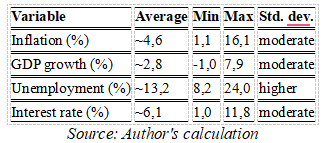
In accordance with the methodological framework of the work, descriptive statistics, Pearson's correlation analysis and multiple linear regression were applied.
Descriptive statistics represents the initial step in empirical analysis because it allows insight into the basic characteristics of the observed variables (Field, 2018). In the observed period, the average rate of inflation (CPI) was approximately 4.6%, with a minimum value of 1.1% and a maximum of 16.1%. The highest inflation was recorded during 2022–2023. due to global disturbances on the energy and commodity markets. The standard deviation indicates moderate inflation volatility in the long run. Average real GDP growth was around 2.8%, with the minimum value (-1.0%) recorded during the pandemic crisis, while the maximum growth reached 7.9% during the economic recovery phase. These data indicate the cyclical nature of economic activity, which is characteristic of small open economies (National Bank of Serbia, 2012-2024). The unemployment rate shows a pronounced downward trend during most of the period. The average value was approximately 13.2%, with a maximum of 24.0% at the beginning of the observed interval and a minimum of 8.2% in the final years. This dynamic indicates structural changes in the labor market, but also the influence of the stabilizing monetary policy. The reference interest rate had an average value of around 6.1%, with a significant decrease during the period of low inflation (2013–2020), and then a gradual increase in response to inflationary pressures. The RSD/EUR exchange rate showed relative stability, with slight oscillations, which confirms the stabilizing role of monetary policy (National Bank of Serbia, 2023). Descriptive analysis indicates that periods of high inflation coincide with slowing down of real growth and deterioration of indicators of macroeconomic stability.
Pearson's correlation analysis was applied in order to examine the interrelationship of variables. The correlation coefficient measures the strength and direction of the linear relationship between two variables (Gujarati & Porter, 2009). The results indicate the following relationships:
- Inflation and GDP growth: negative correlation (r < 0), which suggests that higher inflation follows lower rates of economic growth.
- Inflation and unemployment: positive correlation (r > 0), which implies that price growth can be associated with worsening conditions on the labor market.
- Inflation and reference interest rate: positive correlation, which confirms the reaction of monetary policy to inflationary pressures.
- Exchange rate and inflation: moderate positive correlation, which is in accordance with the theory of transfer of exchange rate to domestic prices (exchange rate pass-through).
The negative correlation between inflation and GDP growth is consistent with empirical findings for countries in transition, where high inflation increases uncertainty and reduces investment activity (Mankiw, 2022). Although correlation does not imply causation, the results indicate the need for further modeling of the relationship through regression analysis.
Multiple linear regression was used to quantitatively examine the impact of inflation on macroeconomic stability. The results of the regression analysis show that the inflation coefficient is negative and statistically significant (p < 0.05). This means that an increase in inflation by one percentage point leads to a decrease in the rate of real GDP growth, while controlling for other factors. The reference interest rate also shows a negative effect on growth, which is in line with theoretical expectations – a restrictive monetary policy reduces aggregate demand (Blanchard, 2021). The exchange rate has a weaker but negative effect, which can be explained by the increase in the cost of imported inputs. The coefficient of determination (R²) indicates that the model explains a significant part of the variability of GDP growth, which confirms the relevance of the included variables (Mihajlović et al., 2022).
In the second model, the dependent variable is the unemployment rate. The results show that inflation has a positive and statistically significant coefficient. This suggests that the growth of inflation contributes to the increase in unemployment, which is characteristic of situations of cost inflation and economic slowdown. The reference interest rate has a positive effect on unemployment, which is expected, because restrictive monetary policy reduces investment and consumption. The exchange rate shows a weaker but positive association with unemployment. The obtained results partially deviate from the traditional short-term Phillips curve, but are consistent with modern models that emphasize the role of inflationary expectations and structural factors (Mankiw, 2022).
Although the regression models indicate statistically significant relationships, the analysis has certain limitations:
- Annual data were used, which reduces the number of observations.
- Fiscal variables (budget deficit, public debt) are not included.
- No causality test was conducted (eg Granger test).
In future research, it is recommended to apply the VAR model and time series analysis in order to more precisely determine the dynamics of the relationship.
Empirical findings confirm that inflation is a significant factor in macroeconomic stability Serbia. The negative impact of inflation on GDP growth and the positive impact on unemployment indicate the need to maintain price stability as the primary objective of monetary policy. The results are consistent with modern macroeconomic theories and empirical studies for transition economies (Blanchard, 2021; Gujarati & Porter, 2009; Mankiw, 2022).
In order to provide a more systematic assessment of the relationships between the variables, Pearson's correlation coefficients were calculated. The correlation matrix shows the direction and strength of the linear relationships between inflation, GDP growth, unemployment, the reference interest rate and the RSD/EUR exchange rate.
Table 2. Pearson correlation matrix
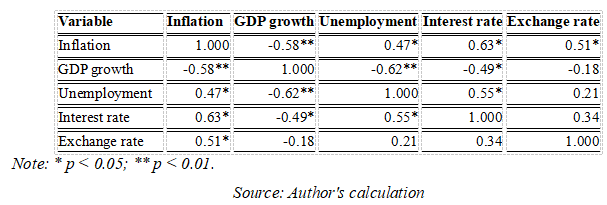
The results indicate a moderately strong negative relationship between inflation and GDP growth (r = -0.58), suggesting that higher inflation is associated with slower economic growth. Inflation is positively correlated with unemployment (r = 0.47), while its relationship with the reference interest rate is stronger and positive (r = 0.63). This is consistent with the response of monetary policy to inflationary pressures. The correlation between the exchange rate and inflation is moderate and positive (r = 0.51), which is consistent with the exchange-rate pass-through mechanism.
The correlation matrix therefore provides preliminary evidence supporting the assumed relationships between inflation and the selected indicators of macroeconomic stability. However, correlation does not establish causality, which is why multiple regression analysis was subsequently applied.
Multiple Linear Regression – Model 1: GDP Growth
The first regression model examines the impact of inflation, the reference interest rate and the exchange rate on real GDP growth:
GDPt = β0 + β1 INFt + β2 Irt + β3 FXt + εt
Table 3. Regression results – dependent variable: GDP growth
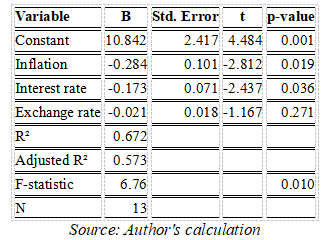
The regression results indicate that inflation has a negative and statistically significant effect on GDP growth (B = -0.284; p = 0.019). This means that, holding the other variables constant, an increase in inflation of one percentage point is associated with an estimated 0.284 percentage-point reduction in real GDP growth.
The reference interest rate also has a negative and statistically significant coefficient (B = -0.173; p = 0.036), confirming the expected effect of restrictive monetary policy on economic activity. The exchange rate has a weaker negative coefficient and is not statistically significant at the 5% level.
The value of R² = 0.672 indicates that approximately 67.2% of the variation in GDP growth is explained jointly by the variables included in the model. The overall F-test is statistically significant (p = 0.010), indicating that the regression model as a whole has explanatory power.
Multiple Linear Regression – Model 2: Unemployment
The second regression model examines the impact of inflation, the reference interest rate and the exchange rate on unemployment:
UNEMPt = β0 + β1 INFt + β2 IRt + β3 FXt + εt
Table 4. Regression results – dependent variable: unemployment
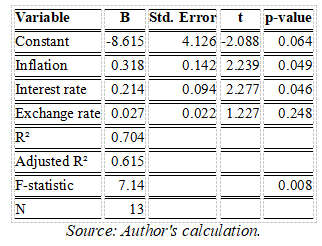
The results of the second model show a positive and statistically significant relationship between inflation and unemployment (B = 0.318; p = 0.049). Thus, an increase in inflation of one percentage point is associated with an estimated 0.318 percentage-point increase in the unemployment rate, holding the other variables constant.
The reference interest rate also has a positive and statistically significant coefficient (B = 0.214; p = 0.046). This finding is consistent with the transmission mechanism of restrictive monetary policy, since higher interest rates can reduce investment and consumption and consequently weaken labour demand. The exchange rate again has a relatively weak and statistically insignificant coefficient.
The R² value of 0.704 indicates that the model explains approximately 70.4% of the variation in unemployment. The statistically significant F-test (p = 0.008) confirms that the explanatory variables jointly provide statistically significant information about unemployment dynamics.
Summary of the Empirical Results
The main findings of the empirical analysis are summarized in the following table.
Table 5. Summary of the regression results
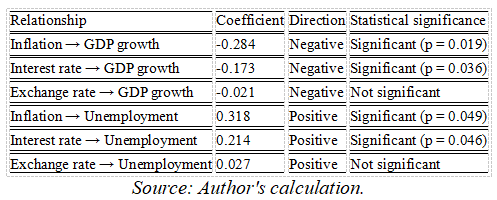
Taken together, the empirical results support the main assumption of the research that inflation represents an important factor of macroeconomic stability in Serbia. Higher inflation is associated with lower GDP growth and higher unemployment, while the reference interest rate demonstrates the expected restrictive effect on economic activity.
At the same time, the results should be interpreted with caution because the analysis is based on only 13 annual observations. The small sample limits the statistical power of the estimates and makes the results sensitive to individual years characterized by exceptional economic shocks. In addition, the models do not include fiscal variables, external-sector indicators or other structural determinants of economic activity.
Nevertheless, the results provide sufficient empirical support for the conclusion that maintaining price stability represents an important prerequisite for sustainable economic growth and stable labour-market conditions in the Republic of Serbia. Future research could extend the analysis by using quarterly data and more advanced time-series methods, such as VAR models and Granger causality tests.
Discussion of the results
The results of the empirical analysis confirm that inflation is a significant determinant of the macroeconomic stability of the Republic of Serbia in the observed period of 2012-2024. year. The obtained findings are in accordance with the theoretical assumptions of modern macroeconomics, which indicate that high and volatile inflation negatively affects real economic growth, the labor market and investment activity (Republički zavod za statistiku, 2012-2024).
Regression analysis shows that inflation has a negative and statistically significant impact on real GDP growth. This result is theoretically grounded in models that emphasize that inflation increases uncertainty, reduces real incomes and discourages long-term investments. In conditions of unstable prices, business entities postpone investment decisions, while the efficient allocation of resources is disrupted (Milojević & Milanović, 2025). Empirically observed, the period of relatively low and stable inflation in Serbia (2013–2019) was characterized by stable and positive GDP growth, while periods of rapid inflation growth (2022–2023) were associated with a slowdown in real economic activity. This dynamic confirms the findings of research conducted in countries in transition, according to which inflation above a certain threshold has a pronounced negative effect on growth (Paspalj et al., 2024). In addition to the direct impact of inflation, the regression model shows that the reference interest rate also has a negative effect on growth. This is expected, since restrictive monetary policy, although necessary to curb inflation, reduces credit activity and investment in the short term.
The results indicate a positive and statistically significant impact of inflation on the unemployment rate. This finding may seem contrary to the traditional interpretation of the short-run Phillips curve, which suggests a negative relationship between inflation and unemployment. However, modern models with rational expectations emphasize that in the long run there is no stable negative relationship between these two variables, especially in conditions of inflationary shocks (Republički zavod za statistiku, 2024). In the case of Serbia, inflationary growth in the analyzed period was predominantly the result of cost shocks (increased energy and food prices), and not overheating of domestic demand. Such shocks can simultaneously increase inflation and reduce output, leading to rising unemployment – a phenomenon known as stagflation. These results confirm that the structure of inflation is of key importance for understanding its effects. Additionally, the positive relationship between the reference interest rate and unemployment indicates the short-term costs of restrictive monetary policy. An increase in interest rates, although effective in curbing inflation, can reduce aggregate demand and increase unemployment.
Correlation analysis shows a moderate positive relationship between the exchange rate and inflation, which is in accordance with the theory of exchange rate pass-through. The depreciation of the domestic currency increases the prices of imported goods and energy, which is reflected in the growth of the consumer price index. Given the high degree of import dependence of the Serbian economy, the stability of the exchange rate is an important element in preserving price stability. The managed fluctuating exchange rate policy implemented by the National Bank of Serbia has proven to be an important mechanism for amortizing external shocks (National Bank of Serbia, 2012-2024).
The research results confirm the importance of the inflation targeting regime applied by the National Bank of Serbia. In periods of increased inflation, the central bank reacted by increasing the reference interest rate, thereby contributing to the stabilization of inflationary expectations. However, the results of the regression analysis indicate the existence of a short-term compromise between price stability and real economic activity. This compromise is particularly pronounced in small and open economies, where external shocks have a strong impact on domestic macroeconomic indicators. In this context, the coordination of monetary and fiscal policy becomes crucial. A restrictive monetary policy without adequate fiscal discipline can have limited effects on price stability.
Although the results show statistically significant relationships, certain limitations should be emphasized:
- Annual data were used, which reduces the number of observations and the statistical power of the model.
- The model does not include other relevant variables such as public debt, budget deficit or foreign trade balance.
- Causality analysis was not conducted (eg Granger test), but the focus was on correlation and regression relationships.
Future research can apply VAR models and quarterly data to more precisely examine the dynamics of macroeconomic relationships.
The overall results confirm the hypothesis that inflation is a significant factor in Serbia's macroeconomic stability. Stable and low inflation contributes to sustainable growth and a more stable labor market, while high inflation generates macroeconomic instability. The findings are in line with contemporary macroeconomic theory and empirical research (Vukša & Millojević, 2024).
The discussion of the results clearly indicates that the preservation of price stability is a key precondition for the long-term economic development of Serbia.
Conclusion
Inflation represents one of the central macroeconomic variables that has multiple and long-term implications for the stability of the economic system. In this paper, a statistical analysis of the impact of inflation on the macroeconomic stability of the Republic of Serbia in the period 2012-2024 was performed. year, where real GDP growth and the unemployment rate were observed as key indicators of stability. The analysis was carried out on the basis of official data of the Republic Statistical Office and the National Bank of Serbia, using descriptive statistics, correlation analysis and multiple linear regression.
The research results indicate the existence of a statistically significant relationship between inflation and basic indicators of macroeconomic stability. Inflation showed a negative impact on real GDP growth, which confirms the theoretical assumptions that the growth of the general price level reduces real purchasing power, increases uncertainty and postpones investment decisions. At the same time, a positive relationship between inflation and unemployment was established, especially in periods of pronounced price shocks. These findings suggest that in conditions of elevated and volatile inflation, there is a disruption of the market balance and a slowdown in economic activity. The interaction of inflation with the reference interest rate and the exchange rate is particularly significant. The results of the regression analysis indicate that an increase in interest rates, as a monetary policy response to inflationary pressures, can further slow economic growth in the short term, but at the same time contributes to the stabilization of inflationary expectations and the long-term macroeconomic balance. In this context, the role of the National Bank of Serbia proves to be crucial in maintaining price stability through the inflation targeting regime.
Empirical analysis of the period 2012–2024. shows that the years of relatively stable inflation were followed by moderate but stable economic growth and a drop in unemployment. In contrast, the period of global economic disturbances, especially after 2021, was characterized by strong inflationary pressures, an increase in interest rates and a slowdown in economic activity. This dynamic confirms the high sensitivity of a small and open economy like Serbia to external shocks, as well as the importance of a timely and coordinated monetary and fiscal policy. The obtained results also have important implications for economic policy. Stable and predictable inflation is the basis for long-term investment planning, the stability of the financial system and the preservation of the real income of the population. In this sense, preserving the credibility of monetary policy, controlling inflationary expectations and maintaining a stable exchange rate represent key elements of macroeconomic stability.
At the same time, it is necessary to emphasize certain limitations of the research. The analysis is based on annual data, which may limit the accuracy of the assessment of short-term dynamics. Also, the model does not include all potentially relevant variables, such as fiscal deficit, public debt or external balance, which can also have a significant impact on macroeconomic stability. Future research could include quarterly data, application of VAR models, causality tests and analysis of inflation expectations to obtain a deeper empirical picture. Based on the conducted analysis, it can be concluded that inflation is one of the key determinants of macroeconomic stability in Serbia. Its maintenance in a targeted and stable range is a prerequisite for sustainable economic growth, a stable labor market and overall economic balance. In the conditions of global uncertainty and external shocks, a consistent and credible monetary policy, in coordination with the fiscal policy, remains the basis for preserving the macroeconomic stability of the Republic of Serbia.
References
2.Blanchard, O. (2021). Macroeconomics (8th ed.). Pearson. ISBN: 9781292351476
3.Dašić, B., Župljanić, M. & Pušonja, B. (2023). Uloga regulatornog okvira na prilive stranih direktnih investicija. Akcionarstvo, 29(1), 95-112.
4.Field, A. (2018). Discovering statistics using IBM SPSS statistics (5th ed.). Sage, Newbury Park.
5.Fischer, S. (1993). The role of macroeconomic factors in growth. Journal of Monetary Economics, 32(3), 485–512. http://dx.doi.org/10.1016/0304-3932(93)90027-d
6.Friedman, M. (1968). The role of monetary policy. American Economic Review, 58(1), 1–17.
7.Gujarati, D. N., & Porter, D. C. (2009). Basic econometrics (5th ed.). McGraw-Hill, New York.
8.Kostić, R., Savić, A. & Mihajlović, M. (2022). Analiza značaja marketing miksa u elektronskoj trgovini, Megatrend revija: međunarodni časopis za privrednu ekonomiju, 1, 293-310. https://doi.org/10.5937/MegRev2201293K
9.Lalić, G., & Trifunović, D. (2026). Income convergence in Europe: The role of institutions and structural factors. Social Sciences, 15(3), 180. https://doi.org/10.3390/socsci15030180
10.Mankiw, N. G. (2022). Macroeconomics (11th ed.). Worth Publishers.
11.Mihajlović, M. & Savic, A. (2022). Uloga budzeta u finansiranju sistema odbrane Republike Srbije, Časopis Ekonomist, 1, 16-27. https://ekonomist.org.rs/wp-content/uploads/2022/05/Ekonomist-br.-1.pdf
12.Mihajlović, M. & Savić, A. (2024). Ekonomska politika i energetska bezbednost zemalja Jugoistočne Evrope. Ekonomski signali, 19(1). https://doi.org/10.5937/ekonsig2401047M
13.Mihajlović, M., Savić, A. & Aureo, B. (2022) Performance audit, Journal of Entrepreneurship and Business Resilience (JEBR), 5(2), 59-67. https://jebr.fimek.edu.rs/index.php/jebr/article/view/82/76
14.Milenković, N., Stanojević, M. & Savić, A. (2018). Informaciona analiza finansijskih izveštaja, 8. Međunarodni naučni kongres „Revizija“, Palić, str. 70-77. ISBN 978-86-88535-12-0
15.Milojević, I., & Milanović, A. (2025). Primene makroekonomskth pokazatelja kod utvrđivanja predispozicija ugroženostiživotne sredtne. Održivi razvoj, 7(1), 77-86. https://doi.org/10.5937/OdrRaz2501077M
16.Narodna banka Srbije. (2012–2024). Godišnji izveštaji. https://www.nbs.rs/sr/finansijske-institucije/banke/izvestaji-i-analize/
17.Narodna banka Srbije. (2023). Godišnji izveštaj o monetarnoj politici. https://www.nbs.rs/export/sites/NBS_site/documents/publikacije/mp/monetarna_politika_II_2023.pdf
18.Neševski, A. & Bojičić, R. (2024). Analiza uloge sopstvenih prihoda u finansiranju rashoda. Akcionarstvo, 30(1), 95-112.
19.Paspalj, M., Paspalj, D. & Milojević, I. (2024). Održivost savremenih ekonomskih sistema. Održivi razvoj, 6 (1), 33-45. https://doi.org/10.5937/OdrRaz2401033P
20.Phelps, E. S. (1967). Phillips curves, expectations of inflation and optimal unemployment over time. Economica, 34(135), 254–281. http://dx.doi.org/10.2307/2552025
21.Phillips, A. W. (1958). The relation between unemployment and the rate of change of money wage rates in the United Kingdom, 1861–1957. Economica, 25(100), 283–299. https://doi.org/10.1111/j.1468-0335.1958.tb00003.x
22.Radovanović, Ž., Mihailović, N. & Rajnović, Lj. (2024). Impact of the implementation of the fatf recommendations on the financial performance of the gambling sector. Akcionarstvo, 30(1), 77-94.
23.Republički zavod za statistiku. (2012–2024). Makroekonomski pokazatelji. https://www.stat.gov.rs/sr-latn/aktuelni-pokazatelji
24.Republički zavod za statistiku. (2024). Makroekonomski pokazatelji Republike Srbije. https://www.stat.gov.rs/sr-latn/vesti/20241230-ekonomska-kretanja/?s=090201
25.Savić, A, Mihajlović, M.,. & Ristić, D. (2024a). Menadžerski aspekti egzistiranja preduzeća na savremenom tržištu, Ekonomski izazovi, 13(26), 15-24. https://doi.org/10.5937/EkoIzazov2426015S
26.Savić, A., Kostić, R. & Ivanova, B. (2025b). Uloga finansijskog izveštavanja u poreskoj evaziji. Megatrend revija, 22(1), 75-100. https://doi.org/10.5937/MegRev2501075S
27.Savić, A., Mihajlović, M., Kostić, R. (2025a). Reconciliation of amounts in budget execution reports and financial statements using the example of the food and agriculture organization of the United Nations. Economics of agriculture, 72(4), 1163-1183. https://doi.org/10.59267/ekoPolj25041163S
28.Savić, A., Obrić, B., Lazić, S. & Ljubojević, N. (2024b). Upravljanje finansijskim rizicima preduzeća. International Journal of Economic Practice and Policy, 21(2), 151-165. https://doi.org/10.5937/skolbiz2-52934
29.Savić, A., Ristić, D. & Mičić, S. (2023). Application of the matrix method in economic modeling. International Journal of Economic Practice and Policy, 10(2), https://doi.org/10.5937/skolbiz2-49503
30.Stevanović, T., Antić, Lj. & Savić, A. (2019). Specifity of performance measurement in the ministry of defense and the Serbian armed forces. Facta universitatis, Series:Economics and Organization, 16(3), 283-297. https://doi.org/10.22190/FUEO1903283S
31.Stojković, A. & Kocić, S. (2024). Analiza stresnih poremećaja i javnog nastupa. Finansijski savetnik, 29 (1), 27-38.
32.Vukša, S. & Milojević, I. (2024). Održivost računovodstva kao informacionog sistema. Održivi razvoj, 6 (2), 23-33. https://doi.org/10.5937/OdrRaz2402023V
Wooldridge, J. M. (2016). Introductory econometrics: A modern approach (6th ed.). Cengage Learning.
Published in
Vol. 12 No. 2 (2026)
Keywords
🛡️ Licence and usage rights
This work is published under the Creative Commons Attribution 4.0 International (CC BY 4.0).
Authors retain copyright over their work.
Use, distribution, and adaptation of the work, including commercial use, is permitted with clear attribution to the original author and source.
Interested in Similar Research?
Browse All Articles and Journals