
STRUCTURAL TRANSFORMATION AND DEVELOPMENT TRENDS OF THE LIFE INSURANCE MARKET IN SERBIA

Abstract
This paper analyzes the role and importance of life insurance in modern economic conditions, with special reference to the market of the Republic of Serbia in the period 2019-2024. The research focuses on different forms of life insurance, including classic life insurance, life annuity, supplementary life insurance and unit-linked life insurance, with an overview of their functional and structural characteristics. Empirical analysis indicates a stable growth of the overall market, manifested through a continuous increase in the number of policies and total premiums, with a simultaneous increase in the value of calculated claims. At the same time, divergent tendencies among individual segments were identified, whereby classic and supplementary models recorded moderate development, life annuity stagnated, while investment-oriented products achieved extremely dynamic growth. Life insurance is affirmed as a complex financial instrument with a significant protection, accumulation and investment function, with the need to improve risk management and the regulatory framework.
Article
Introduction
Modern life insurance has an increasingly important role in ensuring the financial security of individuals and their families. The changes that characterizes the modern society, such as unstable economic conditions, extended lifespan and the rising living costs, emphasize the problem of the long-term financial protection (Adelmann et al., 2021). In this regard, life insurance emerges as one of the key solutions that can mitigate the consequences of unexpected or undesirable situations (Bhatia et al., 2021).
One of the most important function of life insurance is the protection of the family due to the death of the insured pearson and consequent financial pressure growth (Dobrilović, 2020). In these situations, payment of the sum insured have a crucial role because it enables the coverage of basic living expenses, the continuation of children's education and the financing of other obligations (Jovanović, 2021). This reduces the risk of a sudden drop of living standard as well as the long-term financial problems.
Besides the protective function, life insurance provides the possibility of planned and long-term funds accumulation. Through regular payment of insurance premiums, the insured pearson gradually creates a financial reserves that can be used at different life stages (Lehtonen, 2014). These funds can be used for capital investments, such as buying an apartment, financing education or providing additional income in later years (Mishra, 2016). This combination of safety and savings is one of the key advantages of this type of insurance compared to other forms of financial products. Modern pension systems faces serious challenges, primarily due to the population ageing and the decreasing number of the working age population (Siddiqui, 2020). That is why the individuals needs to take the responsibility for their future financial stability. In this context, life insurance can be an important support, as it enables additional income after retirement (Outreville, 2018).
The role of life insurance can also be analyzed from the economy perspective (Pjanić et al., 2016). Collected premiums funds are being invested in various economy sectors. These investments often have a long-term character and includes projects of wider social importance, such as infrastructure or state financial instruments. Thus, life insurance indirectly contributes to the economic development and stability of the financial system (Cheraga, 2024).
The development of the insurance market led to the appearance of various adapted products. Addition to basic protection, there are policies that includes investment components which provides the opportunity to generate additional income (Ahmeti, 2014). Although such products have a certain level of risk, they simultaneously increase the attractiveness of life insurance and make it more accessible to the general population (Dash & Sood, 2013).
However, despite all the advantages, life insurance is still not sufficiently represented in some countries, including Serbia. The reasons for this are multiple - from citizens' lack of information, through mistrust in financial institutions to the limited incomes (Eling & Kochanski, 2013; Zinyoro & Aziakpono, 2023). This is precisely why it is important to raise awareness of the importance of this type of protection, as well as to improve the legal and institutional framework that would further strengthen the people's trust.
Aforementioned indicates that life insurance has a complex and multifaceted role. It is not only a form of protection, but also an instrument of saving, planning for the future and supporting economic development. In the modern condition challenges, its importance will continue to grow, which will make it an indispensable part of every individual's financial planning (Kočović et al., 2024).
Classic life insurance
Classic life insurance is a traditional form of life insurance that covers the risk of death, survival, as well as its combination within the framework of mixed insurance (Ghosh, 2013). The main characteristic of this type of insurance is reflected in the pre-defined insured sum and relatively low level of risk, which makes it a stable instrument of financial protection and long-term savings (Arnejo & Sarsale, 2025). In this sense, classic life insurance plays a significant role in ensuring the financial security of the insured and its beneficiaries, especially in the context of long-term financial planning (Lledó et al., 2025). The following table presents some of its parameters in the period 2019-2024.
Table 1. Movement of selected parameters of classic life insurance in the period 2019-2024. (in thousands RSD)
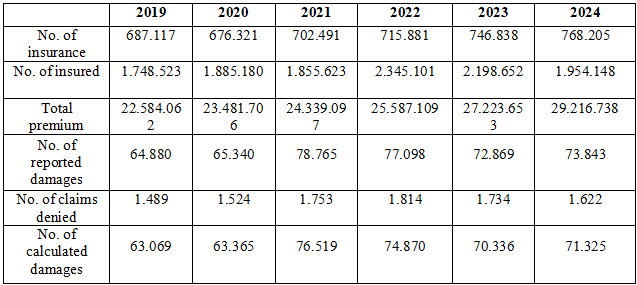

Analysis of classic life insurance data in the period 2019–2024. shows interesting trends in the number of insurances, insured persons, premiums and claims. The number of concluded insurances in the observed period had stable growth, with the exception of 2020 (676,321), which can be explained with the economic consequences of the COVID-19 pandemic. In the following years, a continuous increase is registered up to a maximum of 768,205 policies in 2024. This trend indicates a stable demand growth.
Different from the number of insurances, the number of insured persons is characterized by more pronounced fluctuations. After growth in 2020 (1,885,180 insured pearson), there is a slight decline in 2021 (1,855,623), and then a significant jump in 2022 (2,345,101), which represents an increase of almost 26% compared to the previous year. In 2023 and 2024, the number of insured persons decreases, although the number of insurances continues to grow. Such a movement suggests that individual policies are used for a larger number of insured, as well as that there are changes in the structure of policies, whereby is recorded an increase in the number of individual policies with less coverage per insured person.
The total premium recorded continuous growth, from 22.58 million in 2019 to 29.22 million in 2024. This trend follows the growth of the number of policies and confirms the development of the life insurance market.
The analysis of claims shows that the number of reported and calculated claims fluctuates, but remains at a relatively stable level. The number of reported damages increases until 2021 (78,765), followed by a slight decline and minor fluctuation in the following years, while the number of rejected claims is consistently low (<3% of the total reported), which indicates the efficiency of the regulation process and consistency in the application of insurance criteria. On the other hand, the value of calculated claims recorded a strong growth, from 12.26 million in 2019 to 20.47 million in 2024, which indicates an increase in the amount of coverage but also the impact of inflation.
Taking into account all the indicators, it can be concluded that classisc life insurance is characterized by a stable growth in the number of policies and premiums, fluctuations in the number of insured persons and a significant increase in the value of claims, while the rate of denied claims remains low and stable.
Life annuity
Life annuity is a special form of life insurance which implies that the insured sum is not paid out once, but in the form of pre-agreed periodic annuity payments, usually after the expiration of the agreed term or the fulfillment of certain conditions (Low & Fekete-Farkas, 2021). Its main function is to provide a stable and continuous source of income, which is often used as an instrument of supplementary pension security (Buric et al., 2017). In this context, Life annuity plays a significant role in mitigating the financial risks associated with old age and contributes to the long-term financial security of the insured (Kjosevski, 2012). The following table presents some of its parameters in the period 2019-2024.
Table 2. Movement of selected parameters of life annuity in the period 2019-2024. (in thousands RSD)
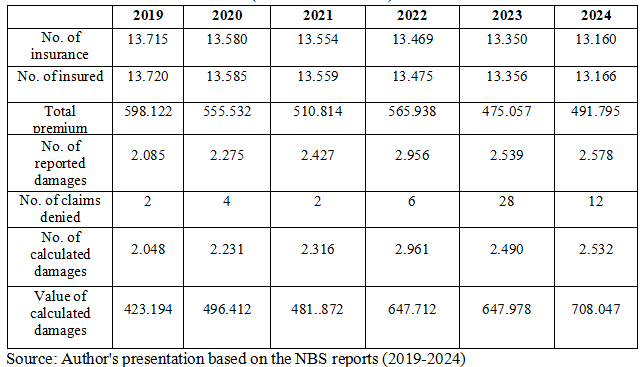
Analysis of data of life annuity in the period 2019–2024. indicates the specificity of this type of life insurance. The number of concluded insurances recorded a slight, gradual decrease, from 13,715 in 2019 up to 13,160 in 2024, which represents a decrease of approximately 4%. Similarly, the number of policyholders follows an almost identical trend, which is expected because each annuity insurance policy usually covers one policyholder. These data indicates stagnation or a slight decline of the life annuity insurance market, which is also one of the characteristics of long-term products with a stable portfolio and a limited influx of new clients. The analysis of total premiums shows fluctuations, whereby the value of premiums decreased in 2021 (510,814), then increased in 2022 (565,938), while in 2023 and 2024 a smaller decrease and increase were recorded. These trends suggest that premiums are not proportional to the number of policies due to different models of annuity policies and variability in the amount paid.
The number of reported claims is continuously increasing, from 2,085 in 2019 to 2,578 in 2024, which indicates an increased realization of rights based on the realization of annuity insurance. The number of rejected claims is very low, although a jump to 28 was recorded in 2023. The number of calculated claims follows the reported trend, while the value of calculated claims recorded a significant increase, from 423,194 in 2019 to 708,047 in 2024, which represents an increase of almost 67%. These data indicate an increase in the financial exposure of insurance companies, although the number of policies remains relatively stable.
Taking into account all indicators, it can be concluded that annuity insurance is characterized by a stable number of policies and insured persons, fluctuations in premiums, as well as a significant increase in the value of calculated claims, with a low rate of rejected claims.
Supplementary life insurance
Supplementary life insurance is an additional form of insurance protection that is contracted as an annex to the basic policy, with the aim to expand the scope of coverage and to improve the overall safety (Lee et al., 2013). This type of insurance most often covers risks such as accident, permanent disability, serious illness or temporary incapacity for work, thus providing a higher level of financial protection in various unforeseen circumstances (Msomi, 2023). In this sense, supplementary life insurance plays a significant role in the individualization of insurance protection and adaptation to the specific needs and risks of the insured. The following table presents some of its parameters in the period 2019-2024.
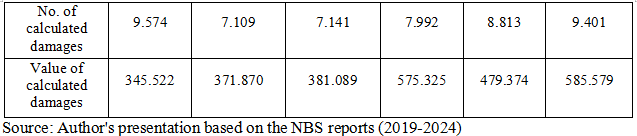
Table 3. Movement of selected parameters of supplementary life insurance in the period 2019-2024. (in thousands RSD)
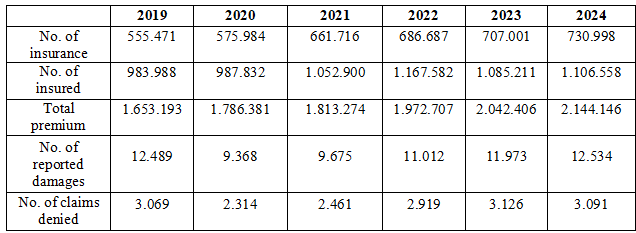
Data analysis for the period 2019-2024. indicates significant trends in the number of insurances, insured persons, premiums and claims. The number of concluded insurances shows a continuous and stable growth throughout the observed period. In 2024, the number of insurances increased by almost 31% compared to 2019, with the most pronounced growth recorded between 2020 and 2021. This trend is a consequence of the development of insurance products, but also the growing awareness of the importance of insurance.
A similar trend can be noticed in the number of insured persons. In the observed period, it has recorded an increase from 983,988 in 2019 to 1,106,558 in 2024. However, unlike the number of insurances, the number of insured persons shows certain oscillations. After a gradual growth until 2022, when it reaches a maximum of 1,167,582 insured persons, in 2023 there is a decrease to 1,085,211, while a slight recovery is recorded in 2024. Such developments indicate changes in the policy structure, i.e. an increase in the number of individual insurances or changes in the scope of coverage per insured.
The total premium recorded a stable growth in the observed period. From 1,653,193 in 2019, the premium rises to 2,144,146 in 2024, which represents an increase of approximately 30%. The increase in premiums follows the increase in the number of insurances, but it is also the result of the increase in the prices of insurance products, inflationary trends and the expansion of the scope of insurance coverage.
The highest number of reported damages was recorded in 2024 (12,534), while the lowest level was recorded in 2020 (9,368). The number of rejected claims is relatively stable and ranges between 2,314 and 3,126 cases per year. The share of rejected claims in total reported claims remains relatively constant, which indicates the consistent application of criteria and the stability of the claims assessment process. The number of calculated claims declines in 2020 and 2021, after which there is a gradual increase, reaching 9,401 cases in 2024. This trend largely follows the movement of reported damages, but also indicates stability in the process of their processing and regulation. The movement in the value of calculated damages is particularly significant, which shows a marked increase in the observed period. From 345,522 in 2019, the value of claims increases to 585,579 in 2024, with a significant jump in 2022. Although a temporary decline was recorded in 2023, in 2024 there is a renewed growth and reaching the highest level in the analyzed period. This trend indicates an increase in financial pressure on insurance companies.
Taken as a whole, the analyzed data indicate a stable growth of supplementary insurance with life insurance, expressed through an increase in the number of policies and premiums, with a simultaneous increase in the value of calculated claims and a relatively stable ratio of reported, rejected and calculated claims.
Unit-linked life insurance
Unit-linked life insurance is a specific form of life insurance that integrates elements of insurance protection and investing on financial markets (Parkman et al., 2015). Within this model, part of the paid premium is intended to cover the insured risk, while the remaining part is invested in units of investment funds, whereby the amount of return depends on market trends and is not guaranteed in advance (Sadowski, 2024). It implies a higher degree of risk compared to traditional forms of life insurance, but at the same time it provides the possibility of achieving higher returns (Olević, 2016). Therefore, it is intended for policyholders with a strong inclination towards investing and long-term financial planning. The following table presents some of its parameters in the period 2019-2024.
Table 4. Movement of selected parameters of unit-linked life insurance in the period 2019-2024. (in thousands RSD)
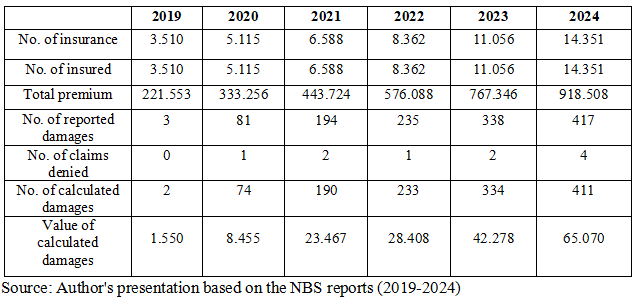
Data analysis for the period 2019-2024. indicates a particularly dynamic development of the observed insurance segment, which is reflected in the strong growth in the number of policies, insured persons, premiums and the value of calculated claims. The number of concluded insurances recorded a continuous and very pronounced growth throughout the observed period. From 3,510 in 2019, the number of insured persons increases to 14,351 in 2024, which represents a more than fourfold increase. A particularly significant growth is observed from 2021. The continuous growth of the number of insured persons indicates the growing interest of the market in this type of life insurance.
The total premium also shows a strong upward trend. From 221,553 in 2019, the premium rises to 918,508 in 2024, which represents an increase of more than four times. The increase in premiums follows the increase in the number of policies and insured persons, but it can also be a consequence of the expansion of the scope of coverage and the increase in the value of the sum insured. Stable and accelerated premium growth indicates a significant strengthening of the financial capacity of this type of insurance.
The movement of reported damages also shows a marked increase. While only three cases of damage were reported in 2019, already in 2020 the number of reports increases to 81, and then continues to grow continuously up to 417 reported damages in 2024. This dynamic can be explained by the sudden increase in the number of insured persons, but also by the greater use of insurance protection by users. The number of rejected claims during the observed period remains very low and ranges between 0 and 4 cases per year. The share of rejected claims in the total number of reported claims is minimal, which indicates a high degree of realization of claims and relatively clear insurance conditions, as well as efficient processing of claims for compensation. The number of calculated claims follows the growing trend of reported claims. With only two calculated cases in 2019, the number of calculated claims increases to 411 in 2024. This trend indicates an increased activity in the regulation of damages and an increase in the number of users who exercise the right to compensation. The movement in the value of calculated damages is particularly significant, which shows a marked increase during the observed period. From 1,550 in 2019, the value of damages increases to 65,070 in 2024. This trend indicates an increase in the total financial exposure of insurance companies, which is a logical consequence of the growth in the number of insurances and the greater scope of insurance coverage.
Taken as a whole, the analyzed data indicate an extremely rapid development of this insurance segment, which is reflected in the strong growth in the number of policies, insured persons and premiums, as well as in the increase in the number and value of calculated claims. At the same time, the low level of denied claims indicates the stability of the claims regulation process and the high realization of the insured's rights. The following table presents some of the parameters of total life insurance in the period 2019-2024.
Table 5. Movement of selected parameters of total life insurance in the period 2019-2024. (in thousands RSD)
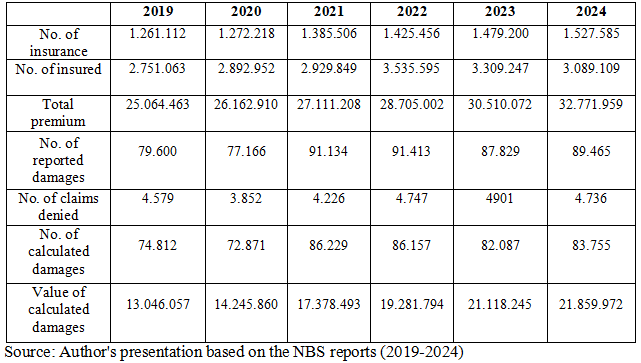
Analysis of data on total life insurance in the period 2019–2024. indicates a stable growth of the market, with some oscillations of certain indicators, especially the number of insured persons and claims. The number of concluded insurances recorded continuous growth during the observed period. Looking at the last and the first year of the analyzed period, there was an increase in the number of insurances by approximately 21%. The trend in the number of insured persons also shows growth, but with more pronounced fluctuations. The number of insured persons increases from 2,751,063 in 2019 to a maximum of 3,535,595 in 2022, after which there is a decline in 2023 and 2024. Such dynamics may indicate changes in the structure of insurance, especially with regard to the representation of collective and individual policies, as well as a possible reduction in the coverage of insured persons in the later period. The total premium recorded a stable and continuous growth by approximately 31%, looking at the last and the first year of the analyzed period. This growth follows the increase in the number of insurances, but it is also the result of inflationary trends, the increase in prices of insurance products as well as the scope of coverage. Certainly, the continuous growth of the premium indicates the strengthening of the financial potential of the total life insurance sector.
The number of reported damages shows moderate oscillations. After a slight decline in 2020, there is an increase in 2021 and 2022, when the highest values are recorded (over 91,000 applications). In 2023, there is a decline with a slight increase in 2024. The number of rejected claims is relatively stable. The share of rejected claims in the total number of claims remains low and stable, which indicates the consistent application of criteria and the stability of the claims assessment process. The number of calculated claims largely follows the trend of reported claims. After a slight decline in 2020, there is growth in 2021 and 2022, then a decline in 2023 and growth again in 2024. The movement in the value of calculated damages is particularly significant, showing a continuous and pronounced growth of approximately 67%. This trend indicates a significant increase in the financial exposure of insurance companies, as a result of the growth of sums insured, the growth of the value of claims and inflationary trends. Essentially, the total life insurance market in the analyzed period is characterized by a stable growth in the number of policies and premiums, with fluctuations in the number of insured persons and claims, as well as a marked increase in the value of calculated claims. These trends indicate the continuous development of the sector, but also the need for careful risk management and preservation of financial stability in conditions of growing exposure to damages. In addition to all types of life insurance considered in isolation, the following table presents their relative changes of selected parameters.
Table 6. Percentage changes of selected parameters of total life insurance and its types
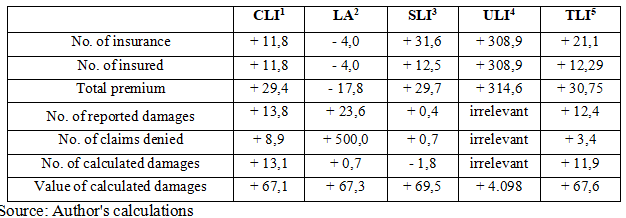
Analyzing the relative changes in the last compared to the initial year of the observed period, it is possible to observe the growth of almost all categories within all modalities of life insurance. Namely, when it comes to CLI (with the exception of the number of rejected claims), a double-digit percentage growth of all analyzed parameters is noticeable. The most intense is the growth of total premiums, i.e. the value of calculated claims, with a growth of 29.4 and 67.1%, respectively. It can be additionally noted that LA achieved the worst ratio of premiums and the value of calculated claims, since the total premiums based on this type of life insurance decreased by 17.8%, while the value of calculated claims increased by 67.3%.
When it comes to SLI, a significant increase in the number of insurances of 31.6% can be observed, which does not follow the increase in the number of insurances. In 2024, it is 12.5% higher than in 2019. The characteristic of this type of insurance is a large increase in the premium of 29.7%, but also an extremely large increase in the value of calculated claims of 69.5%. It is interesting to note all the developments concerning damages, so very small deviations can be noted, ranging from -1.8 to 0.7%.
The greatest growth in the observed period was achieved by ULI, since the number of insurance policies, insured persons and total premiums increased by more than 300%. Changes regarding the number of reported, rejected and calculated claims were not measured since in 2019 these data were almost negligible. Also, it can noticed a huge growth in the value of calculated claims based on life insurance related to units of investment funds, since it is greater than 4000%, which is a record growth compared to other types of life insurance. The fact is that this type of insurance has achieved the greatest growth and will also be the biggest challenge for insurance companies in the following years.
When analyzing the TLI, there is a noticeable growth in all categories, especially premiums, but also the value of calculated claims. The growth in the value of calculated claims is more than twice as high as the growth in premiums, which highlights the potential liquidity problem of insurance companies. In this regard, in the future, additional attention will be focused on adequate investment activity on the financial markets as a necessary instrument for preserving confidence in the life insurance market.
Taken as a whole, the analysis points to structural changes within the life insurance market, where traditional products develop stably, annuity insurance stagnates, while segments related to investment funds record extremely dynamic growth. At the same time, the growth in the value of calculated claims in all segments indicates increased financial exposure of insurance companies, which imposes the need for careful risk management and adequate adjustment of business strategies.
Conclusion
The conducted analysis indicates that the life insurance market in the Republic of Serbia in the period 2019-2024. characterized by stable and continuous development, with pronounced structural changes within certain segments. The overall increase in the number of policies and premiums confirms the strengthening of this sector and its increasingly significant role in the financial system, while the simultaneous increase in the value of calculated claims indicates an increased financial exposure of insurance companies.
The results of the research shows that classic life insurance and supplementary life insurance are experiencing moderate but stable growth, thereby confirming their traditional role in providing financial security. In contrast, life annuity shows a tendency to stagnate, which may be a consequence of limited market interest and the specific nature of this product. On the other hand, life unit-linked life insurance recorded a very dynamic growth, indicating a change in user preferences towards products that integrate insurance and investment components.
Observed trends point to the need for further improvement of the regulatory framework, as well as the development of adequate risk management strategies, especially in the context of the growth in the value of claims and the growing presence of investment products. Also, it is important to work on raising financial literacy and user confidence, in order to further encourage market development. In the future, we can expect the continuation of product diversification and the strengthening of the role of life insurance as an important instrument of financial protection, savings and investment.
Acknowledgement
This research is supported by the Ministry of Science, Technological Development and Innovation of the Republic of Serbia by the Decision on the scientific research funding for teaching staff at the accredited higher education institutions in 2026 (No. 451-03-34/2026-03/200375 of February 5, 2026).
References
2.Ahmeti, U. (2014). The importance and characteristics of life insurance. Research Journal of Finance and Accounting, 4(19), 188-209. https://www.iiste.org/Journals/index.php/RJFA/article/view/9515
3.Arnejo, A., & Sarsale, M. (2025). Measuring hotel financial performance: A bibliometric review. Menadžment u hotelijerstvu i turizmu, 13(2), 117-135. https://doi.org/10.5937/menhottur2500017A
4.Bhatia, R., Bhat, A. K., & Tikoria, J. (2021). Life insurance purchase behaviour: A systematic review and directions for future research. International Journal of Consumer Studies, 45(6), 1149-1175. https://doi.org/10.1111/ijcs.12681
5.Buric, M. N., Bacovic, M., Cerovic, J., & Bozovic, M. L. (2017). Factors influencing life insurance market development in Montenegro. Periodica Polytechnica Social and Management Sciences, 25(2), 141-149. https://doi.org/10.3311/PPso.10049
6.Cheraga, S. (2024). Microinsurance as a tool for enhancing financial inclusion in the insurance industry–a study of the life insurance sector in india. International Journal of Professional Business Review, 9(11), 23. https://dialnet.unirioja.es/servlet/articulo?codigo=9869627
7.Dash, G., & Sood, T. (2013). Why should one invest in a life insurance product? An empirical study. Researchers World, 4(1), 36-45. https://www.researchersworld.com/index.php/rworld/article/view/1067
8.Dobrilović, N. (2020). Analiza i značaj životnih osiguranja kao potencijal za investiciona ulaganja i unapređenje kvaliteta života osiguranika kroz naknadu šteta. Zbornik radova fakulteta tehničkih nauka, 35(8). https://doi.org/10.24867/08GI16Dobrilovic
9.Eling, M., & Kochanski, M. (2013). Research on lapse in life insurance: what has been done and what needs to be done? Journal of Risk Finance, 14(4), 392–413. https://doi.org/10.1108/JRF-12-2012-0088
10.Ghosh, A. (2013). Does life insurance activity promote economic development in India: an empirical analysis. Journal of Asia Business Studies, 7(1), 31-43. https://doi.org/10.1108/15587891311301007
11.Jovanović, S. O. (2021). Negativna kamatna stopa i mogućnost raskida ugovora o osiguranju života zbog promenjenih okolnosti. Tokovi osiguranja, 37(4), 57-86. https://doi.org/10.5937/TokOsig2104057J
12.Kjosevski, J. (2012). The determinants of life insurance demand in central and southeastern Europe. International journal of Economics and Finance, 4(3), 237-247. http://dx.doi.org/10.5539/ijef.v4n3p237
13.Kočović, J. Ž., Rakonjac Antić, T. N., Koprivica, M. R., & Bradić, K. N. (2024). Pravci razvoja tržišta osiguranja. Tokovi osiguranja, 40(3), 536-548. https://doi.org/10.5937/TokOsig2403536K
14.Lee, C. C., Lee, C. C., & Chiu, Y. B. (2013). The link between life insurance activities and economic growth: Some new evidence. Journal of International Money and Finance, 32, 405-427. https://doi.org/10.1016/j.jimonfin.2012.05.001
15.Lehtonen, T. K. (2014). Picturing how life insurance matters. Journal of Cultural Economy, 7(3), 308-333. https://doi.org/10.1080/17530350.2013.869503
16.Lledó, J., Pavía, J. M., & Espinosa, P. (2025). Impact of income level on life insurance pricing and reserving: evidence from Spain. Applied Economics Letters, 1-5. https://doi.org/10.1080/13504851.2025.2534509
17.Low, D., & Fekete-Farkas, M. (2021). The demand for life insurance in a developing country and the mediating role of persuasion. Journal of International Studies, 14(3), 138-154. https://www.ceeol.com/search/article-detail?id=995840
18.Mishra, K. (2016). Fundamentals of life insurance: Theories and applications. Delhi: PHI Learning Pvt. Ltd.
19.Msomi, T. S. (2023). Macroeconomic and firm-specific determinants of financial performance: Evidence from non-life insurance companies in Africa. Cogent Business & Management, 10(1), 2190312. https://doi.org/10.1080/23311975.2023.2190312
20.NBS (2019). Broj i iznos šteta po vrstama i tarifama osiguranja za Srbiju u 2019. godini https://www.nbs.rs/export/sites/NBS_site/documents/osiguranje/godisnji/god_T2_2019.pdf
21.NBS (2019). Pregled broja osiguranja i premije po vrstama i tarifama osiguranja za Srbiju u 2019. godini https://www.nbs.rs/export/sites/NBS_site/documents/osiguranje/godisnji/god_T1_2019.pdf
22.NBS (2020). Broj i iznos šteta po vrstama i tarifama osiguranja za Srbiju u 2020. godini https://www.nbs.rs/export/sites/NBS_site/documents/osiguranje/godisnji/god_T2_2020.pdf
23.NBS (2020). Pregled broja osiguranja i premije po vrstama i tarifama osiguranja za Srbiju u 2020. godini https://www.nbs.rs/export/sites/NBS_site/documents/osiguranje/godisnji/god_T1_2020.pdf
24.NBS (2021). Broj i iznos šteta po vrstama i tarifama osiguranja za Srbiju u 2021. godini https://www.nbs.rs/export/sites/NBS_site/documents/osiguranje/godisnji/god_T2_2021.pdf
25.NBS (2021). Pregled broja osiguranja i premije po vrstama i tarifama osiguranja za Srbiju u 2021. godini https://www.nbs.rs/export/sites/NBS_site/documents/osiguranje/godisnji/god_T1_2021.pdf
26.NBS (2022). Broj i iznos šteta po vrstama i tarifama osiguranja za Srbiju u 2022. godini https://www.nbs.rs/export/sites/NBS_site/documents/osiguranje/godisnji/god_T2_2022.pdf
27.NBS (2022). Pregled broja osiguranja i premije po vrstama i tarifama osiguranja za Srbiju u 2022. godini https://www.nbs.rs/export/sites/NBS_site/documents/osiguranje/godisnji/god_T1_2022.pdf
28.NBS (2023). Broj i iznos šteta po vrstama i tarifama osiguranja za Srbiju u 2023. godini https://www.nbs.rs/export/sites/NBS_site/documents/osiguranje/godisnji/god_T2_2023.pdf
29.NBS (2023). Pregled broja osiguranja i premije po vrstama i tarifama osiguranja za Srbiju u 2023. godini https://www.nbs.rs/export/sites/NBS_site/documents/osiguranje/godisnji/god_T1_2023.pdf
30.NBS (2024). Broj i iznos šteta po vrstama i tarifama osiguranja za Srbiju u 2024. godini https://www.nbs.rs/export/sites/NBS_site/documents/osiguranje/godisnji/god_T2_2024.pdf
31.NBS (2024). Pregled broja osiguranja i premije po vrstama i tarifama osiguranja za Srbiju u 2024. godini https://www.nbs.rs/export/sites/NBS_site/documents/osiguranje/godisnji/god_T1_2024.pdf
32.Olević, S. (2016). Perspektive razvoja životnog osiguranja u Srbiji. Tokovi osiguranja, 4, 63-82. https://tokoviosiguranja.edu.rs/wp-content/uploads/2018/03/16-04_2.pdf
33.Outreville, J. F. (2018). Culture and life insurance ownership: Is it an issue? Journal of Insurance Issues, 41(2), 168-192. https://www.jstor.org/stable/26505753
34.Parkman, A. A., Foland, J., Anderson, B., Duquette, D., Sobotka, H., Lynn, M., & Cox, S. L. (2015). Public awareness of genetic nondiscrimination laws in four states and perceived importance of life insurance protections. Journal of genetic counseling, 24(3), 512-521. https://doi.org/10.1007/s10897-014-9771-y
35.Pjanić, M., Kalaš, B., & Vasić, N. (2016). Analysis of life insurance market in Serbia and countries in the region. Anali Ekonomskog fakulteta u Subotici, 52(36), 145-160. https://scindeks-clanci.ceon.rs/data/pdf/0350-2120/2016/0350-21201636145P.pdf
36.Sadowski, J. (2024). Total life insurance: Logics of anticipatory control and actuarial governance in insurance technology. Social Studies of Science, 54(2), 231-256. https://doi.org/10.1177/03063127231186437
37.Siddiqui, S. A. (2020). Evaluating the efficiency of Indian life insurance sector. Indian Journal of Economics and Development, 16(1), 72-80. https://doi.org/10.35716/ijed/19140
Zinyoro, T., & Aziakpono, M. J. (2023). Performance determinants of life insurers: A systematic review of the literature. Cogent Economics & Finance, 11(2), 2266915. https://doi.org/10.1080/23322039.2023.2266915
Published in
Vol. 12 No. 2 (2026)
Keywords
🛡️ Licence and usage rights
This work is published under the Creative Commons Attribution 4.0 International (CC BY 4.0).
Authors retain copyright over their work.
Use, distribution, and adaptation of the work, including commercial use, is permitted with clear attribution to the original author and source.
Interested in Similar Research?
Browse All Articles and Journals