
ACHIEVED RESULTS AND PERSPECTIVES FOR FURTHER DEVELOPMENT OF SMALL AND MEDIUM-SIZED ENTERPRISES: STATISTICAL FINDINGS AND ANALYSIS
Abstract
Small and medium-sized enterprises are a key part of every national economy and represent a factor of economic and social stability. In particular, entrepreneurial organizations are recognized as drivers of economic development, because they encourage the introduction of new technologies and have a direct impact on the level of investments and aggregate demand in terms of macroeconomic indicators. Also, this type of organizations contributes to solving the problem of unemployment and unequal distribution of wages. The need for strategic support and development of small and medium enterprises at the state level is permanent. In the past, these entities have been hit by the pandemic caused by the Covid-19 virus, inflation and digitization.
The subject of the paper is the results review of the small and medium-sized enterprises development in Serbia, as well as the perspective of their further growth. Taking into account the effect of quality standards on business results, the connection of small and medium-sized enterprises with scientific and research institutions, but also the connection between the same organizations on the market, the authors propose certain improvements for their development. The key elements are based on the adequate and correct diagnosis of the mentioned connections.
The research sample was purposive, which included companies in each of the 5 regions of the Republic of Serbia (n=112). The importance of quality standards and cooperation with faculties and scientific research institutions was established. It has been proven that the biggest obstacles in the development of the business of small and medium-sized enterprises are administrative procedures, as well as fiscal appropriation, and that the biggest impact on future business prospects is the adopted quality standard, investment in modern equipment, innovation, new knowledge and the introduction of new production lines.
Article
Introduction
Small and medium-sized enterprises play a key role in the world economy and have not been a novelty in the world for a long time. Immediately after economic sanctions were canceled in Serbia at the beginning of the 21st century, significant efforts were made to affirm the entrepreneurial sector. Since 2001, numerous systemic measures have been adopted to encourage development. Those measures were divided into three key segments: 1) formulation of development policy; 2) institutional support; 3) financial and non-financial support. In the further course of events in 2003, the Strategy for the Development of Small and Medium Enterprises and Entrepreneurship for the period from 2003 to 2008 was adopted. The main goal of the strategy is to make the sector of small and medium-sized enterprises in Serbia more competitive, based on planning support that is primarily aimed at creating a more favorable business environment. In the following period, two more strategies were adopted: 1) Strategy of competitiveness and innovation of small and medium-sized enterprises for the period from 2008 to 2013; 2) Strategy for supporting the development of small and medium-sized enterprises, entrepreneurship and competitiveness for the period from 2015 to 2020. All the donated strategies were aligned with the documents that represent the official policy framework for the development of the SME sector at the EU level. The modern development of the competitiveness of small and medium-sized enterprises is impossible without the introduction of new knowledge, skills and abilities at the organizational level. In addition, cooperation with external entities represents a key turning point in increasing the innovative and sustainable capacities of the organization, because small and medium-sized enterprises due to limited resources do not have enough capacity for long-term business sustainability, as well as for maintaining a competitive advantage. Close connection with scientific and research institutions should be one of the main tasks of the entrepreneurial sector in Serbia, in order to effectively absorb new knowledge and use research results that are close to their business strategies.
Given that innovation processes include different experimental phases, as well as risk tolerance, cooperation with scientific research subjects would enable organizations to access the most up-to-date proven results in order to strengthen the overall capabilities of small and medium-sized enterprises. And the main focus in this work is small and medium-sized enterprises, which form the basis of a healthy economy of every society. The importance of the cooperation of these organizations with external stakeholders is related to the limited resources that small and medium-sized enterprises have at their disposal. Without strengthening innovative potential, organizations will not be able to maintain a competitive advantage in the modern market, which can directly affect their survival in the long term. Therefore, this paper will examine the level of connection between small and medium-sized enterprises with scientific and research institutions in order to increase the general quality of organizational performance as well as their perspective for further development.
Factors of competitiveness in the entrepreneurial environment
According to Kanth (2015), competitiveness represents an economy that is recognized at multiple levels: national, industrial, and regional. The interpretation of competitiveness is introduced by comparing the performance of either the same industry or geographical area. When it comes to developing countries, competitiveness is viewed in a different way - a "temporary way" that is expected to achieve limited "internationalization effects". The most important component of the economic and management mechanism for creating a company's competitiveness is quality management. Also, one of the factors for sustainable business are intangible resources where the company's reputation stands out in creating a competitive advantage (Đervida et al., 2017). Building a reputation requires intensive and long-term investment.
Also, Boruke and Roper (2017) state that quality improvement and innovation are correlated within organizations, and while it seems that quality management most often benefits innovation; that relationship does not always have to be positive. In addition, different behavioral or organizational mechanisms may be used in terms of hard and/or soft elements of quality management practices. Quality standards encourage SMEs to innovate and research in order to meet or exceed set standards. SMEs that adhere to quality standards often attract greater investor confidence, while global markets also require compliance with certain standards in order to put a product or service on the market.
Globally oriented companies implement specific tools and methods to improve quality (Zhussipova et al., 2021). More attention is directed towards the market and customers, so the quality of the product in terms of requirements, reduction of costs, and time is a priority. Also, Maljugić et al. (2021) point out that the introduction of quality systems in small and medium-sized enterprises should not be seen as a cost but as an investment in improvements that bring better results in the long term. Often, small and medium-sized enterprises also need certain transformations that can be caused by long-term unresolved problems, new challenges coming from the market or new trends and changes in the external environment. Transformations can refer to: company strategies, company structure and business processes, and mostly lead to changes in the approach to business management, employee management, employee attitudes, company's innovative potential, etc. (Litvaj et al., 2023).
Miletić, Ćurčić (2021) point out that various factors have an impact on the productivity of the business of different companies - procurement of modern technological solutions and equipment, standardization of business quality, continuous improvement of employees' knowledge, investment in the development of domestic brands, etc. With the help of quality standards, it is possible to provide additional support. It is emphasized that with their help it is possible to predict potential errors, as well as that they are of great benefit in terms of the customer's wishes, i.e. discovering what is wanted on the market. Thanks to this, organizations can focus on safe and profitable decisions (Tadić et al., 2022).
Therefore, when talking about the skills that employees in the entrepreneurial sector should have, their level plays a significant role in economic development and success. First of all, it affects the level of productivity and innovative power of the company. One of the key recommendations of international institutions on how to develop countries - and it is part of the Washington Consensus - is to increase spending on education and training. This recommendation implies higher state expenditures. However, a more equal distribution of income also allows the poorer sections of society to spend more money on education and training. Without denying the important role of education, it is necessary to emphasize that education alone is not enough to initiate development, but it is necessary to be incorporated into a package of strategies. Otherwise, unemployed academics will migrate to other countries (Solga, 2016). This means that the limitations faced by small and medium-sized enterprises in terms of performance are mainly the result of insufficient skills in management and leadership, but also in the perception of global tendencies in business (Umar et al., 2022). Based on this, it is possible to point out that insufficient productivity of employees in small and medium-sized enterprises requires thorough research, since it has been proven that this sector is the driver of the economy in developed countries as well as in growing economies such as Serbia.
Innovation and cooperation in the function of sustainable development of small and medium-sized enterprises
Diversified literature on innovation refers to a number of factors that potentially influence the general readiness of small and medium enterprises to recognize innovation as a trigger for increasing the overall performance of the organization (Bishop et al., 2011). It basically refers to creating an organizational culture that is passionate about innovation and creativity of internal stakeholders. A culture set in this way contributes to the mobilization of other factors that support the overall quality and perspective of the development of small and medium-sized enterprises. Although results can be found in the relevant literature that show a positive correlation between innovation and the development potential of small and medium-sized enterprises, there is an insufficient number of studies linking the influence of external factors on the innovative tendencies of these organizations. Emergency partners, such as scientific and research organizations, represent alternative sources for small and medium-sized enterprises for gathering information and modern knowledge in order to develop internal potentials and consider innovative ideas (Herzog, Leker, 2010). In order for organizations to move towards further incremental development, it is necessary that they are not isolated from the research process that they can obtain from external partners.
The model of open innovation and enterprise development perspective suggests that external sources are in a significant number of cases more relevant than internal sources of knowledge. It can be stated that in modern business trends, research organizations represent one of the most important sources of information and knowledge, due to large stores of competence and expertise, as well as the possibility of continuous research procedures. Scientific and research organizations provide companies with complementary knowledge, technologies and skills that facilitate complex and risky activities, as well as the possibility of further development of organizational content (Huizingh, 2011). The conclusion is that active cooperation with research organizations increases the adaptive capacity of small and medium-sized enterprises to find technological discoveries or innovative work methods, which exceeded the internal possibilities of development, precisely because of the limited resources that such organizations have at their disposal. Earlier studies indicate clear advantages of cooperation between scientific institutions and entrepreneurial organizations, especially in terms of technological innovation. Although previous research mostly focuses on the technological aspect of innovation, there are few who emphasize the importance of developing the overall innovative culture of the organization, which is established through such collaboration. This is justified by the fact that research organizations employ researchers with a high level of knowledge in their fields who, in addition, possess creativity, enthusiasm, communication skills, the ability to learn and take risks, etc. Therefore, it can be expected that the innovative culture of the organization, as well as the development potential, would be strengthened by its interaction with the wider scientific community.
It is a fact that organizations and research institutions work according to different systems. Research organizations rely on the principles of 'public science' and the free, rapid and objective dissemination of research results, while entrepreneurial organizations rely on the principles of 'private science' such as the appropriation and commercialization of secondary research outcomes (Lazzarotti, Manzini, 2009). Such divergent principles create differences in terms of goals, incentives, structures and resources. These differences can create misunderstandings and difficulties in the cooperation of the two parties, but they can also increase the chances of effective acquisition of new knowledge. Cooperation with research organizations primarily refers to research learning, which enables solving problems in real time, managing new knowledge and skills, supported by empirical facts and outcomes. The above attributes encourage the innovative envelope of organizations. The direct interaction of employees in organizations with relevant scientists increases the adaptive capacity of each individual in terms of innovation, creativity and acquisition of new knowledge, which is especially relevant for small and medium-sized enterprises that, due to scarce or limited resources, cannot realize this within themselves.
However, it is necessary to point out the most common barriers to the commercialization of scientific research. They represent: an overload of teaching and administrative tasks related to teaching, in the case of teaching staff, i.e. the absence of commercialization's impact on the academic career, both for researchers and teachers (Petrov, 2022). Academic engagement does not only depend on personal affinities and individual factors to influence scientists, but also depends on organizational and institutional factors. Therefore, they are not new: The entrepreneurial university model, which is expected to take an active role in the commercialization of knowledge through patenting and licensing, that is, the establishment of spin-off companies (Etzkowitz, Leydesdorff, 2000); and the Regional Innovation System Model, according to which universities represent important generators of knowledge that collaborate with regional actors, leading to systemic innovation (Isaksen et al., 2018).
In his study from 2017. Hansjörg and Zeyner pointed out that depending on the economic sector, SMEs require people with certain types of education. For example, it induces that tertiary education would be necessary for high-tech startups, while on the other hand, traditional SMEs need skilled workers who are continuously educated and trained throughout their professional life. However, in research "How to involve small and medium-sized enterprises in universities", Pereira and Franco (2023) came to clearer results in the domain of enterprises, but less clear in the region, which implies that cooperation between universities and small and medium-sized enterprises it still does not represent a clearly expressed benefit, and only under that precondition, companies would be more aware of the results.
In addition, it can be stated that small firms invest more in product innovation than in process innovation (Hasan, 2017). It is clear from this trend that the most frequent approach is to research the effect of product innovation on market opportunities. On the other hand, it is emphasized that it is necessary that companies should apply a culture of innovation in their practices, in order to enable them to succeed in terms of innovative products and services. Therefore, empirical evidence suggests that it is important to build, maintain and promote a culture of innovation, if companies want to remain successful and create new products, which, among other things, indicates the necessity of cooperation between small and medium-sized companies with scientific institutions. The ability to innovate is not only necessary for companies to continue to exist in today's economy, but is also a significant factor in growth, productivity and competitiveness (Miočević, 2022).
The basic assumption for the creation of knowledge transfer between scientific and research institutions and companies is interaction. Due to the lack of interaction, research results and the needs of knowledge users often cannot be combined in the intentions of fulfilling a certain goal. Interaction represents the flow of a certain amount of knowledge, with the exact volume and quality (Peranović, Ćirić, 2015). In their research, Adam & Alarifi (2021) provided empirical evidence on the importance of external support (whether governmental or non-governmental) for the survival of small and medium-sized enterprises in times of crisis. The research has important implications for governments and policy makers, who should develop policies to provide more incentive packages for SMEs that include financing, advisory services and training.
External support to SMEs can be direct or indirect. Direct external support usually takes the form of financial assistance used for the acquisition of basic assets, the purchase of technology, or the implementation of development plans in order to solve the problem of lack of funds. It is usually provided in accordance with specific government policies. According to Adžić et al. (2023) compliance with other "non-tax" instruments of local economic policy is required. Indirect external support usually takes the form of consultations, ideas and advice provided by experts, advisory offices or scientific-educational institutions in order to eliminate the lack of knowledge and increase the amount of available information. Despite the variety and importance of external support for small and medium-sized enterprises, it is noticeable that they benefit little from such support due to the lack of information and awareness about this form of support and the inability of the company's management to choose the appropriate type of incentive (Adam, Alarifi, 2021).
In the scientific literature, it is possible to find many authors who emphasize a significant positive relationship between innovation and the performance of small and medium enterprises (Kian, Li, 2003; Rosenbusch et al., 2011; Verhees, Meulenberg, 2004; Yıldız et al., 2014). Research has also indicated the positive impact of innovation capabilities on the performance of small and medium-sized enterprises (O'Cass, Sok, 2014; Oura et al., 2016; Zhang et al., 2018). Zulu- Chisanga et al. (2016) note that the efforts made to develop various innovations are the primary reason for improving the financial performance of SMEs.
Data and methodological approach
The primary analysis was created to look at certain aspects of the business of small and medium-sized enterprises, related to the achieved results, perspectives of further development and the creation of business strategies in order to improve business growth and development. Accordingly, the following research questions were defined:
Q1. How and to what extent does the existence of quality standards affect the results and perspectives of further development?
Q2. How and to what extent does cooperation with scientific research institutions affect the results and perspectives of further development?
Q3. How and to what extent does business connection affect the results and perspectives of further development?
The data were collected by direct survey method. Participation in the survey was on a voluntary basis and for the purposes of this work and cannot be used for other purposes. The research purposive sampling, and included companies in each of the 5 regions of the Republic of Serbia. The pilot survey included 20 companies. After the analysis of the pilot research (which involved checking the content validity of all aspects measured in this research, namely the evaluation of the achieved results, the quality standard and connectivity as a perspective for further investments), the final version of the survey was compiled and the research was conducted on a new group of 112 companies (n=112). Data collection was from March 2023 to May 2023.
The questionnaire consisted of three parts. The first part deals with general questions about the size of the company, competition and connection with scientific and research institutions. In the second part, the respondents assessed on a scale the previous period of business, the current state, but also the perspectives related to the future period (1-not at all, 5-significantly). The third part of the questionnaire was related to the assessment of obstacles in the development of the competitiveness of the company. In order to obtain answers to the research questions, descriptive measures, dispersion measures, symmetry measures and correlation analysis were calculated. Non-parametric and parametric techniques were used for hypothesis testing. Data were processed using the SPSS software package.
Empirical results and data analysis
In this survey participated, 50.8% (57) of companies with up to 50 employees, 35.7% (40) with up to 250 employees and 13.4% (15) with over 250 employees. The intensity of competition in the business the company is engaged in is high for 74.1% of companies (of these 74.1% have: 45.78% up to 50 employees, 39.76%
up to 250 employees, and 14.46% over 250 employees). Medium for 24.1% and low for 1.8%. If we look at the assessment of the intensity of competition in relation to the size, then 33.93% give the assessment high and have up to 50 employees, 29.46% give the assessment high and have up to 250 employees, and 10.71% high and have over 250 employees. Cooperation has 60.7% (68) companies with universities and/or scientific research institutions. The chi-square test of independence showed a significant relationship between cooperation with scientific research institutions and company size, χ2(2, n=112) =17.941, p<0.001. The value of Cramer's V is 0.400, and it is stated that the influence is large (R- 1/K-1 is 1 (two categories)), (Gravetter, Wallnau, 2012). The companies with up to 50 employees, 43.9% have cooperation with scientific and research institutions, 70.0% of companies with up to 250 employees and all companies with over 250 employees have cooperation with scientific and research institutions. The values in the Adjusted Residual cell (in the SPSS report) for companies with up to 50 employees and the answer No, as well as for companies with more than 250 employees and the answer Yes, are greater than 2 and amount to 3.7 and 2.3, respectively, which indicates that the number of cases is significantly higher than expected, while the values in the Adjusted Residual cells for companies with up to 50 employees and Yes, as well as for companies with over 250 employees and No are less than -2 and amount to -3.7 and -3.3, respectively, which indicates that the number of cases is significantly lower than expected.
80.4% of companies have business connection/cooperation with large companies. 71.9% of companies with up to 50 employees have a business connection with large companies, 85.0% with up to 250 employees, while all companies with over 250 employees have a business connection/cooperation with some other large company. The chi-square test of independence also showed a significant relationship between the existence of business connections with large companies and the size of the company, χ2(2, n=112) =6.778, p=0.034. The value of Cramer's V is 0.246, so can be said that the impact is medium (R-1/K-1 is 1 (two categories)).
62.5% of companies have adopted the standard of civility. All companies with over 250 employees have an adopted quality standard, 49.1% of companies with up to 50 employees and 67.5% of companies with up to 250 employees. The chi- square test of independence showed a significant relationship between the existence of an adopted quality standard and the size of the company, χ2(2, n=112)=13.779, p=0.001. The value of Cramer's V is 0.351, so we say that the influence is large (R-1/K-1 is 1 (two categories)).
Increase in productivity in the last three years, companies estimate with an average score of 3.10, Median and Mode are 3, the variable shows weak positive asymmetry (Skewness=0.181), and relatively weak variability (CV is 29.03%). One-factor ANOVA investigated the influence of company size on the assessment of productivity increase (group 1: up to 50 employees, group 2: up to 250 employees, group 3: over 250 employees). No statistically significant difference was observed (p=0.345). Subsequent comparisons using the Tukey HSD test revealed that the mean values do not differ between individual groups of companies.
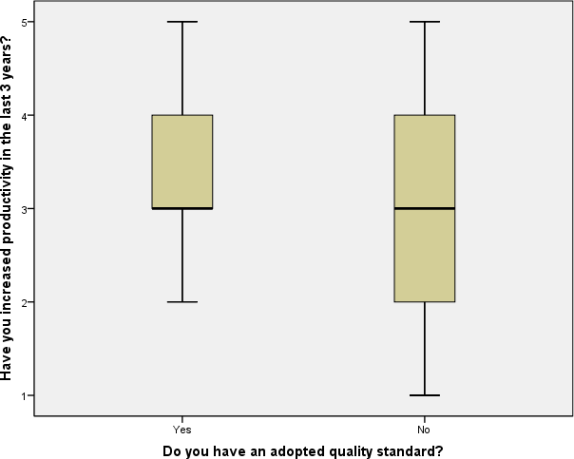
Independent samples T Test compared the results of the assessment of productivity increase for companies that have an adopted quality standard (Yes) and those that do not (No). It was determined that there was a significant difference between Yes (Mean=3.24, SD=0.875) and No (Mean=2.86, SD=0.899); t(110)=2.235, p=0.027. The difference between the mean values of the characteristics by groups (Mean Difference=0.386, 95% CI: 0.044 to 0.728) was medium,
2 t2
(2.235)2
(h = = = 0.04 ), Cohen (1988).


t2 + (N + N - 2) (2.235)2 + (70 + 42 - 2)
1 2
Graph 1. Assessment of productivity increase in relation to the existence of the adopted quality standard
Source: Authors (2023), results of primary research
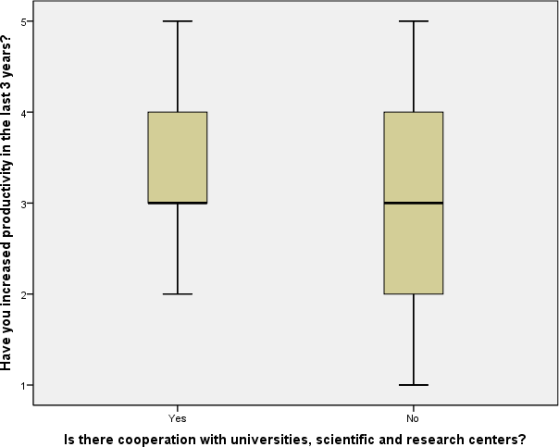
Independent samples T Test compared the results of the assessment of productivity increase for companies that have cooperation with universities or scientific research centers (Yes) and those that do not (No). It was determined that there was no significant difference between Yes (Mean=3.21, SD=0.890) and No (Mean=2.93, SD=0.900); t(110)=1.585, p=0.116. The IQR for the Yes option is (Q3-Q1=4-3) 1, while for the No option it is (Q3-Q1=4-2) 2.
Graph 2. Assessment of productivity increase in relation to cooperation with universities or scientific research institutions
Source: Authors (2023), results of primary research
The biggest obstacles in the development of companies' competitiveness are: lack of financial resources, administrative procedures and fiscal appropriations, insufficiently stimulating business environment, outdated equipment and technology. If we look at the obstacles in the development of competitiveness in relation to the size of the company, then the biggest obstacles are: (1) for up to 50 employees: administrative procedures and fiscal appropriations, lack of financial resources, insufficiently stimulating business environment, outdated equipment and technology; (2) for up to 250 employees: administrative procedures and fiscal appropriations, lack of financial resources, insufficiently stimulating business environment, outdated equipment and technology; and (3) for over 250 employees: lack of finance, insufficiently stimulating business environment, outdated equipment and technology.
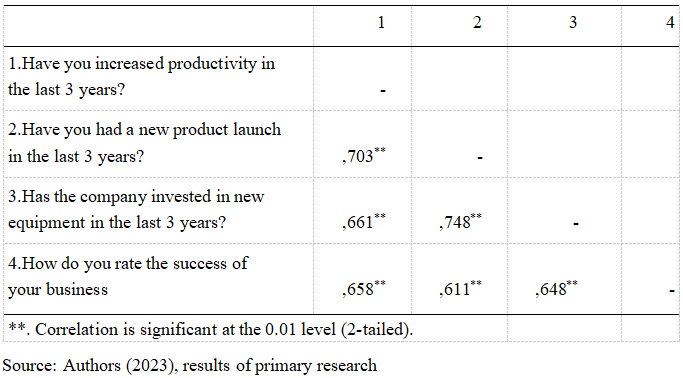
In Table 1, it can be seen that among the variables: Have you increased productivity in the last 3 years and has the company invested in new equipment in the last 3 years; Have you increased productivity in the last 3 years and how do you evaluate the success of your business; have you launched a new product in the last 3 years and how do you rate the success of your business; Whether the company has invested in new equipment in the last 3 years and how you rate the success of your business, there are significant linear relationships. While among the variables: Have you increased productivity in the last 3 years and have you had a new product launch in the last 3 years; whether you had a new product launch in the last 3 years and whether the company invested in new equipment in the last 3 years there are strong linear associations. This practically means that companies that invested in new equipment and introduced new products achieved improvements in business.
Table 1. Correlations
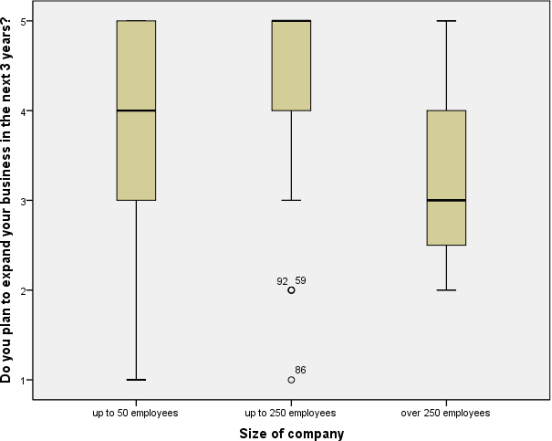
When looking at the assessment of business expansion in the next three years, the highest average score is for companies with up to 250 employees, for which the
1.5IQR interval rangeDs from 3 to 5, and the median is 5.
Graph 3. Expansion of activity in relation to company size
Source: Authors (2023), results of primary research
Conclusion
The results of this research show that there is a significant relationship between cooperation with scientific research institutions and company size. Companies with up to 50 employees have less business connection with large companies and that they are more oriented towards cooperation with companies of the same size. A little more than half of the observed companies have the adopted quality standard. Administrative procedures and fiscal appropriation are cited as the biggest obstacle to the development of competitiveness for companies with up to 50 employees, while for other companies it is the lack of financial resources. Businesses that invested in new equipment and introduced a new product increased productivity and improved operations.
The conclusion is that the existence of quality standards has a significant impact on the results and perspectives of the further development of SMEs. The contribution of quality standards can be seen through the following performances: increasing competitive advantage, access to global markets, more efficient processes, increasing investor confidence, and innovation and research.
Serbia, as a country striving for economic growth and innovation, is increasingly recognizing the importance of connecting small and medium-sized enterprises (SMEs) with scientific institutions. This synergy not only fosters innovation, but also provides a sustainable basis for economic progress.
One of the key aspects of this connection is knowledge transfer. Scientific institutions are the source of new ideas, research and technological innovation. Through the establishment of cooperation with SMEs, this knowledge can be directly translated into practical application, thus boosting the competitive advantage of the company. This connectivity enables SMEs to remain agile and adaptable in a dynamic business environment. Scientific institutions often have resources and knowledge that can support SMEs in carrying out research projects. Through joint efforts, SMEs can access the latest technological trends and innovations, thereby achieving a competitive advantage in the market.
In addition, affiliation with scientific institutions provides SMEs with the opportunity to participate in training and education programs. Such initiatives encourage the development of employee skills, improving the company's workforce. Also, joint programs can contribute to the creation of an innovative work environment, which attracts talent and encourages creativity.
However, in order for this connection to be effective, it is necessary to create a favorable environment and mechanisms for cooperation. This includes facilitating access to finance for research projects, creating platforms for the exchange of information between SMEs and scientific institutions, as well as supporting government policies that encourage innovation. Also, it should be emphasized that not all organizations benefit equally from cooperation with research institutions. Companies that are more intensive in research and development directions will benefit more from cooperation with research institutions. Studies that use absorptive capacity as their main theoretical framework consider research and development as a necessary condition to fully utilize the knowledge possessed by research organizations. The relevance of innovative perspectives in small and medium-sized enterprises can be a significant incentive for cooperation with a research organization. As a conclusion, the view is taken that the implementation of an innovation-oriented strategy supports the development perspectives of organizations and enables them to further increase their market value.
References
2.Adam, N. A. & Alarifi, G. (2021), Innovation practices for survival of small and medium enterprises (SMEs) in the COVID-19 times: the role of external support. Journal of innovation and entrepreneurship, Vol. 10 No.1, pp. 15.
3.Adžić, S., Nestorović, O., Zakić, N., Aničić & D., Penjišević, A., The Impact of Tax Policy, System, and Administration on Small and Medium- Sized Enterprises in the Republic of Serbia: A Statistical Analysis of the Situation, Eastern European Economics Vol. 61, pp. 86-109.
4.Bishop, K., D’Este, P., & Neely, A. (2011), Gaining from interactions with universities: Multiple methods for nurturing absorptive capacity. Research Policy, Vol. 40 No. 1, pp. 30–40.
5.Bourke, J. & Roper S. (2017) Innovation, Quality Management and learning: Short-term and longer-term effects, Research Policy, Vol. 46, No. 8, pp. 1505-1518.
6.Cohen, J.W. (1988). Statistical Power Analysis for the Behavioral Sciences (2nd edn). Hillsdale, NJ: Lawrence Erlbaum Associates.
7.Đervida R., Demirović F.D., Milovanović M. & Radosavac A., Unapređenje poslovnih procesa kao factor postizanja konkurentske prednosti malih i srednjih preduzeća, Poslovna ekonomija DOI: https://doi.org/10.5937/poseko12-13060
8.Edquist, C. (2013). Systems of Innovation (C. Edquist (ed.)). Routledge. https://doi.org/10.4324/9780203357620
9.Etzkowitz, H. & Leydesdorff, L. (2000), The dynamics of innovation: from National Systems and “Mode 2” to a Triple Helix of university– industrygovernment relations. Research Policy, Vol.29 No.2, pp. 109–123.
10.Gereffi, G. & Lee, J. (2016), Economic and Social Upgrading in Global Value Chains and Industrial Clusters: Why Governance Matters, in: Journal of Business Ethics Vol. 133 No.1, pp. 25.
11.Gravetter, F.J., Wallnau, L.B. (2004, 2012). Statistics for the Behavioral Sciences (10th edn). Belmont, CA: Wadsworth.
12.Hansöjorg H. & Zeyner M. N. (2017) The Role of Small and Medium- sized Enterprises in Development What Can be Learned from the German Experience? Friedrih Elbert Stiftung.
13.Hasan A. (2017), How do innovation culture, marketing innovation and product innovation affect the market performance of small and medium- sized enterprises (SMEs)? Tehnology in Society, Vol 51., pp. 133-141.
14.Herzog, P., & Leker, J. (2010), Open and closed innovation: Different innovation cultures for different strategies. International Journal of Technology Management, Vol. 52 No. 3/4, pp. 322–343.
15.Huizingh, E. K. (2011), Open innovation: State of the art and future perspectives. Technovation, Vol. 31 No. 1, pp. 2–9.
16.Isaksen, A., Martin, R, & Trippl, M. (2018). New Avenues for Regional Innovation Systems - Theoretical Advances, Empirical Cases and Policy Lessons. Springer.
17.Lazarević Moravčević, M. Erić, D. & Kamenković, S. (2018), Uticaj poslovnog okruženja na performanse sektora MSPP u Srbiji. Poslovna ekonomija, Vol 7 No. 1, pp. 33-53.
18.Lazzarotti, V., & Manzini, R. (2009), Different modes of open innovation: A theoretical framework and an empirical study. International Journal of Innovation Management, Vol. 13 No. 4, pp. 615–636.
19.Litvaj, I., Drbúl, M. & Bůžek, M. (2023). Sustainability in Small and Medium Enterprises, Sustainable Development in the Slovak Republic, and Sustainability and Quality Management in Small and Medium Enterprises. Sustainability, Vol. 15 No.3, pp. 2039. MDPI AG.
20.Madni, G. R. & Chaudhary, M. A. (2017), Economic Growth in Context of Institutions and Fiscal Policy. Pakistan Economic and Social Review, Vol. 55 No.1, pp. 107–126.
21.Maljugić, B.M. (2021). Sistem upravljanja kvalitetom i konkurentnost u savremenom poslovnom okruženju: pregled literature i poslovne prakse.
22.Miletić, V. & Ćurčić N. (2021), Building strategic alliances as agents of business internationalization for domestic companies, Ekonomija – teorija i praksa, Vol. 14 No.3, pp. 64-82.
23.Miocevic D. (2022), Don’t get too emotional: how regulatory focus can condition the influence of top managers’ negative emotions on SME responses to economic crisis. Int Small Bus J Res Entrep No. 40, pp. 130– 149
24.O’Cass, A. & Sok, P. (2014), The role of intellectual resources, product innovation capability, reputational resources and marketing capability combinations in firm growth. International Small Business Journal, Vol. 32 No. 8, pp. 996–1018.
25.Oura, M. M., Zilber, S. N. & Lopes, E. L. (2016), Innovation capacity, international experience and export performance of SMEs in Brazil. International Business Review, Vol .25 No.4, pp. 921–932.
26.Peranović, M. & Ćirić, I. (2015), Prevazilaženje barijera u prenosu znanja izmeu univerziteta i poslovnih sistema, Infoteh, Vol 14, pp. 436-440.
27.Pereira, R. & Franco, M. (2023). University-firm cooperation: how do small and medium-sized enterprises become involved with the university?.European Business Review.
28.Petrov, V. (2022) Mogućnosti prevazilaženja jaza između naučno- istraživačkog rada I komercijalizacije, Nauka i inovacije kao pokretači privrednog razvoja,
29.Qian, G. & Li, L. (2003), Profitability of small-and medium-sized enterprises in high-tech industries: The case of the biotechnology industry. Strategic Management Journal, Vol. 24 No. 9, pp. 881–887.
30.Rosenbusch, N., Brinckmann, J. & Bausch, A. (2011), Is innovation always beneficial? A meta-analysis of the relationship between innovation and performance in SMEs. Journal of Business Venturing, Vol. 26 No. 4,
pp. 441–457.
31.Solga, H. (2016): The social investment state and the myth of meritocracy, in: Gallas, A., Herr, H., Hoffer, F., Scherrer, C. (eds.): Combating Inequality. The Global North and South. Abingdon: Routledge.
32.Tadić, D., Stanisavljev, S. & Kavalić, M.(2022), Izazovi kvaliteta 4,0 pregled literature i poslovne prakse, Procedia CIRP, No. 2212,pp. 8271.
33.Umar, A., Adawiah, A., Barkatullah, A., Ifrani, I., Mahyuni, M., Amrin,
M. & Farisi, N. (2022), Government Policies and Regulations, Leadership Style and Employee Performance in Increasing Productivity of Indonesia’s Small and Medium Enterprises. Society, Vol. 10 No.1, pp. 182-206.
34.Verhees, F. J. & Meulenberg, M. T. (2004), Market orientation, innovativeness, product innovation, and performance in small firms. Journal of Small Business Management, Vol. 42 No. 2, pp. 134– 154.
35.Vlada Republike Srbije. (2020). Strategija industrijske politike RS od 2021. do 2030. godine. In Strategija industrijske politike RS od 2021. do 2030. godine. www.pravno- informacionisistem.rs/SlGlasnikPortal/eli/rep/sgrs/vlada/strategija/2020/35
/1/reg
36.Vukotić, S., Aničić, J. & Laketa, M. (2013), Clusters as a part of improvement function of Serbian economy real sector competitiveness. Amfiteatru Economic Journal, Vol. 15 No.33, pp. 224- 245.
37.Yıldız, S., Baştürk, F. & Boz, İ. T. (2014), The effect of leadership and innovativeness on business performance. Procedia-Social and Behavioral Sciences, Vol. 150, pp. 785–793.
38.Zhang, J., Zhang, T., Dai, Y., Harandi, M. & Hartley, R. (2018). Deep unsupervised saliency detection: A multiple noisy labeling perspective [Paper presentation]. Proceedings of the IEEE Conference on Computer Vision and Pattern Recognition
39.Zhussipova E. E, Beisenova M, Kuralbayeva A. S, Aitymbetova AN, Imanbayev A, Kamalov A. A, Narkulova S, Issayeva G. K, Utarov K. & Satymbekova K. B. (2019), Areas of Improvement of the Economic Mechanism of Increasing the Competitiveness of Enterprises Producing Fat Product in the Republic of Kazakhstan (Example: Shymkentmai JSC). Revista Espacios, Vol. 40 No. 3, p. 26.
Published in
Vol. 9 No. 2 (2023)
Keywords
🛡️ Licence and usage rights
This work is published under the Creative Commons Attribution 4.0 International (CC BY 4.0).
Authors retain copyright over their work.
Use, distribution, and adaptation of the work, including commercial use, is permitted with clear attribution to the original author and source.
Interested in Similar Research?
Browse All Articles and Journals