
THE DETERMINANTION OF THE DEMAND FOR THE INTERNATIONAL RURAL DESTINATION - THE PLS MODEL
Abstract
One of the biggest challenges facing agritourism destination managers is a clear understanding of the factors that motivate consumers to choose a particular agritourism destination, and be loyal to it, when they have countless other options. The research on the international agritourism destination, from a broader perspective, aims to analyze the market behavior of tourists and implies the necessary prior knowledge of tourists’ decision-making. Therefore the subject of research is the analysis of the influence of the agritourism gastronomic experience, thorough the analysis of the influence of the factors of the agritourism gastronomic experience on the development of loyalty towards an agritourism destination. The survey analyzes international tourists' reactions to the atmosphere of catering establishments, gastronomy, services, quality and prices which affects the satisfaction and the loyalty to the agritourism destination, in our case the agritourism destinations in the Province of Vojovodina, close to the city of Novi Sad. The findings have shown that there is a statistically significant and positive association between atmosphere of agritourism catering establishments and gastronomy and satisfaction with the agritourism destination. The satisfaction with the agritourism destination has a positive relationship with the loyalty to the agritourism destination. The findings can help the stakeholders to improve the agritourism gastronomic experience as it covers an important role in the development of the gastronomic experience. The contribution of this paper is that it directly focuses on an aspect of the relationship between the elements of the agritourism gastronomic experience, satisfaction and loyalty that have not been previously directly addressed.
Article
Introduction
In the conditions of growing competition, the factors of tourist perception of a agritourism destination is an important issue. In practice, it is possible to see that some cities live and attract visitors, while some rural destinations simply die. Numerous authors indicate the connection between food and the tourist experience Forleo & Benedetto (2020), that is, they emphasize the role gastronomy in making a decision about a tourist destination Nicolett et al. (2019); Berbel-Pineda et al. (2019). Food is a factor in the development of a destination, complements the tourist offer and represents an important tourism resource Piramanayagam et al. (2020). So far, research on rural tourism in the Republic of Serbia have not paid enough attention to researching the relationship between the elements of the gastronomic experience and satisfaction with the agritourism destination, therefore this research shall fill the gap in the literature and enable the understanding of socio-economic, political, marketing and managerial factors involved in the process. The essential question that arises is to what extent the agritourism gastronomic experience and its factors (gastronomy and services, atmosphere, food quality and prices) influence international tourists to be loyal to the agritourism destinations in the Province of Vojovodina, close to the city of Novi Sad, how willing will they be to visit the agritourism destinations again.
In recent years, and especially in the period after the COVID 19 pandemic, there have been significant changes in the behavior of domestic and international tourists, which have not been sufficiently investigated. In fact, changes in the motives, preferences, and expectations of the tourists, which are important when creating an agritourism destination brand or rebranding an agritourism destination and developing loyalty, have not been sufficiently researched(Škrbić et al., 2023). The studies of the gastronomic experience in the Republic of Serbia have so far aimed to determine the potential of traditional culinary events for improving the overall tourist offer of destinations, examine the role of social networks in predicting the choice of restaurants and the gastronomic offer in Serbia, analyze the role of events and tourism in economic development (Kostić et al., 2018; Ćirić et al., 2020).
The accelerated development of the agritourism tourism has started since the nineties of the twentieght century, when realizing the importance of the agritourism tourism in the rural Europe and North America. Therefore also the countries of the Eastern Europe as well have started to develop their agritourism offer. Shapes and forms differ from country to country, depending on the type of agritourism accommodation capacities and natural-geographic features of the rural areas. The development of agritourism tourism in Serbia has been conducted spontaneously and has assumed different forms. Rural areas occupy more than 80% of the Republic and on these areas, according to the last Census, live 44% of total population. The development of agritourism tourism in the Republic of Serbia has so far gone through two phases in development - the phase of independent i.e. "spontaneous development" and the phase of "dedicated development" that began in 2008, when the Ministry of Agriculture, Forestry and Water Management decided in 2008 to invest additional funds for the development. Each region in Serbia strives to promote and develop its rural areas, i.e. it strives to promote its tourist attractions in order to initiate, among other things, the development of rural tourism.
Therefore, starting from the research of Folgado-Fernández et al. (2017), Berbel-Pineda et al. (2019) and other available knowledge, it is necessary to create a model for examining the connection between agritourism gastronomic experience and loyalty. Due to the fact that the agritourism destinations do not have a recognizable gastronomic offer that would generate a positive gastronomic experience, as well as the fact that there are no recognizable and differentiated parameters of the agritourism destinations tourist offer, we believe that there is a complete justification for the research. The rural destinations of Province of Vojvodina have not fully utilized its potential, as the studies of the gastronomic aspects of the agritourism are lacking, the gastronomic offer is undifferentiated and there are no recognizable factors that attract tourists to the agritourism destinations of Vojvodina.
The main goal of the research in the paper is to investigate the influence of the elements of the gastronomic experience in the development of loyalty towards the agritourism destinations of Vojvodina. By understanding the strength of the direct action of individual factors of the gastronomic experience, it is easier to create, on the one hand, the gastronomic offer, and on the other hand, development strategies, which should operate synergistically. The indirect effects of the research are reflected in the identification of agritourism areas that need to be developed, all with the aim of improving the socio-economic situation in the rural destinations of Vojvodina, the satisfaction of residents, tourists, etc. Because of the above, the subject of research in the paper is the analysis of the influence of the agritourism gastronomic experience, that is, the analysis of the influence of the factors of the gastronomic experience (atmosphere, gastronomy and service and quality and price) in the development of loyalty towards a certain agritourism tourism destination. After the introductory section, the authors present the theoretical and the methodological framework, which is followed by the research results, discussion and conclusions, stemming from the research.
Literature review
The gastronomic offer represents a specific segment of the culture of the tourist destination, it affects satisfaction and the intentions of tourists towards a certain destination (Berbel-Pineda et al., 2019). A positive or negative gastronomic experience in a certain tourist destination affects the development of loyalty Folgado-Fernández et al. (2017); Đurović et al. (2022) and repeated visits. Knowing the factors of the gastronomic experience, in the context of the overall picture of the agritourism destination, enables the perception of the tourist's satisfaction and the manner of the behavior. The satisfaction of the users is the starting point for improving the offer and creating strategies for the development and promotion of a certain destination (Josphine, 2021). The gastronomic experience affects the satisfaction, loyalty and future intentions of tourists towards a tourism destination (Berbel-Pineda et al., 2019; Stankov & Roganović, 2022; Kostić, 2023).
The gastronomic agritourism is becoming an area of intensive development and intensive study. Regardless of the aspect of study, gastronomic tourism is associated with food the offer of local (for example olives - Folgado- Fernández et al. 2019), traditional authentic food products, entertainment and gastronomic events (Vuković & Ružičić Mosurović, 2020; Paspalj et al., 2024; Gojković et al., 2023), tourist routes (Berbel-Pineda et al., 2019), gastronomic facilities, local culture, customs and traditions, heritage and natural resources. The green growth is related to economic policy and sustainable development policy, and can enhance also agritourism (Ignjatijević, et al. 2020).
The gastronomic experience affects the overall tourist experience, by presenting and consuming the specific food of a certain destination (Berbel- Pineda et al., 2019). Some authors point out that gastronomy is becoming a means of differentiating destinations (Santos et al., 2022), they indicate that food and wine (Vesci & Botti, 2019) can be means of self-expression and enjoyment, improving the general image of the destination or the entire region.
The gastronomy and gastronomic experience complete the image of a place, attract tourists (Ullah et al., 2022) and influence the attitude towards the destination (Berbel-Pineda et al., 2019; Piramanayagam et al., 2020). The authors explain the gastronomic experience as a positive feeling, a feeling of attraction (Babolian-Hendijani, 2016), which is influenced by several different parameters. The food is only one of the components of the gastronomic experience, and the atmosphere (Berbel-Pineda et al., 2019), communication and friendliness of the staff, events are important in the building (Japutra et al., 2022) and the like. The gastronomic experience depends on external factors and internal, that is, individual factors. The internal factors are the emotions, memory of past visits (Badu-Baiden et al., 2022), expectations and all together influence differences in tourist behavior (Şahin & Kılıçlar, 2023).
A positive gastronomic experience is directly related to the satisfaction with the tourist destination and loyalty (Folgado-Fernández et al., 2017). If the satisfaction with the tourist destination is achieved, tourists can promote those destinations, that is, satisfaction can influence various activities of tourists and prolong their stay (Ullah et al., 2022; Vladisavljević et al., 2023), increasing consumption (Đurkin Badurina et al., 2023), strengthening the emotional connection with the destination, revisits (Berbel-Pineda et al., 2019; Piramanayagam et al. et al., 2020), evoking memories (Badu-Baiden et al., 2022; Milanović, 2023) and recommendations (Ramón, 2020).
In such a situation, tourists’ perceptions influence the sustainable development of the chosen tourist destination. The previous analysis of the gastronomic offer of the agritourism destinations of Vojvodina, close to the city of Novi Sad are insufficient, especially if it is known that the Province of Vojvodina is extremely multicultural in all respects. In fact, we are of the opinion that the biggest lack in the literature is empirical and econometric studies of the combined influence of parameters on satisfaction with the agritourism destinations of Vojvodina - as a chosen agritourism destination. Based on the above, the following hypotheses were set:
H1. Gastronomy and services have a positive effect on satisfaction with the agritourism destination;
H2. The atmosphere has a positive effect on satisfaction with the agritourism destination;
H3. Quality and price have a positive effect on satisfaction with the agritourism destination.
The loyalty can be understood as a repeat visit or the existence of the intention to visit and recommend the tourist destination again, and the measurement of loyalty is of particular importance when creating development strategies of a certain destination (Pavlidis & Markantonatou, 2020). The loyalty in tourism is desirable and is an indicator of the success of a destination (Santos et al., 2022; Dašić et al, 2023), it is important to attract future tourists, ensure frequent visits and increase income. Folgado-Fernández et al. (2017) point to the relationship between destination image and gastronomy, and point out that the number of tourists looking for specific and pleasant experiences at destinations is increasing. The distinctiveness of the local cuisine and local manifestations, combined with other characteristics of the agritourism destination, can become a decisive factor in the success of the destination and as such enhance the experience and memory of a certain destination. Thus, experiences influence the level of tourist loyalty and determine subsequent actions (Stavrianea & Kamenidou, 2022). In order to promote the destination, it is necessary to know the factors of the gastronomic experience (Kovalenko et al., 2023) and the level of tourist satisfaction. The trust that a customer develops towards a product or service, which is greater in relation to a competing product or service, turns into loyalty and leads to the willingness to pay a higher price. In measuring loyalty, several approaches and methodologies have been developed, but there is no single definition of loyalty to a destination. The authors noted that loyalty is seen as a consequence of multidimensional cognitive attitudes. The results of earlier research are limited due to the fact that the choice of parameters that were investigated was modest or the multiple influence of variables was not examined, as well as due to the applied analysis methods. Authors in Serbia investigated the role of tourism in economic development (Janković et al., 2020; Kostić et al., 2018; Ćirić et al., 2020), manifestations and especially culinary manifestations in the context of improving the tourist offer (Zrnić et al., 2021; Milenković et al., 2023). The authors further investigated the role of social networks in gastronomic tourism, while there is a lack of improved studies of loyalty towards specific rural destinations, such as research by Miljanović (2016). Because of the above, the hypothesis was put forward:
H4: Satisfaction with the agritourism destination has a positive effect on the development of loyalty towards the agritourism destination.
Material and methods
The research analyzes tourists' reactions to the atmosphere of agritourism catering establishments, gastronomy, services, quality and prices, that is, the gastronomic experience, which further affects satisfaction and the creation of loyalty to the agritourism destination. In the research, there is a need to first define the terms gastronomic experience, and then carry out a quantitative assessment of the perception of tourists and establish the strength of the influence of variables on the development of loyalty to the agritourism destination(Milenković, 2023). In order to confirm the positive influence of the gastronomic experience, as pointed out by Folgado-Fernández et al. (2017), Berbel-Pineda et al. (2019), the research in the paper represents a comprehensive and improved approach in the analysis of loyalty towards the agritourism destination. The research has been conducted by surveying international tourists at agritourism locations in the period of May-October 2022. The surveys that have been collected in full have included 1591 international tourists based on convenience sampling at the various locations, restaurant and bar locations in the agritourism destination close to the City of Novi Sad. The survey has been created in such a way as to enable the presentation of the profile of the respondents, so it contains questions about the socio-demographic characteristics of the respondents. In addition, the survey has 45 statements (ATM (atmosphere) - 12, GAS (gastronomy and services) - 10 and QAP (quality and price) - 8 statements, LOY (loyalty) - 8 statements and SAT (satisfaction with the tourist destination) - 7 statements, which the respondents were to rate these claims from 1 to 5 (Likert scale).
Descriptive statistical analysis (mean value, standard deviation, variance, measures of asymmetry and flatness) have been employed in the analysis of the received answers. Then, the normality of the data distribution (Kolmogorov - Smirnov test) and the reliability of the variables (Cronbach's alpha) in representing the latent constructs of the model were examined. Data analysis has been conducted by SPSS software, ver. 26 and PLS Smart4. The PLS model (partial least squares method) is a linear regression method used to calculate the regression effect of independent variables, i.e. constructs (each construct is represented by a large number of elements), on the dependent variable (the dependent variable is also represented by several elements).
Results
The results of the descriptive statistics (Table 1) show that 58% of the sample were female and 42% male respondents. The majority of the respondents have over 41 years of age (70.08%) and have a high school diploma (37.96%).
Table 1. Gender, age and education of respondents


Source: Author's calculation
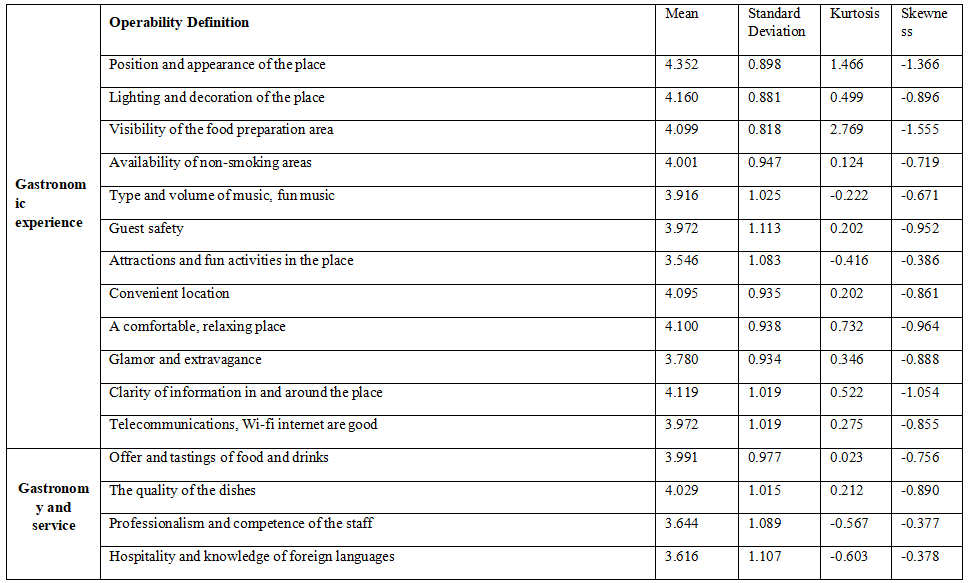
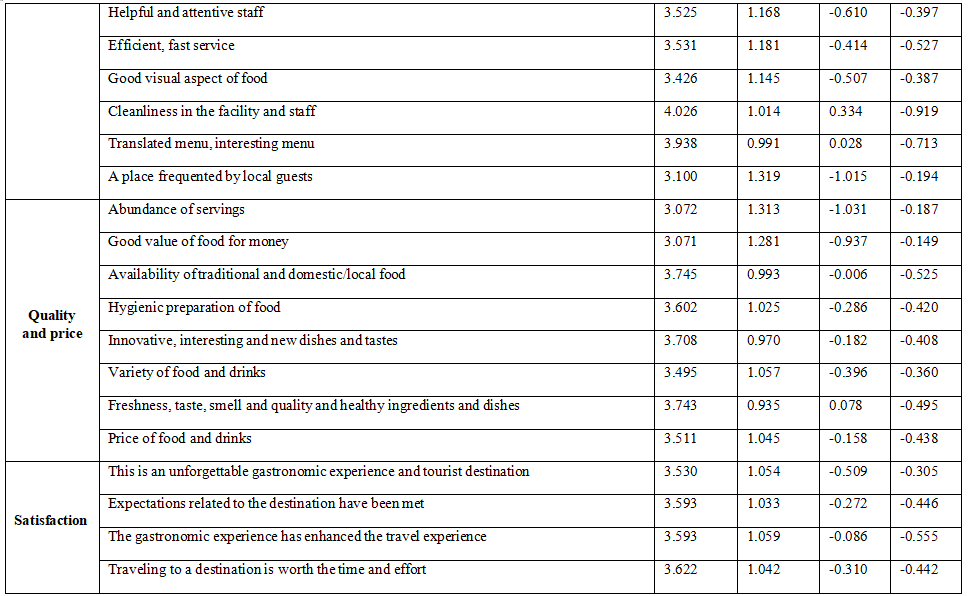
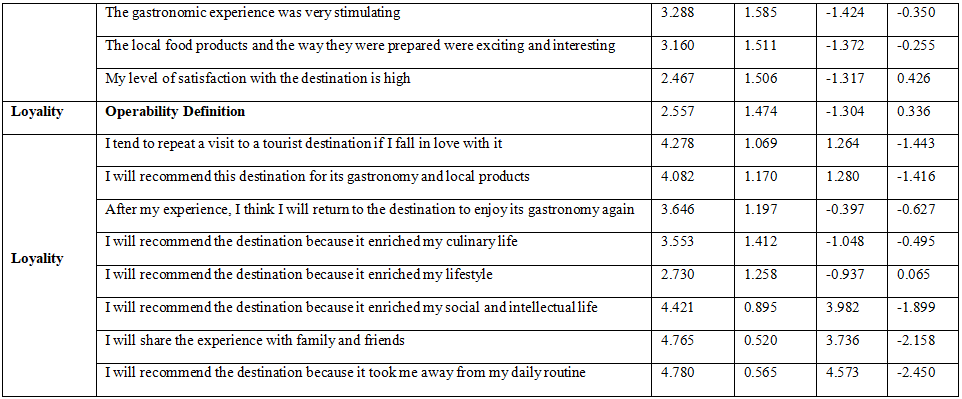
The results show that the variables have a mean score of QAP - 4.718 (std.dev. 0.6); GAS – 4.036 (std.dev. 0.970) and ATM – 2.868 (std.dev. 1.519). The Skewness coefficient ranges from -2.119 to 0.039. The Skewness values show a negatively asymmetric distribution in QAP and GAS. The kurtosis coefficients range from -1.354 to 3.491 (Table 2).
Table 2. Descriptive values for the variables of gastronomic experience
Source: Author's calculation
The assessment of the reflective measurement model began with the assessment of the reliability of the loading of variables - Construct reliability and validity. The variables whose factor loading is greater than 0.7 have been kept in the model (Table 3).
Table 3. Values of standardized factor loadings and the results of the analysis of the reflective measurement model
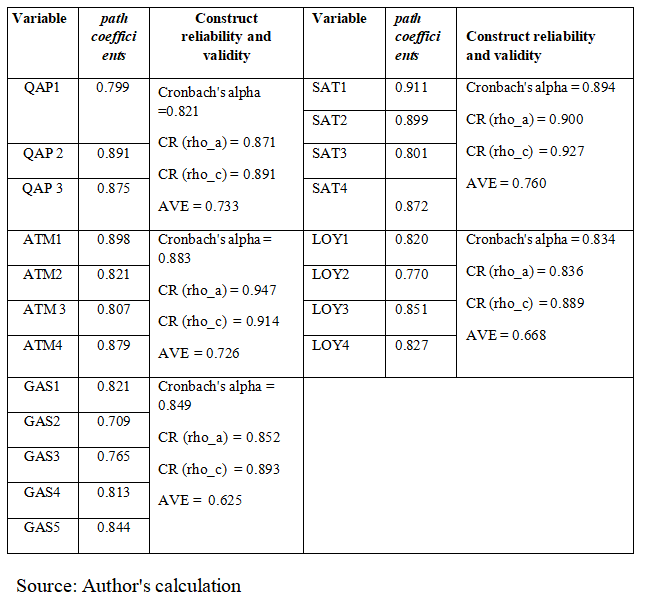
The result of the analysis of the reflective measurement model, which was carried out by the analysis of standardized factor loadings, shows that the model consists of variables with a loading greater than 0.7. The values of the Cronbach alpha coefficients range from 0.821 to 0.894 and indicate high reliability. The composite reliability score ― CR has values from 0.836 to 0.947, and from 0.889 to 0.927 and indicate good reliability and existence of internal connection. The convergent validity score – AVE is in the range of 0.625 - 0.760, i.e. AVE > 0.5.
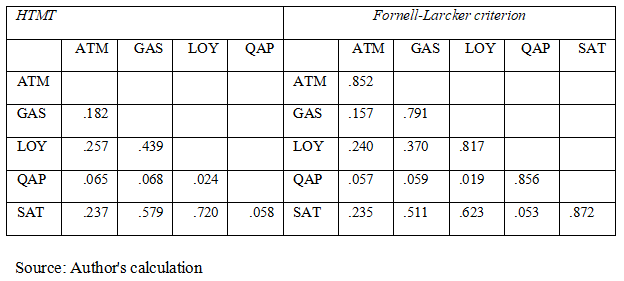
Discriminant validity analysis has been performed using HTMT values and Fornell Larcker criteria. The values of the cross-standardized factor loadings of the reflective measurement model are presented below in the Table 4.
Table 4. HTMT and Fornell Larcker criteria of the measurement model
Analysis of the results of the structural ie internal model
As part of the analysis of the structural model, the relationship between the variables ATM, GAS and QAP and SAT) and SAT and LOY has been examined. In the analyzed model, the independent variables ATM and the dependent/independent variable SAT are endogenous, while the dependent variable business performance - LOY is exogenous.
Table 5. Inner VIF Values, R-square Values and f2
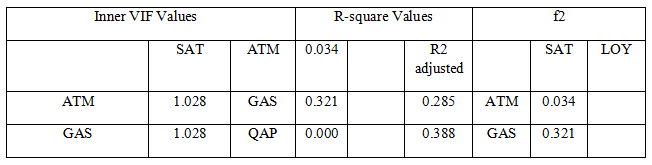

The results in the Table 5 of the collinearity between latent constructs (VIF) ranges from 1.000-1.028, that is, the obtained values are less than 3, which means that there is no problem of collinearity in the model. The results of the correlation, i.e. the regression influence, indicate a correlation between the variables of gastronomic experience and satisfaction (0.286). The correlation between SAT and LOY is stronger (0.388). In the model, the value of the corrected coefficient of determination (eng. R2 adjusted) indicates the percentage in which the independent variables explain the dependent variable - SAT and LOY (there is a weak and moderate influence). Finally, the significance testing of the structural model and the confirmation of the hypotheses has been carried out (Table 6).
Table 6. Results of structural model analysis and path coefficients in the model
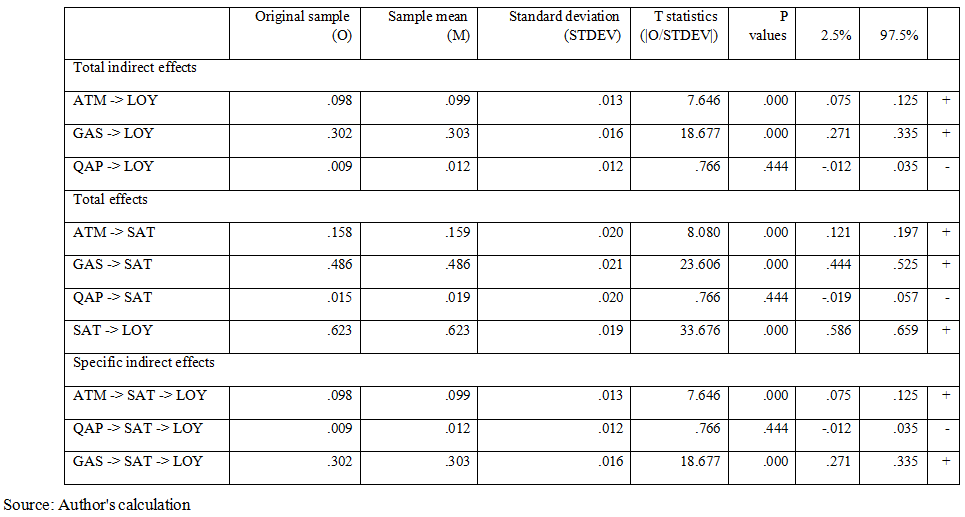
H1: There is a statistically significant and positive association between ATM and SAT, has been confirmed due to the empirical relationship (β = 0.158; t = 8.080) which is statistically significant at the p < 0.000 level. The population is with 97.5% probability in the confidence interval from 0.121 to 0.197.
H2: There is a statistically significant and positive association between GAS and SAT, has been confirmed. The empirical relationship is statistically significant and persistent (β = 0.486; t = 23.606). The population is with 97.5% probability in the confidence interval from 0.444 to 0.525.
H3: There is a statistically significant and positive association between QAP and SAT, has been rejected due to a exisitng empirical relationship (β = 0.015; t =
.766; p=0.444) and statistical significance at the 97.55% probability in the confidence interval from -0.019 – 0.057.
H4: There is a statistically significant and positive relationship between SAT and LOY has been confirmed due to the consistent empirical relationship (β = 0.623; t
= 33.676; p=0.000) and statistical significance at the 97.55% probability in the confidence interval from 0.586 – 0.659.
Discussion
Earlier studies of the gastronomic experience in the Republic of Serbia have pointed to the potential of traditional culinary events for improving the overall tourist offer of destinations (Zrnić et al., 2021), the choice of restaurants, etc. the overall economic development (Janković et al., 2020; Kostić et al., 2018; Ćirić et al., 2020B N). Therefore, the models developed by Berbel-Pineda et al. (2019) examined the partial dependence of gastronomic experience and loyalty (Berbel- Pineda et al., 2019). On the other hand, the research of Folgado-Fernández et al. (2019) states the structural element, as a variable that affects loyalty, which contains gastronomic offer and gastronomic experience as constituent elements. Dinis et al (2019) have developed an empirical model showing that intentions are important but insufficient to explain behaviour, and other factors such as lodgement location, business success, manager's residence, level of education, and past professional experience, are crucial to explain the adoption of local development practices by local hosts. The developed model represents the improvement of the mentioned models, by introducing the gastronomic experience as new variables in the research. The results of earlier research confirmed the positive influence of gastronomic experience on satisfaction with a particular destination, which results in the development of loyalty and the repeated visits (Danylyshyn et al., 2020).
The gastronomic experience, made up of determinants (gastronomy and food, atmosphere and quality and price), affects the tourist experience, which is in line with the previously conducted research (Forleo & Benedetto, 2020). The research findings have shown that the respondents have rated the Atmosphere of the hospitality facility with the highest rating (4.009; stand.dev 0.968), and the best rated were: Position and appearance of the facility; Visibility of food preparation areas, Availability of non-smoking areas and Clarity of information in and around the facility, which is consistent with the findings (Moral-Cuadra et al., 2020). The respondents in the agritoursim destinations prefer the traditional, ie. home made/local food, which is in line with the research of Henderson (2009). The food should preferably indicate history (Baldacchino, 2015), tradition, local culture, history and customs (Pavlidis & Markantonatou, 2020; Babolian-Hendijani et al., 2013); that it is innovative and interesting, i.e. or as the authors call it the specific food of a certain destination (Berbel-Pineda et al., 2019; Ji et al., 2016; Yılmaz & Özdemir, 2015). The above mentioned statements were evaluated by the respondents with 3.745 (stand.dev 0.993) and 3.708 (stand.dev. 0.970) respectively. It is especially important that the food is freshly prepared, tasty, high-quality and healthy in the agritourism destinations (3.743, stand.dev. 0.935), which is in accordance with the findings of Figueroa et al (2021).
The variable Gastronomy and service has been rated by respondents with 3,683 (stand.dev.1.101) and the best rated statements were: Hospitality and knowledge of foreign languages, Cleanliness of the facility and staff, and Offer and tasting of food and beverages (Hall et al., 2003; Josphine, 2021). The total gastronomic experience was rated 3,728 (stand.dev 1,048) and indicates the attitude of tourists that the mentioned factors are important for achieving a positive experience, as well as that it affects satisfaction and loyalty to the agritourism destinations. The gastronomic experience is created and developed, sought after (Pavlidis & Markantonatou, 2020) and becomes a factor of tourists' satisfaction with a agritourism destination.
In terms of agritourism destination satisfaction, the most significant variables for the model are: Expectations related to the destination are fulfilled and, as respondents state, it is worth the time and effort, which is in line with the conclusions of Yasami et al (2021). The attitude that the Gastronomic Experience has improved the travel experience has been rated with 3.593 (stand.dev.1.059), which is in line with the findings of Piramanayagam et al. (2020); Pavlidis & Markantonatou (2020).
Therefore, the gastronomic experience affects the overall agritourism experience, differentiates and improves the image of the destination (Manola & Koufadakis, 2020) and influences satisfaction towards the destination (Berbel-Pineda et al., 2019; Piramanayagam et al., 2020). The research confirms the influence of the gastronomic experience on satisfaction and loyalty towards the agritourism destination, for the variables atmosphere and gastronomy and service, which is in line with the conclusions of Vázquez-Martinez et al. (2019). The strongest total indirect effects and total effects on satisfaction and loyalty are present in Gastronomy and service, which is in accordance with the findings (Berbel-Pineda et al., 2019). The role of atmosphere on satisfaction and loyalty is significant, which is in accordance with the findings (Babolian-Hendijani, 2016).
Finally, it can be emphasized that hypothesis H4 was confirmed, i.e. total effects and specific indirect effects between satisfaction and loyalty were established, which is in line with the conclusions (Marinković et al., 2014). The satisfaction with the gastronomic service, affects the later behavior of tourists, and as research has shown, the satisfaction depends on the expectations, overall experiential contribution, stimulating and interesting travel, memories, which is in line with the findings.
The research findings have confirmed the high impact of satisfaction on loyalty, so tourists will be ready to repeat the visit to the agritourism destinations, which is in line with the findings (Berbel-Pineda et al., 2019; Folgado-Fernández et al., 2019). The loyal tourists will recommend the agritourism destination, share the experience or extend their stay, which is in line with the findings.
Conclusion
The tourism product represents a wide range of tangible and intangible benefits that the customer acquires by purchasing the product and services. Good agritourism destination implies the establishment of a product at the level of a specific rural tourism destination and stems from the needs, demands and wishes of consumers. The agritourism destination that satisfies the consumer directly depends on the availability of all elements of the rural tourism offer, and implies a combination of the elements, such as its natural, cultural and social attractiveness of the rural destination; conditions for the stay and services in the agritourism destination and accessibility of the agritourism destination in terms of costs, speed and comfort of reaching the rural destination. In conditions of rapid and turbulent changes in the environment, it is very important to monitor changes in the strategic position of the agritourism destination in the tourist market over time.
The tourist traffic in the agritourism destination, income from agritourism destination and additional research should serve as the primary basis for any attempt to improve the position of the chosen agritourism destination. Bearing in mind the constant changes in the wishes and demands of consumers/tourists, the agritourism destination that continuously offers the same products and promotion in perspective may worsen its current position in the market. Better positioning can be achieved by changes in the value of the offer, but also by changes in image. The agritourism destination positioning is closely related to its’ branding, since it represents the differentiation of the product in the consumer's mind compared to the competition based on the superior characteristics that the tourist product possesses. The specificity of the agritourism destination also stems from the peculiarity of including the gastronomic attractiveness of the rural destination in the tourist offer.
When taking into account the entire heritage of Vojvodina, cultural - historical and natural, it can be concluded without exaggeration that this part has a huge agritourism tourism potential. In order that a agritourism destination operates successfully and makes a profit, it is necessary to efficiently and rationally manage its business processes and existing resources. This means making a series of economic choices on the activation of available resources in the gastronomic experience, made up of determinants (gastronomy and food, atmosphere and quality and price), that affects the agritourism experience. The research findings have confirmed the high impact of satisfaction on loyalty, so international tourists will be ready to repeat the visit. The natural position of the agritourism destination can also be seen as the reason why the target segment of tourists is interested in choosing a specific destination. As the gastronomic experience influences the satisfaction and loyalty towards the agritourism destination the ultimate goal of the successful destination positioning is to achieve a sustainable competitive advantage, which can be maintained for a long period of time.
References
2.Babolian Hendijani, R. (2016). Effect of food experience on tourist satisfaction: the case of Indonesia. International Journal of Culture, Tourism and Hospitality Research, 10(3), 272-282. https://doi.org/10.1108/IJCTHR-04-
2015-0030
3.Badu-Baiden, F., Correia, A., & Kim, S. (2022). How do tourists’ memorable local gastronomy experiences and their personal gastronomic traits influence destination loyalty? A fuzzy set approach. Journal of Travel & Tourism Marketing, 39(5), 501-515. https://doi.org/10.1080/10548408.2022.2148041
4.Baldacchino, G. (2015). Feeding the rural tourism strategy? Food and notions of place and identity. Scandinavian Journal of Hospitality and Tourism, 15(1- 2), 223-238. https://doi.org/10.1080/15022250.2015.1006390
5.Berbel-Pineda, J. M., Palacios-Florencio, B., Ramírez-Hurtado, J. M., & Santos- Roldán, L. (2019). Gastronomic experience as a factor of motivation in the tourist movements. International Journal of Gastronomy and Food Science, 18, 100171.https://doi.org/10.1016/j.ijgfs.2019.100171
6.Ćirić, M., Kalenjuk, B., & Janković, I. (2020). Regional Products With the Protection of Origin in Serbia Tourism Offer. Indonesian Journal of Tourism and Leisure, 1(2), 61-72. https://doi.org/10.36256/ijtl.v1i2.101
7.Danylyshyn, B.; Bondarenko, S.; Niziaieva, V.; Veres, K.; Rekun, N.; Kovalenko, L. 2020. Branding a tourist destination in the region’s development.
International Journal of Advanced Research in Engineering and Technology (IJARET), 11(4).
8.Dašić, B., Župljanić, M. & Pušonja, B. (2023). Uloga regulatornog okvira na prilive stranih direktnih investicija. Akcionarstvo, 29(1), 95-112
9.Dinis, I., Simões, O., Cruz, C., & Teodoro, A. (2019). Understanding the impact of intentions in the adoption of local development practices by rural tourism hosts in Portugal. Journal of Rural Studies, 72, 92-
103.https://doi.org/10.1016/j.jrurstud.2019.10.002
10.Đurkin Badurina, J., Klapan, M., & Soldić Frleta, D. (2023). Stakeholders’ Collaboration in the Development of an Authentic Gastronomic Offering in Rural Areas: Example of the Ravni Kotari Region in Croatia. Sustainability, 15(5), 4649. https://doi.org/10.3390/su15054649
11.Đurović, M., Borković, M., Tošić, T., & Simić, A. (2022). ПРИМЕРИ ДОБРЕ ПРАКСЕ У РУРАЛНОМ ТУРИЗМУ РУСКЕ ФЕДЕРАЦИЈЕ. Turističko
poslovanje, (30), 5-11. https://doi.org/10.5937/turpos0-41425
12.Gojković, B., Obradović, Lj. & Mihajlović, M. (2023). Uticaj makroekonomskih faktora na javni dug Republke Srbije u posttranzicionom periodu. Akcionarstvo, 29(1), 217-238
13.Figueroa, V., Farfán, M., & Aguilera, J. M. (2023). Seaweeds as novel foods and source of culinary flavors. Food Reviews International, 39(1), 1-26. https://doi.org/10.1080/87559129.2021.1892749
14.Forleo, M. B., & Benedetto, G. (2020). Creative cities of gastronomy: Towards relationship between city and countryside. International Journal of Gastronomy and Food Science, 22, 100247.. https://doi.org/10.1016/j.ijgfs.2020.100247
15.Hall, C. M., Sharples, L., Mitchell, R., Macionis, N., & Cambourne, B. (Eds.). (2004). Food tourism around the world. Routledge.Henderson, J. C. Food tourism reviewed. British Food Journal 2009, 111(4), 317–326. https://doi.org/10.1108/00070700910951470
16.Janković, I., Ćirić, M., & Vujasinović, V. (2020). Uticaj autentične hrane kao odabir turističke destinacije. BizInfo (Blace) Journal of Economics, Management and Informatics, 11(2), 81-92.
https://doi.org/10.5937/bizinfo2002081J
17.Japutra, A., Tjiptono, F., Setyawan, A., Permana, I. B. G. A., & Widaharthana,
I. P. E. (2022). Life events, philosophy, spirituality and gastronomy experience. International Journal of Contemporary Hospitality Management, (ahead-of-print). https://doi.org/10.1108/IJCHM-09-2021-1196
18.Ji, M., Wong, I. A., Eves, A., & Scarles, C. (2016). Food-related personality traits and the moderating role of novelty-seeking in food satisfaction and travel outcomes. Tourism Management, 57, 387-396.
https://doi.org/10.1016/j.tourman.2016.06.003
19.Josphine, J. (2021). A critical review of gastronomic tourism development in Kenya. J. Hosp. Tour. Manag, 4, 27-39.
20.Kostić, M., Lakićević, M., & Milićević, S. (2018). Sustainable tourism development of mountain tourism destinations in Serbia. Економика пољопривреде, 65(2), 843-857. https://doi.org/10.5937/ekoPolj1802843K
21.Kovalenko, A., Dias, Á., Pereira, L., & Simões, A. (2023). Gastronomic Experience and Consumer Behavior: Analyzing the Influence on Destination Image. Foods, 12(2), 315. https://doi.org/10.3390/foods12020315
22.Kostić, T. (2023). Udžbenik u elektronskom obliku u srpskom obrazovanju - za i protiv. Društveni horizonti, 3(6), 69-
84. https://doi.org/10.5937/drushor2306069K
23.Manola, M., & Koufadakis, S. X. (2020). The gastronomy as an art and its role in the local economic development of a tourism destination: A Literature Review. SPOUDAI Journal of Economics and Business, 70(1-2), 81-92.
Available at: https://spoudai.org/index.php/journal/article/view/106/88
24.Marinkovic, V., Senic, V., Ivkov, D., Dimitrovski, D., & Bjelic, M. (2014). The antecedents of satisfaction and revisit intentions for full-service restaurants. Marketing Intelligence & Planning, 32(3), 311-327.
https://doi.org/10.1108/MIP-01-2013-0017
25.Milanović, N. (2023). Menadžment finansijske održivosti neprofitnih organizacija. Održivi razvoj, 5(1), 7-
17. https://doi.org/10.5937/OdrRaz2301007M
26.Milenković, N. (2023). Mogućnosti koriscenja aplikacija sa otvorenom licencom u razvoju programa. ITB-informatika, tehnika, biznis, 1(1), 33-48
27.Milenković, N., Radosavljević, M., & Vladisavljević, V. (2023). Korišćenje aplikacija sa otvorenom licencom u razvoju programa poslovnog preduzeća. Održivi razvoj, 5(2), 35-49. https://doi.org/10.5937/OdrRaz2302035M
28.Miljanović, M. P. (2016). Measuring the value of the city brand and its position in the minds of users of local services. Tehnika, 71(6), 889-895. https://doi.org/10.5937/tehnika1606889M
29.Moral-Cuadra, S., Acero de la Cruz, R., Rueda Lopez, R., & Salinas Cuadrado, E. (2020). Relationship between consumer motivation and the gastronomic experience of olive oil tourism in Spain. Sustainability, 12(10), 4178. https://doi.org/10.3390/su12104178
30.Nicoletti, S., Medina-Viruel, M. J., Di-Clemente, E., & Fruet-Cardozo, J. V. (2019). Motivations of the culinary tourist in the city of Trapani, Italy. Sustainability, 11(9), 2686. https://doi.org/10.3390/su11092686
31.Pavlidis, G., & Markantonatou, S. (2020). Gastronomic tourism in Greece and beyond: A thorough review. International Journal of Gastronomy and Food Science, 21, 100229. https://doi.org/10.1016/j.ijgfs.2020.100229
32.Paspalj, M., Paspalj, D., & Milojević, I. (2024). Održivost savremenih ekonomskih sistema. Održivi razvoj, 6(1), 33-
45. https://doi.org/10.5937/OdrRaz2401033P
33.Piramanayagam, S., Sud, S., & Seal, P. P. (2020). Relationship between tourists’ local food experiencescape, satisfaction and behavioural intention. Anatolia 31 (2): 316–330. https://doi.org/10.1080/13032917.2020.1747232
34.Ramón, N. D. (2020). Relational dynamics of high-level gastronomy in tourism. European Journal of Tourism Research, 24, 1-5.
35.Şahin, A., & Kılıçlar, A. (2023). The effect of tourists' gastronomic experience on emotional and cognitive evaluation: an application of SOR paradigm. Journal of Hospitality and Tourism Insights, 6(2), 595-612. https://doi.org/10.1108/JHTI-09-2021-0253
36.Santos, M. C., Veiga, C., Santos, J. A. C., & Águas, P. (2022). Sustainability as a success factor for tourism destinations: A systematic literature review. Worldwide Hospitality and Tourism Themes, 14(1), 20-37. https://doi.org/10.1108/WHATT-10-2021-0139
37.Stankov, B. & Roganović, M. (2022). Pružanje podrške i podsticanje razvoja malih i srednjih preduzeća u Evropskoj uniji. Akcionarstvo, 28(1), 21-44
38.Stavrianea, A., & Kamenidou, I. E. (2021). Memorable tourism experiences, destination image, satisfaction, and loyalty: an empirical study of Santorini Island. EuroMed Journal of Business, 17(1), 1-20.
https://doi.org/10.1108/EMJB-10-2020-0106
39.Škrbić, S., Malešić, S. & Gojkov, D. (2023). Proces budžetskog planiranja.
Revija prava javnog sektora, 3(2),21-36
40.Ullah, N., Khan, J., Saeed, I., Zada, S., Xin, S., Kang, Z., & Hu, Y. (2022). Gastronomic tourism and tourist motivation: Exploring northern areas of Pakistan. International Journal of Environmental Research and Public Health, 19(13), 7734. https://doi.org/10.3390/ijerph19137734
41.Vázquez-Martinez, U. J., Sanchís-Pedregosa, C., & Leal-Rodríguez, A. L. (2019). Is gastronomy a relevant factor for sustainable tourism? An empirical analysis of Spain country brand. Sustainability, 11(9), 2696.
https://doi.org/10.3390/su11092696
42.Vesci, M., & Botti, A. (2019). Festival quality, theory of planned behavior and revisiting intention: Evidence from local and small Italian culinary festivals. Journal of Hospitality and Tourism Management, 38, 5-15.
https://doi.org/10.1016/j.jhtm.2018.10.003
43.Vladisavljević, V., Mičić, S & Zupur, M. (2023). Analiza kao osnov za donošenje poslovnih odluka. Finansijski savetnik, 28(1), 7-35
44.Vuković, P., & Ružičić Mosurović, M. (2020). Potentials for development food tourism in AP Vojvodina in the Republic of Serbia. Ekonomika: časopis za ekonomsku teoriju i praksu, 66(1), 77-92. Available at: http://www.ekonomika.org.rs/sr/PDF/ekonomika/2020/Ekonomika-1-2020.pdf
45.Yasami, M., Promsivapallop, P., & Kannaovakun, P. (2021). Food image and loyalty intentions: Chinese tourists’ destination food satisfaction. Journal of China Tourism Research, 17(4), 592-612.
https://doi.org/10.1080/19388160.2020.1784814
46.Yılmaz, G., & Özdemir, B. (2015). Yerel gastronominin tanıtım materyallerindeki yeri: Kapadokya bölgesi üzerine bir araştırma. I. Avrasya Uluslararası Turizm Kongresi, 2, 760-780.
47.Zrnić, M., Vujić, M., Košutić, J., Obradović, M., & Obradović, A. (2021). Gastronomical events in the function of promotion of Serbia as tourist destinations. Turističko poslovanje, (28), 47-55. https://doi.org/10.5937/turpos0-34453
Published in
Vol. 10 No. 2 (2024)
Keywords
🛡️ Licence and usage rights
This work is published under the Creative Commons Attribution 4.0 International (CC BY 4.0).
Authors retain copyright over their work.
Use, distribution, and adaptation of the work, including commercial use, is permitted with clear attribution to the original author and source.
Interested in Similar Research?
Browse All Articles and Journals