
THE INFLUENCE OF LIQUIDITY ON THE PROFITABILITY OF COMPANIES IN THE PROCESSING SECTOR IN THE RURAL SERBIA

Abstract
The subject of this paper is the examination of the impact of liquidity on the profitability of 100 companies in the processing sector of the Republic of Serbia with the highest level of business income in the period from 2016 to 2020. A regression with fixed effects was applied to the panel data. Based on the obtained results, it can be argued that there is no direct relationship between indicators of accelerated liquidity and net return on assets when it comes to the observed companies, which implies that the optimal amount of cash and cash equivalents that would enable the maximization of net return on assets cannot be determined either.. There is no direct connection between profitability and the length of the business cycle of the observed companies. On the other hand, a faster turnover of capital results in a higher level of profitability, as well as the growth of company assets, while higher indebtedness has negative implications for the profitability of companies in the processing sector. The obtained results have significant implications for the decisions of financial managers, for the financial sector, as well as for competent state institutions.
Article
Introduction
The goal of establishing any company is profit maximization, which is necessary for its long-term growth and development. After the world economic crisis in 2008, financial managers realized that, in addition to profit maximization, it is necessary to seriously consider the issue of liquidity (Bigio, 2015; Lang and Maffet, 2011, Raykov, 2017). Therefore, one of the most important tasks of financial managers is determining the optimal financial structure, which is determined by striving for a higher level of profitability while ensuring the necessary level of liquidity (Figure 1).
Figure 4: Optimal ratio of liquidity and profitability of the company
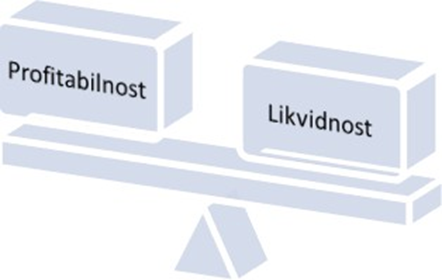
Source: adapted from Balaban (2022)
There are two different approaches that theoretically explain the relationship between liquidity and profitability. According to the first approach, a higher level of liquidity leads to an increase in costs, i.e. high opportunity costs, which can have a negative impact on profitability. However, this impact is likely to be short- lived. Hirigoyen (1985) found that in the medium to long term there is a possibility of a positive relationship between liquidity and profitability because low liquidity would cause low profitability, since it results in more loan requests and insufficient cash flow. Similarly, Hollmayr and Kühl (2019) believe that active liquidity management has a positive impact on profitability, while Bakić and Petković (2020) claim that both liquidity and profitability are equally important components for the existence of the company and the maximization of the company's value (Knauer, 2013). Namely, a higher level of liquidity is a positive indicator of the company's financial condition, and although in the short term, a higher level of liquidity can have a negative impact on profitability, in the medium and long term it will increase the profitability of the company and minimize the risk of bankruptcy. Gonçalves and authors (2018) consider that finding a balance between profitability and liquidity is one of the main challenges of managing business finances. In this regard, the subject of research in this paper is the analysis of the relationship between liquidity and profitability of companies in the processing sector in the Republic of Serbia, while the goal is to quantitatively determine the impact of liquidity on the profitability of the observed companies. In accordance with the available theoretical and empirical literature, the following hypotheses were set:
H 1: There is a direct relationship between liquidity and profitability
H 2: A higher level of liquidity implies a lower level of profitability
H 3: There is an optimal level of liquid assets for each company.
The majority of available empirical research proved the existence of a relationship between liquidity and profitability (table 1), and the first hypothesis was formed in accordance with this fact. Although the available theoretical literature indicates a long-term positive relationship between liquidity and profitability, our assumption is that a higher level of liquid assets implies a lower rate of profitability. We were led to this assumption, i.e. the definition of the second hypothesis, by studies that analyzed the mentioned relationship on the example of companies in the environment (Raykov, 2017; Vuković and Jakšić, 2019). The results of a study conducted by Korent and Orsag (2018) imply the existence of a relationship between net working capital and return on assets. This indicates the existence of an optimal level of net working capital, that is, in our case, liquid assets that balance costs and benefits and maximize the profitability of the analyzed companies. In accordance with the mentioned results, the third hypothesis was defined. In every company, the level of working capital should be optimized, which entails the need to maintain a balance between two seemingly opposite goals, profitability and liquidity (Van Horne and Wachowicz, 2009; Bieniasz and Gołaś, 2011; Gołaś, 2020).
Literature review
The relationship between liquidity and profitability has attracted the attention of a large number of authors, and the results of a certain number of empirical studies are presented in Table 1.
As can be seen from the table, most authors applied regression and/or cointegration to panel data, i.e. the observed sample of a larger number of companies. What is clear is that there is no consensus regarding the ratio of liquidity and profitability of the company. In this regard, the goal of this paper is to quantitatively determine the impact of liquidity on the profitability of companies in the processing sector in the Republic of Serbia, which also represents the scientific contribution of this paper.
Table 2: Results of previous empirical studies
|
Author(s) |
A sample |
Period of time |
Methodology |
Results |
|
Mazanec (2022) |
3828 transport companies from the Visegrad Group countries |
in 2019 |
Correlation and regression |
Different results |
|
Milošev (2021) |
367 non-financial companies from the Republic of Serbia |
2016- 2019 |
PCSE |
A positive relationship |
|
Kryszak et al (2021) |
477 farms from the EU |
2007- 2018 |
SYS-GMM |
There is no relationship |
|
Högerle et al. (2020) |
115 companies listed on FSE |
2011- 2017 |
Regression |
A positive relationship |
|
Gołaś (2020) |
Dairies in Poland |
2008- 2017 |
Regression |
Negative relationship |
|
Seth and the Authors (2020) |
563 Indian manufacturing companies |
2008- 2018 |
FE regression |
Negative relationship |
|
Al-Homaidi and authors (2020) |
2154 Indian companies |
2010- 2016 |
Regression |
Different results |
|
Olaoye (2020) |
Food companies listed on NSE |
2014- 2018 |
Regression and correlation |
There is no relationship |
|
Lee et al (2020) |
15 non-financial companies listed on the GSE |
2008- 2017 |
Cointegration |
Negative relationship |
|
Yameen and the Authors (2019) |
82 pharmaceutical companies listed on BSE |
2008- 2017 |
Regression |
A positive relationship |
|
Alsulayhim (2019) |
67 companies listed on SSE |
2007- 2016 |
Regression and cointegration |
A positive relationship |
|
Hossain and Alam (2019) |
6 companies from the cement industry listed on the DSE |
2013- 2017 |
Pearson correlation |
Negative relationship |
|
Wren and the Authors (2019) |
Listed Chinese manufacturing companies |
2010- 2017 |
FE regression |
Negative relationship |
|
Vuković and Jakšić (2019) |
9883 food companies from Southeast Europe |
2010- 2014 |
Probit regression |
Negative relationship |
|
Asche et al. (2018) |
Norwegian salmon farms |
2000- 2014 |
Cointegration and regression |
There is no relationship |
|
Corent and Orsag (2018) |
442 Croatian IT and consulting companies |
2008- 2013 |
Cointegration and regression |
Negative relationship |
|
Alom (2018) |
Non-financial companies listed on the DSE |
1998- 2013 |
Cointegration |
A positive relationship |
|
Gonçalves and Authors (2018) |
400 large and medium- sized companies from the UK that are not listed on the stock exchange |
2006- 2014 |
Regression |
A positive relationship |
|
Nanda and Panda (2018) |
173 manufacturing companies listed on BSE |
2000- 2015 |
Panel GLS i VAR |
A positive relationship |
Source: author's systematization
Table 1- continued: Results of previous empirical studies
|
Author(s) |
A sample |
Period of time |
Methodology |
Results |
|
Boțoc and Anton (2017) |
937 fast growing companies from Central, Eastern and Southeastern Europe |
2006- 2015 |
GMM |
Negative relationship |
|
Evci and Sak (2017) |
41 companies listed on BIST |
2005- 2016 |
Regression |
Negative relationship |
|
Raykov (2017) |
20 companies listed on the BSE (Bulgarian SE) |
2007- 2015 |
Cointegration and regression |
Negative relationship |
|
Al-Jafari and Al Samman (2015) |
17 industrial companies listed on MSM |
2006- 2013 |
Regression |
Negative relationship |
|
Kandpal (2015) |
10 Indian Infrastructure Companies |
2007- 2015 |
Correlation and regression |
Different results |
Source: author's systematization
Data and methodology
The sample consists of 100 companies in the processing sector with the highest level of business income from the territory of the Republic of Serbia, and the time frame of the research is the period from 2016 to 2020. When considering the impact of liquidity on company profitability, most empirical studies used the regression model (table 1), so the authors opted for the regression model assessment. Following Milošev (2021), Nanda and Panda (2018), Gonçalves and authors (2018) and Knauer and Wöhrman (2013), the ROA indicator was used as a measure of profitability in the paper. As a measure of liquidity, the indicator of accelerated liquidity was used, since only liquid funds can be used in a relatively short period of time to settle the assumed short-term obligations of the company. The same measure of liquidity was used by Milošev (2021), Boțoc and Anton (2017), as well as Raykov (2017). In order to obtain relevant results, control variables were entered into the regression model. In this regard, the following regression model was evaluated:
whereby:-  net return on assets, i.e. a measure of the company's profitability,
-  the ratio of debt to capital, i.e. a measure of the company's indebtedness,
-  the duration of the business cycle, i.e. the approximation of the success of working capital management,
-  the capital turnover ratio, i.e. the indicator of the company's activity i
-  the first difference of the natural logarithm of the asset value, i.e. a measure of the size of the company,
 - section, varies among individual units of observation, but is constant over time. It consists of a constant part
  and an error term for individual observation units
  ,
,
 – model error.
Descriptive statistics of the observed variables of 100 processing companies with the highest level of business income in the Republic of Serbia in the period from 2016 to 2020 are presented in Table 2.
Table 2: Descriptive statistics
|
|
ROA |
CHARACTER |
DEBT |
WCM |
ACT |
SIZE |
|
Mean |
0.076713 |
1.325527 |
2.741983 |
75.23207 |
4.569831 |
9.902181 |
|
Median |
0.069500 |
0.900000 |
1.000000 |
54.00000 |
2.400000 |
9.924504 |
|
Max |
0.591000 |
11.60000 |
159.3000 |
651.0000 |
124.7000 |
10.99446 |
|
Min |
-0.631000 |
0.000000 |
0.000000 |
-669.0000 |
0.400000 |
8.455786 |
|
St. Dev. |
-0.110303 |
1.392566 |
9.341054 |
123.3299 |
8.955761 |
0.392289 |
Source: author's calculation based on APR data, EViews program
Results of work with discussion
Correlation analysis was conducted in order to detect the possible problem of multicollinearity that can lead to a wrong interpretation of the estimated parameters. Based on Table 3, it can be concluded that there is no correlation between the observed independent variables, which implies the absence of multicollinearity in the estimated regression model.
In order to test the stationarity of the observed variables, unit root tests (Levin, Lin, Chu and IPS test) were conducted. In order to determine whether it is appropriate to apply the unit root test of the first or second generation to the observed variables, an interdependence test (Pesaran CD test) was also conducted, and the results of the obtained tests are shown in table 4.
Table 3: Correlation matrix
|
|
ROA |
CHARACTER |
DEBT |
WCM |
ACT |
SIZE |
|
ROA |
1.000000 |
0.215900 |
-0.189275 |
0.053742 |
0.176536 |
-0.070089 |
|
CHARACTER |
0.215900 |
1.000000 |
-0.139458 |
0.249664 |
-0.057682 |
-0.058240 |
|
DEBT |
-0.189275 |
-0.139458 |
1.000000 |
-0.029278 |
-0.061399 |
0.003790 |
|
WCM |
0.053742 |
0.249664 |
0.249664 |
1.000000 |
-0.256425 |
0.114399 |
|
ACT |
0.176536 |
-0.057682 |
-0.061399 |
-0.256425 |
1.000000 |
-0.503348 |
|
SIZE |
-0.070089 |
-0.058240 |
-0.003790 |
0.114399 |
-0.503348 |
1.000000 |
Source: author's calculation based on APR data, EViews program
Table 4: Interdependence test and unit root tests
|
Test/ Variables |
Pesaran CD |
Levin, Lin and Chu |
IPS |
|||
|
none |
individual intercept |
in. intercept and trend |
individual intercept |
in. intercept and trend |
||
|
ROA |
0.715861 (0.4741) |
-8.93573 (0.0000) |
-31.3427 (0.0000) |
-24.3550 (0.0000) |
-10.4610 (0.0000) |
-11.1931 (0.0000) |
|
CHARACTER |
-0.970247 (0.3319) |
-6.67467 (0.0000) |
1.239930 (0.8924) |
-96.6276 (0.0000) |
-2.73695 (0.0031) |
-9.0e+11 (0.0000) |
|
DEBT |
0.851633 (0.4012) |
-15.8839 (0.0000) |
-0.07486 (0.4702) |
-318,283 (0.0000) |
-2.8e+14 (0.0000) |
-7.1e+13 (0.0000) |
|
WCM |
1.560188 (0.1187) |
-3.93235 (0.0000) |
-110,476 (0.0000) |
-63.4740 (0.0000) |
-14.2062 (0.0000) |
-5.41119 (0.0000) |
|
ACT |
1.274329 (0.2057) |
-17.3259 (0.0000) |
-337,830 (0.0000) |
-83.5527 (0.0000) |
-37.0798 (0.0000) |
-1.9e+12 (0.0000) |
|
dSIZE |
-0.813611 (0.4159) |
-10.8386 (0.0000) |
-7.54897 (0.0000) |
|
|
|
Source: author's calculation based on APR data, EViews program
Note: Pesaran CD test of interdependence – H 0: There is no interdependence; Levin, Lin and Chu unit root test – H 0: There is an individual unit root; IPS unit root test – H 0: There is a common unit root.
Based on the obtained results from Table 4, it can be concluded that there is no interdependence in the individual observed variables, which implies the use of unit root tests of the first generation. The authors opted for the Levin, Lin and Chu test and the IPS test, since the mentioned tests have different null hypotheses and can serve as checks against each other. Based on the conducted unit root tests (table 4), it can be claimed that all the observed variables, except the size of the company, are stationary. The variable expressing the size of the company is stationary in the first differentiator, so it will be included in the model as such.
The Hausman test shows that it is adequate to use a regression model with fixed effects. The results of the performed FE regression are presented in Table 5.
Judging by the obtained results, liquidity has no influence on the profitability of the largest companies in the processing sector in the Republic of Serbia, which implies that there is no direct connection between profitability and liquidity, as well as that there is no optimal amount of cash and cash equivalents that would enable the maximization of the net return on assets.
Table 5: Estimated regression model with fixed effects
|
Variables |
Coefficient |
Probability |
|
c |
0.049238 |
0.0001 |
|
CHARACTER |
0.005319 |
0.4263 |
|
DEBT |
-0.005652 |
0.0001 |
|
WCM |
-6.01e-05 |
0.4351 |
|
ACT |
0.005794 |
0.0007 |
|
dSIZE |
0.302544 |
0.0000 |
|
Effect specification |
||
|
R-squared |
0.688366 |
|
|
Adjusted R-squared |
0.575246 |
|
|
F-statistic |
6.085280 |
|
|
Prob (F-statistic) |
0.000000 |
|
Source: author's calculation based on APR data, EViews program
Profitability, expressed by the ROA indicator, is not even related to the length of the business cycle of the observed companies. On the other hand, the higher indebtedness of companies in the processing sector in the Republic of Serbia negatively affects the profitability of the company, while the faster capital turnover and larger company assets have a positive impact on the net return on assets in the observed period.
Conclusion
There is no single opinion on the relationship between the company's liquidity and profitability. According to one approach, the relationship between the two variables is negative, since higher liquidity requires a higher level of opportunity costs and discourages new investment. However, some authors claim that this relationship is present only when two variables are observed in the short term. In the long and medium term, liquidity and profitability move in the same direction. In other words, companies that have liquidity problems in the medium and long term cannot be profitable. In this regard, the goal of this paper is to quantitatively determine the impact of liquidity on the profitability of 100 companies in the processing sector in the Republic of Serbia with the highest level of business income observed in a five-year period.
Initial hypotheses were formed on the basis of available theoretical and empirical literature and tested on panel data with the help of regression with fixed effects. The obtained results indicate that there is no direct connection between indicators of accelerated liquidity and net return on assets when the observed companies are concerned, which implies that it is not possible to determine the optimal amount of cash and cash equivalents that would enable the maximization of net return on assets. There is no direct connection between profitability and the length of the business cycle of the observed companies. It can be argued that a faster turnover of capital results in a higher level of profitability, as well as the growth of the company's assets. On the other hand, higher indebtedness has negative implications for the profitability of companies in the processing sector.
The results of the conducted research have significant implications for the financial management of companies in the processing sector in the Republic of Serbia in order to make adequate business decisions when it comes to increasing profitability. The obtained results can be useful to the financial sector when making decisions on granting loans to companies in the processing sector, as well as to the competent institutions that provide support to the enterprises under review.
Suggestions for future research refer to the use of alternative measures of certain indicators of financial analysis, primarily liquidity and profitability, in order to make the obtained results even more reliable. The second suggestion refers to the extension of the observation period, since the relatively weak public availability of time series data (five-year period) of financial statements can be cited as a limitation of this study.
References
2. Al-Jafari, MK and H. Al Samman. 2015. Determinants of Profitability: Evidence from Industrial Companies Listed on Muscat Securities Market, Review of European Studies; 7(11): 303-311.
https://doi.org/10.5539/res.v7n11p303
3. Alsulayhim, N. 2019. The Relationship between Working Capital Management and Profitability, International Business Resesarch, 12(8) https://doi.org/10.5539/ibr.v12n8p142
4. Alom. K. 2018. Liquidity and Profitability: A Co-Integration Study, Review of Pacific Basin Financial Markets and Policies 21(2) https://doi.org/10.1142/S021909151850011X
5. Asche, F., M. Sikveland, and D. Zhang. 2018. Profitability in Norwegian salmon farming: the impact of firm size and price variability Aquaculture Economics and Marketing 22: 306-317.
https://doi.org/10.1080/13657305.2018.1385659
6. Bakić, S. and Z. Petković. 2020. Position of banks from the aspect of analysis of financial indicators. Auditor 2.
https://doi.org/10.5937/Oditor2002039B
7. Balaban, S. 2022. Business finance. Alfa BK University. White City. ISBN: 978-86-6461-052-0
8. Bieniasz, A. and Z. Gołaś. 2011. The Influence of Working Capital Management on the Profitability of Food Industry Enterprises. Contemporary Economics 5(4): 68-81. https://doi.org/10.5709/ce.1897-
9254.29
9. Bigio, S. 2015. Endogenous Liquidity and the Business Cycle. The American Economic Review 105(6): 1883-1927.
https://doi.org/10.1257/aer.20110035
10. Boțoc, C. and SG Anton. 2017. Is profitability driven by working capital management? Evidence for high-growth firms in emerging Europe. Journal of Business Economics and Management 18(6): 1135-1155. https://doi.org/10.3846/16111699.2017.1402362
11. Evci, S. and N. Šak. 2017. The Effect of Working Capital Management on Profitability in Emerging Countries: Evidence from Turkey. In G. Kucukkocaoglu and S. Gokten (Eds.), Financial Management from an Emerging Market Perspective. IntechOpen. https://doi.org/10.5772/intechopen.70871
12. Gołaś Z. (2020) Impact of working capital management on business profitability: Evidence from the Polish dairy industry. Agricultural Economic – Czech, 66: 278–285. https://doi.org/10.17221/335/2019- AGRICECON
13. Gonçalves, T., C. Gaio, and F. Robles. 2018. The impact of Working Capital Management on firm profitability in different economic cycles: Evidence from the United Kingdom. Economics and Business Letters, 7
(2): 70-75. https://doi.org/10.17811/ebl.7.2.2018.70-75
14. Hirigoyen, G. 1985. Rentabilité et solvabilité. Direction et Gestion 3:13- 26.
15. Hossain, I. and J. Alam. 2019. The Relationship between Liquidity and Profitability in Emerging Countries: Evidence from Bangladesh. Journal of Finance and Accounting 7(1): 22-27. https://doi.org/10.12691/jfa-7-1-4
16. Hollmayr, J. and M. Kühl. 2019. Learning about Bank's Net Worth and the Slow Recovery after the Financial Crisis. Journal of Economic Dynamics and Control 109(8). https://doi.org/10.1016/j.jedc.2019.103776
17. Högerle, B., M. Charifzadeh, M. Ferencz, and KB Kostin. 2020. The development of working capital management and its impact on profitability and shareholder value: evidence from Germany. Strategic Management 25(2): 27-39. https://doi.org/10.5937/StraMan2002027H
18. Kandpal, V. 2015. An Analysis of Working Capital Management in Selected Construction Companies. Journal of Commerce and Management Thought, 6(1): 7-31. https://doi.org/ 10.5958/0976-478x.2015.00001.4
19. Knauer, T. and A. Wöhrmann. 2013. Working capital management and firm profitability. Metrics: International Journal for Theoretical and Applied Statistics 24(1): 77-87. https://doi.org/ 10.1007/s00187-013-0173-
3
20. Korent, D. and S. Orsag. 2018. The Impact of Working Capital Management on Profitability of Croatian Software Companies. Zagreb International Review of Economics and Business 21(1): 47-66. https://doi.org/10.2478/zireb-2018-0007
21. Kryszak Ł., M. Guth, and B. Czyżewski. 2021. Determinants of farm profitability in the EU regions. Does farm size matter? Agricultural Economic – Czech, 67: 90–100. https://doi.org/10.17221/415/2020- AGRICECON
22. Lang, M. and M. Maffett. 2011. Transparency and Liquidity Uncertainty in Crisis Periods. Journal of Accounting and Economics, 52(2): 101-125. https://doi.org/ 10.1016/j.jacceco.2011.07.001
23. Li, K., M. Mohammed, Y. Kong, IA Mensah, SK Antwi, J. Bawuah, M. Donkor, CPK Coffie, and AA Osei. 2020. Liquidity and Firms' Financial Performance Nexus: Panel Evidence From Non-Financial Firms Listed on the Ghana Stock Exchange. SAGE Open. doi:10.1177/2158244020950363
24. Madhou, A, I. Moosa, and V. Ramiah. 2015. Working capital as a determinant of corporate profitability. Review of Pacific Basin Financial Markets and Policies 18(4): 1–17. https://doi.org/10.1142/S0219091515500241
25. Mazanec, J. 2022. The Impact of Working Capital Management on Corporate Performance in Small–Medium Enterprises in the Visegrad Group. Mathematics 10. https://doi.org/10.3390/math10060951
26. Milošev, I. 2021. The Impact of Working Capital Management on Profitability of Large Firms in Serbia. Business Economics 2: 1-18. https://doi.org/10.5937/poseko20-34263v
27. Nanda, S. and AK Panda. 2018. The determinants of corporate profitability: an investigation of Indian manufacturing firms. International Journal of Emerging Markets 13(1): 66-86. https://doi.org/10.1108/IJoEM- 01-2017-0013
28. Olaoye AA 2020. Impact of Liquidity Management on Profitability of Selected Companies in Nigeria. Journal of Economics & Management Research. 118. https://doi.org/ 10.47363/JESMR/2020(1)112
29. Ren, T., N. Liu, H. Yang, Y. Xiao, and Y. Hu. 2019. Working capital management and firm performance in China. Asian Review of Accounting 27(4): 546-562. https://doi.org/10.1108/ARA-04-2018-0099
30. Raykov, E. 2017. The Liquidity – profitability trade-off in Bulgaria in terms of the changed financial management functions during crisis. Management 22(1): 135-156.
https://doi.org/10.30924/mjcmi/2017.22.1.135
31. Samonas, M. 2015. Financial Forecasting, Analysis, and Modelling. John Wiley & Sons Ltd. ISBN: 978-1-118-92109-8
32. Seth, H., S. Chadha, N. Ruparel, PK Arora, and SK Sharma. 2020. Assessing working capital management efficiency of Indian manufacturing exporters. Managerial Finance 46(8): 1061-1079.
https://doi.org/10.1108/MF-02-2019-0076
33. Van Horne, JC and JM Wachowicz. 2009. Fundamentals of Financial Management. 13 th Edition. Pearson
34. Vržina, S. and M. Dimitrijević. 2020. Determinants of profitability of the agricultural sector of Vojvodina: the role of corporate income tax. The European Journal of Applied Economics 17(1): 1-19.
https://10.5937/EJAE17-21368
35. Vuković, A., D. Riznić and A. Jevtić (2021) Impact of the COVID-19 pandemic on economic development, Ecologica 28(104): 565-572.
36. Vuković, B. and D. Jakšić. 2019. The effect of working capital management on profitability evidence from Southern Europe. Economics of Agriculture 66(1): 159-172. https://doi.org/10.5937/ekoPolj1901159V
37. Yameen, M., N. Farhan, and M. Tabash. 2019. The Impact of Liquidity on Firms' Performance: Empirical Investigation from Indian Pharmaceutical Companies. Academic Journal of Interdisciplinary Studies 8(3): 212-230. https://doi.org/ 10.36941/ajis-2019-0019
38. Zečević, M., M. Joksimović and Balaban, S. (2022) Impact of the Covid- 19 pandemic on international commodity flows, Ecologica 29(107): 440-
448. DOI:10.18485/ecologica.2022.29.107.19
Published in
Vol. 9 No. 2 (2023)
Keywords
🛡️ Licence and usage rights
This work is published under the Creative Commons Attribution 4.0 International (CC BY 4.0).
Authors retain copyright over their work.
Use, distribution, and adaptation of the work, including commercial use, is permitted with clear attribution to the original author and source.
Interested in Similar Research?
Browse All Articles and Journals