
VELIKE AGRARNE REFORME U SVETU

Apstrakt
Agrarne reforme predstavljaju postupak redistribucije agrarnih resursa jedne zemlje. Cilj rada je da ukaže na značaj i potrebu agrarnih reformi u socijalnom, ekonomskom i političkom kontekstu. U radu se koriste istorijske i analitičke metode, kao i komparativne metode, a uzete su agrarne reforme koje su sprovedene u carskoj Rusiji, Kraljevini SHS i Federativnoj Narodnoj Republici Jugoslaviji. Sublimirani su svi efekti i rezultati ovih agrarnih reformi, sa opštim zaključkom da su one donele korenite promene u oblasti poljoprivredne delatnosti, oporezivanja, kreditiranja, rentiranju i osnivanju zemljoradničkih zadruga.
Članak
Introduction
Agrarian reforms imply the application of legal and political measures, undertaken by the state, in order to redefine the ownership of agricultural land, in terms of the way it is used. The aim of these measures is to establish social justice on the one hand and more efficient production and political stability on the other. Predominantly, reforms in this area imply redistribution of property over agricultural land. They are directed against landowners and those who have accumulated large land holdings, to the detriment of smaller ones. Throughout history, examples of agrarian reforms have involved the reduction of manorial holdings, which were parceled into smaller plots of land, which were allocated to individual agricultural producers. Often, such reforms were implemented without compensation or with some symbolic compensation, and less often with full compensation of the real market price of the land.
Judging from past practice throughout history, agrarian reforms consisted of restrictions or confiscation of large land holdings. The so-called the maximum amount of land that an agricultural owner could have. Expropriations were generally carried out with some symbolic compensation, and often without it. Many reforms were aimed at allocating land to farmers, small farmers who would properly cultivate the same land. It was about small, individual agricultural producers, possibly agricultural farms owned by one family.
The opposite process from expropriation is consolidation, which implies consolidation of land holdings that have been divided into smaller land units. In the past, nationalization also occurred, which meant that the state took ownership of land holdings from private individuals (Samardžić, 2014).
The basis for the implementation of agrarian reforms is found in the legal regulations and acts of the legislative authority. Reforms must be clearly defined and governed by legal acts, which prescribe what the goal is and what is to be achieved through the reform process. The main goal is to reduce economic and social inequalities, create a better atmosphere and reduce dissatisfaction among neighboring agricultural producers, increase productivity in agricultural production and create a politically stable situation.
Aim
The aim of the work is reflected in the intention of pointing out the major agrarian reforms that have been implemented throughout history in the world, with a special reference to the reforms in the Kingdom of SHS and Yugoslavia. For the sake of comparison, an account of agrarian reforms in imperial Russia is given. It strives to determine the legal, economic, social, political and other effects achieved by the reform processes. The predominant goals of agrarian reforms can be manifested in reducing inequality among landowners, achieving social stability in rural areas, encouraging the productivity of agricultural activity, reducing dissatisfaction among agricultural producers, who express loyalty to government structures, as well as the introduction of new techniques in the process of agricultural production, which modernizes agriculture.
Methodological framework
In preparing this work, the authors used historical, comparative, analytical and inductive methods. The paper analyzes the major agrarian reforms that took place in history during the 19th and 20th centuries. In this context, socio-political relations, international relations and the legal-economic basis of reforms are observed. The comparative method is reflected in the process of comparing the achieved economic and legal effects of agrarian reforms, which were previously observed from the mentioned aspects. For the application of the comparative method, the effects achieved by the reforms, both in the short and long term, are particularly relevant.
By applying the analytical method, broader aspects of applied agrarian reforms in the observed societies are analyzed. Similarities, as well as differences, can be observed in all analyzed cases, the positive and negative sides of the implemented reforms are highlighted.
Finally, by applying the inductive method, general conclusions are drawn from individual analyzed cases from the Kingdom of SHS, post-war Yugoslavia, imperial Russia, which are generally applicable to all agrarian reforms in the past.
Imperial Russia
Thanks to the victory it achieved with the help of its allies against Napoleon, Russia managed to establish a dominant role in the politics of the 19th century. Russia's dominance was first of all manifested in the fact that Alexander I Romanov was declared the savior of Europe, which in the following period opened up the possibility for him to be the creator of European destiny, presiding at the Congress of Vienna (1814-1815). Although the Russian Empire apparently played a key role in the politics of the 19th century, the retention of serfdom contributed to the decline of its further economic development, while, on the other hand, the countries of Western Europe grew economically in the process of the industrial revolution that began in the 18th century. Russia's status as a great power was further challenged by the failure of the government, the isolation of the Russian people, and certainly the aforementioned economic decline.
The official Russian government announced that Tsar Alexander I Romanov died suddenly in 1825 at the age of 48 in a small town by the Sea of Azov. The British ambassador's view that Alexander I signed the abdication after allegedly seeing him board a ship as a common sailor. That and many stories about the emperor's mysterious death created a myth that later forced Russian scientists to stand in his way, but to everyone's surprise, the coffin in which Alexander I was supposedly buried was empty. In a situation of such vague mysteries, an incomparably less liberal ruler, Nicholas I, came to power, who additionally strengthened absolutism and built an authoritarian state out of Russia. The beginning of his reign was very difficult, because there was an uprising, and the background of this uprising lay in the Napoleonic Wars, when a large number of officers participated in military campaigns in Europe, where they "became infected" with the liberal ideas of Western Europe. The result of these influences was the uprising known as the Decembrist uprising in December 1825, which was suppressed in blood. Tsar Nicholas I Romanov was afraid of any revolutionary movement, not only in Russia but also beyond. This is evidenced by the significant help he provided to Austria during the Hungarian revolution in 1849. On the other hand, Tsar Nicholas I also saw the problems associated with a large number of serfs, and supported efforts to free them. The first task was reflected in the clear definition of the problem and the formation of a plan, ideas and attitudes for solving them (Bursać; Glumac 2017).
First, he reduced the serf problems into two clear groups: 1) The serf dependence of the peasants on the spahi and 2) The legal - economic dependence of the state serfs. The next step he took was the draft on the optional liberation of the serfs, of course according to the agreement formulated by the serfs in accordance with the species. And that was about the maximum that Tsar Nicholas I dedicated to this issue, the government did continue solving this problem, but it all came down to very weak support for serfs, which was reflected in: 1) Prohibition of selling serfs without land; 2) Limited right to send serfs to captivity in Siberia; 3) The method of freeing serfs was improved, but not intensified (Ivanovič 2001).
Substantial attempts to further reform the Russian Empire ended when Tsar Nicholas I entered the war in 1848 and provided assistance to Austria in the fight against the Hungarian rebels. In addition, it was obvious that Tsar Nicholas I led an extremely anti-Turkish policy, which was met with resistance from the great powers, and there was a defeat in the Crimean War (1853-1856), which ended with the Peace of Paris in 1956, by which Russia lost part of Bessarabia, lost the right to keep a fleet in the Black Sea and the right to protect all Christians in the Ottoman Empire.
The successor of Nicholas I Romanov is Alexander II Romanov, the most progressive Russian emperor, who abolished the right of feudal lords to own serfs in 1861, which partially led to the abolition of feudalism, thus beginning a period of reform but also the awakening of extreme action on Russian territory. Emperor Alexander II was ready to defend the autocratic rule and the interests of its main support, i.e. the nobility. On the other hand and at the same time, he was imbued with pity for the popular masses and above all aware that without fundamental changes and reforms the Russian Empire would not survive for long.
The reform tendency was getting stronger, and it should be taken into account that at that time there were 23 million serfs with absolute rights in Russia. Therefore, this question was, to say the least, of special importance for the further survival and development of the Russian Empire. So, upon coming to power, Alexander II had an extremely difficult task, which was reflected in one clear position: either he would abolish serfdom or serfdom would be abolished with the help of a general popular revolution.
On February 19, 1861, Emperor Alexander II officially signed the famous proclamation of national liberation, and on March 5, the proclamation was announced to the people (Khristoforov, 2022). Before that, the emperor inserted a paragraph, on the basis of which the peasants, in agreement with the spahis, could receive the so-called "beggar's share" and thus get rid of other obligations towards the former masters, while receiving a quarter of the land they had before. On the other hand, it can be concluded that this measure significantly reduced the already small area of peasant land, thus becoming one of the main causes of the later agrarian problem, thus slowing down further economic progress (Mihailović 1995).
In this period, there were many Spahian serfs in Russia, about 21,000,000 agricultural serfs, 1,500,000 "courtiers", i.e. household servants of the nobility, 4,700,000 serfs of the imperial house and 20,000,000 state serfs. The essence of the reform was as follows: 1) Servants (courtiers) were given simple freedom with the obligation to serve two more years, but their economic position after the reform was catastrophic because they had neither a house, nor land, nor were they skilled in any craft; 2) The peasant's house and garden with outbuildings were handed over to them with a certain tribute, but even that could be turned into their property with the help of a contract between the nobles and the peasants; 3) Village municipalities so-called "peaces" (mainly in the Great Russian governorates) and families (mainly in the Little Russian and Belorussian governorates) received with a certain tribute the land that they had cultivated until then, but they could also buy it with the help of the state; 4) The relations between the nobility and the spahiluk were regulated by a voluntary agreement with the mediation of a special government confidant, but later the forced liquidation of peasant-noble relations was carried out wherever they were not regulated on a voluntary basis; 5) Peasants preserved their customary law, class self-governance was subsumed into municipalities, municipalities were subsumed into larger areas so-called "volosti", with an elected elder, and a court that resolves peasant civil lawsuits and minor criminal cases (Jelačić 1929).
The reforms of Tsar Alexander II greatly helped Russia, but also produced new social strata such as the citizenry, the intelligentsia, and the free peasantry. Two camps "Slavophiles" and "Westerners" were formed, which differed in that the Westerners, at least the majority of them, advocated that Russia follow in the footsteps of Western Europe, considered Western laws and institutions as a model that Russia should emulate, while the Slavophiles doubted the truth of Western educational principles, the validity of morality and society, and the applicability of the institutions of Western countries to Russia. They drew their science from memories of Russia before Peter the Great, dividing their sympathies between ancient Moscow and Kiev. Russia had accepted Christianity in the form of Universal Orthodoxy, and it always remained under the protection of the Universal Church, so it also received classical education thanks to the Church (Dušanić 1996).
During the first years of the "great reforms", the followers of Slavophiles and Westerners went in three political directions: conservative, liberal and socialist. Socialist, with the significant participation of some Westerners, and to a large extent Herzen, occupied a very valued place in Russian ideological development. At the time of these reforms, the first public opinion, partial freedom of the press and, therefore, a group of people living from intellectual work were created in Russia. Cooperatives, lawyers, and local self-government appeared, which opened the doors to a large number of intellectuals, which allowed the entry into public life of the intelligentsia, which was considered a class of "various professions" without pedigree, but they were neither peasants, nor priests, nor merchants, but significant advocates of socialist thought.
The peasantry did not protest, although they were very dissatisfied. It considered that a burden was imposed on him in favor of the nobility and that the division of land was made to their detriment, and that they should not pay anything, because they are the real owners of the land and that the existence of spahiluks is a great injustice. Nevertheless, in spite of everything, they are by conviction monarchists, the ideal of a great, Orthodox self-sustaining emperor lives in them, and they believe that the Tsar-Baćushka was deceived and captured by the nobility.
Kingdom of Serbs, Croats and Slovenes
In the Kingdom of Serbs, Croats and Slovenes (SHS), which was founded on December 1, 1918, there was a strong need to implement radical agrarian reforms, with the clear goal of abolishing feudal relations (Aleksić, 2025). Among the rural population, oriented towards agricultural production, there was hope and expectation that their status would be improved through reform efforts. In particular, there were great expectations from the process of colonization of Vojvodina, which directly resulted in the confiscation of land estates from those who were loyal to Austria-Hungary and their allocation to poor peasants for cultivation and use.
The data, which date back to before the First World War, indicate rough guidelines on the type and quantity of land holdings, which were then, in the agrarian reform implemented during the SHS Kingdom, confiscated from "suspicious" landowners, mostly Austro-Hungarian counts and prominent citizens. It is about the following facts: 39 thousand cadastral acres were taken from Count Čekonjić (one cadastral area equals 5,455 square meters); 33 thousand cadastral acres to Count Kotek; 25 thousand cadastral acres to Prince Odeskalko; 25 thousand karastar acres to Count Elc; 24 thousand cadastral acres to Count Karačonji; 21,600 cadastral acres to Count Felix Hernkurt; 15,600 cadastral acres to Count Pejačević; 13,800 cadastral acres to the Lelbach family, 10,500 cadastral acres to Maria Sechenja; 9,700 cadastral acres to the Latinović family; 8 thousand cadastral acres to Count Baćanji; 8 thousand cadastral acres to Count Janos Ziča; Arthur in Carl Lederer 7,800 cadastral acres; Gedeon Dunđerski 7 thousand cadastral acres; 4,500 cadastral acres were confiscated from Djokovic Dunđerski and 4 thousand cadastral acres from Lajos Redl (Gulan 2021).
The reform was based on a promise made during the war, which was supposed to be an incentive for the Serbian peasant to fight for his homeland. The promise was that every volunteer - a fighter, especially from Vojvodina, would receive 8 cadastral acres, that is, if he was not a fighter, 5 cadastral acres (Drakić 2014). The basis for the agrarian reform carried out in this way in the area of Vojvodina was the thesis that smaller land holdings are better and are cultivated more efficiently. Of course, the reform had a political basis and favored attitudes that glorified the working and peasant classes and were in favor of dealing with the landowners and Austro-Hungarian subjects.
The ideas of major agrarian reforms were born even before the First World War, at the People's Council in Zagreb, when it was first heard that serfdom and landed estates should be abolished. The land was to be distributed to the poor peasantry, with fair compensation to the former owners (Mutapčić 2011). In February 1919, these ideas were translated into the Preliminary Provisions for the Preparation of Agrarian Reform, adopted by the Government, which represent the legal basis and at the same time the mechanism for the implementation of reforms. They set the basic principles of reforms, namely: 1) abolition of serf and peasant relations in Bosnia and Herzegovina, Macedonia, Montenegro and Kosovo and Metohija; 2) serfs and peasants receive the status of free owners of land holdings; 3) previous landowners receive compensation, and until a decision is made, they have the right to rent in the amount of the previous rents; 4) abolition of colonial relations; 5) large estates are expropriated. We are talking about estates larger than 100 cadastral acres, indivisible family estates with one heir each, and the quality of the land and local circumstances were additionally taken into account; 6) the property of the Austro-Hungarian monarchy, as well as the property that individuals received from it in the name of various merits, were especially targeted by the reforms. These possessions were confiscated without any compensation (Gaćeša 1967).
The aforementioned measures were mostly aimed at large land holdings, which needed to be divided. Previously, it was necessary to pass legal acts and court rulings, which would give this procedure additional legitimacy. The goal of the reforms was to satisfy the poor peasantry and agricultural producers, who did not have enough land to cultivate. Particularly privileged were the participants in the war, the fighters, but also the widows and families of the participants who died in the war. Certainly, the reform also had a strong political background, because it aimed to win over the rural strata of the population and their loyalty.
The agrarian reform was implemented most quickly and efficiently in the territory of Bosnia and Herzegovina, and it is considered completed already in 1921. The land was divided into smaller serfdoms, and thus 113 thousand serfs got their own estates. The old owners received compensation in the total amount of 65 million dinars and about 130 million in bonds. On later occasions, pastures and meadows were divided, and this procedure was officially ended in 1933 (Gaković 1970).
In Kosovo and Metohija, as well as in Montenegro, the land was largely abandoned after the First World War due to the marked emigration of the local population. As a result, uncertainty arose because it was not known who the real owner of the land was. The process of taking these possessions began in 1931, and these possessions were assigned to chifchis for a period of ten years. The compensation that was determined for the old owners was 840 dinars per acre.
In the area of Kosovo and Metohija, in 1929, the Decree on Settlement of the Southern Regions was passed, which started the colonization and settlement of the population on abandoned land holdings. Immigrant families, according to the Decree, had the right to five hectares of land, with the fact that every married man had the right to an additional four hectares, and unmarried persons up to the age of 21, to an additional three hectares. Unmarried men between the ages of 16 and 21 received an additional two hectares, while minor children and widows had the right to an additional hectare of land (Antonović 2023).
Yugoslavia
After the Second World War, a very significant agrarian reform was implemented in Yugoslavia in the period between 1945 - 1953. The goal of the state was the formation of organs and institutions that would bear the burden of agrarian reforms, in the spirit of new political ideologies and attitudes that were favourable to the small peasantry. In the mentioned period, agrarian policy experienced changes that were very dynamic. However, from the institutional and at the same time normative aspect, two very significant periods can be observed, namely the first, which lasted from 1945 to 1950 and the second from 1950 to 1953 (Milošević 2015).
The changes that occurred were the result of the political aspirations of the then only ruling Communist Party of Yugoslavia. It strove for full state interventionism, i.e. the creation, direction and control of all economic movements. The centralism that reigned in Yugoslavia was maintained in all political, economic and social fields. Precisely, carried by this ideology, the agrarian reform was conceived at the very top of the state, by the highest holders of state functions. Formally, agrarian reforms are defined by legal acts, which were passed by the Presidency of AVNOJ on November 20, 1944, under the title "Decision on the transfer of enemy property to state ownership, on the state administration of the property of absent persons and on the sequestration of property forcibly alienated by the occupying authorities" ("Official Gazette of the FNRJ No. 2/1945).
The essence of this Decision was to legalize the procedure of confiscation of property that belonged to the Third Reich and to citizens and members of the German national minority. In this way, the state acquired large land holdings and thus started radical agrarian reforms, which ultimately resulted in the creation of state property in the field of agriculture (Petranović 1964). Ideologically, this Decision expressed the direction of the state in the following period. The goal was the best possible integration of the economic system and the connection of economic activities into one whole. These directions in the economy were defined as early as 1944, when an expert body, the Economic Council, was established, which had special powers, with the general goal of economic coordination and equal development in all Yugoslav republics.
The agrarian reform in Yugoslavia was primarily based on a new property concept, defined by the Constitution of the Federal Republic of Yugoslavia from 1946, which strictly stated that "means of production in the Federal Republic of Yugoslavia are either public property, that is, property in the hands of the state, or property of national cooperative organizations or property of private individuals or legal entities." State and cooperative property were considered as a form of socialist property, with the fact that state property represented general social property, while cooperative property represented a transitional form between private and general social property.
Also, the direction of agrarian reforms in Yugoslavia is given by state statism, which was also promoted by this Constitution. Therefore, in this document, there was a clear provision that "in order to protect the vital interests of the people, raise the people's well-being and properly exploit all economic opportunities and strengths, the state gives direction to economic life and development through a general economic plan, relying on the state and cooperative economic sectors, and exercising general control over the private sector of the economy" (Vidas - Bubanja 2001). Control of the cooperative and private sectors were crucial in the matter of agrarian reform, and at the same time they determined the fate of a large number of Yugoslav farmers.
On the basis of these constitutional principles, the economic and agrarian system in Yugoslavia was built. The basic ideas regarding agriculture were very useful, because they insisted on the rational cultivation of available agricultural land. The main slogan was that “not a single piece of land should remain uncultivated” and agricultural production was expected to provide the necessary quantities of food for the Yugoslav market. In the Five-Year Plan for the Development of the Country, the greatest importance was given to the economy, but also to agriculture, which had to be “organically linked” to the economy. In this regard, the goal was to create good preconditions for improving agriculture and raising it to a higher level. Therefore, investments in agricultural production were envisaged, both direct and indirect, and through investments in industry, which is intended for agriculture.
The plan for agriculture included determination of capacity in terms of land areas, machines and mechanization, agricultural buildings and other necessary elements. Defining norms in agriculture meant determining the consumption of seeds, fertilizers, plant protection products, labour, food costs, working materials and other necessary elements of agricultural production. Quantitative and qualitative indicators of agricultural production are manifested through the volume of production, scale and activities, that is, specific characteristics of production processes and products. Territorial indicators identify regional specificities, while social indicators indicate ownership sectors.
What is particularly significant from the aspect of agrarian reform is the fact that the Plan for Agriculture plans agricultural areas, their purpose and method of use. Also, various agrotechnical and agrochemical measures are planned, in order to achieve the agronomic maximum of soil cultivation, application of fertilizers and agricultural protection. The plan foresees the so-called crop rotation, which in practice meant alternating agricultural crops on a certain plot of land, which improved the fertility of the land.
Results with discussion
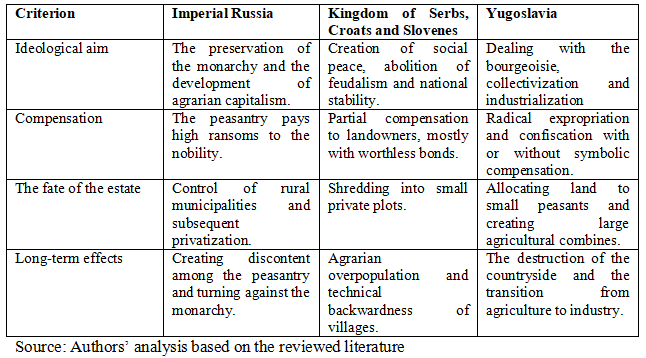
Agrarian reforms in Imperial Russia, the Kingdom of Serbs, Croats and Slovenes and Socialist Yugoslavia represent key turning points, which contributed to the complete transformation of the economic and social structure of society. Despite the fact that they were launched in different time periods and under different ideological directions, all three agrarian reforms are characterized by the use of land policy with the aim of achieving exclusive political and state interests (Milošević, 2010).
In Imperial Russia, with the emancipation of 1861, serfdom was abolished, the peasants were allocated poor quality land, which they bought from the nobility through state loans. This reform, which was carried out in Russia during the time of Tsar Alexander II, managed to greatly help the dying Russian Empire, but it also shook its foundations, paving the way for the establishment of various organizations. The effects of agrarian reforms in imperial Russia were manifested only decades later. The reform was implemented with considerable delay because Imperial Russia was already affected by a huge economic crisis, and such bad economic and social conditions were suitable for the emergence and development of the Bolshevik Revolution.
When we talk about the agrarian reform in the Kingdom of SHS, which was started in 1919, it opened up a very significant issue of agrarians, with also very significant effects of fragmentation of land holdings, especially in those parts where large plots dominated, as was the case in Vojvodina, Bosnia and Herzegovina, Croatia and Macedonia (Drakić, 2014). Land was allocated to small agricultural producers, as well as landless persons and war volunteers. This particularly contributed to the weakening of the former landowner class and the creation of new classes and social strata. Also, feudal relations, which until then were dominantly present on the territory of the former Kingdom of SHS, were abolished. The peasant finally becomes the owner of the land he cultivated. There is stabilization on the social and political level, which was particularly significant in the context of the tensions that prevailed after the end of the First World War. A special problem in the new monarchy was that a completely different system ruled in different parts: in Bosnia and Herzegovina and Macedonia there was a system of serfdom, while in Vojvodina and Croatia there were large capitalist estates.
The positive effects of this reform are the liquidation of feudalism and the creation of a large number of small and fragmented, economically weak estates, without adequate technical equipment and subsidies, which contributed to the economic weakening of villages and rural areas (Trifunović et al., 2026).
In socialist Yugoslavia, the reform was carried out according to the principle of "the land belongs to the one who works it", which in practice meant confiscation of church and banking estates, but also dealing with state enemies. The model of reforms in Yugoslavia was taken from Russia, with an attempt to realize collectivization, and then the determination of private maximums, which amounted to ten hectares, was started. This reform created a dual system with highly productive state-owned enterprises with economic limits and small and weakened estates. The success of this reform can only be seen from the aspect of solving the problem of agrarian overpopulation and the constant migration of the population from the countryside to the cities.
By applying a comparative analysis, the effects of the mentioned agrarian reforms could be shown in table 1:
Table 1. Effects of major agrarian reforms
Conclusion
The agrarian reforms, which are analysed in this paper, represent the three most significant reforms in the agrarian sector that have been implemented in recent times, along with the reform in Mexico and China. Reforms in Russia from 1861, reforms in the Kingdom of SHS from 1919 and reforms in the FNRJ from 1945 actually do not have many common denominators. In Russia, they wanted to create a discontinuity with feudalism, while creating better living and working conditions for agricultural producers. The previous position of small peasants in Russia was bad, because they depended on their feudal lords. They had numerous obligations and limited rights. However, the effects did not turn out to be too good for the position of small farmers, who again did not receive significantly greater rights, while the obligations imposed on them still remained as a burden that they had to deal with.
In the Kingdom of SHS, it can be said that agrarian reforms actually had a corrective function with deep social roots. The aim was to break up the large estates, the land was allocated to the peasantry and thus the social animosities, which had reigned until then, were reduced. From an economic point of view, the effects of this reform were weak, considering the excessive fragmentation of the estates and without adequate mechanical modernization.
The reform in the FNRJ had a deep ideological coloration and was created in the light of major social transformations in Yugoslavia. These reforms concerned social relations in the countryside, the transformation of property relations and the complete restructuring of relations between the former and the newly created elite. The effects were in collectivization, strengthening of the state sector and industrialization. However, the reforms led to major upheavals, resistance among farmers, escape from collectivization and a drastic drop in production.
In general, it can be concluded that the effects of the reform in Russia were the most impressive, because they contributed to the emancipation of society and significant changes. The reforms in the Kingdom of SHS contributed to the redistribution of private property, while the reform in the Federal Republic of Yugoslavia affected a complete change in the agrarian and social order.
Based on the conducted analysis, the co-authors are of the opinion that all the mentioned reforms still have one common denominator, which is the fact that, apart from economic and legal ones, they actually have an important political component. Analysing agrarian reforms, it is not possible to bypass the socio-political context in which they were created, which gave them a very significant stamp and directed the direction of their movements. Also, all the mentioned reforms took place in politically very turbulent periods, which inevitably had to affect their course. They can be associated with major war events and political changes (Kapor, 2025).
Reference
2.Antonović, R. (2023) Običajno pravo na Kosovu i Metohiji, Institut za srpsku kulturu Priština - Leposavić;
3.Bursać, B; Glumac, S. (2017) “Agrarna reforma u Rusiji u XIX veku i njen uticaj na rusku privredu”, FBIM Transactions, Fakultet za biznis i pravo, Beograd;
4.Drakić, G. (2014) “O stanju uoči početka sprovođenja agrarne reforme u Kraljevstvu Srba, Hrvata i Slovenaca”, Pravo i društvena stvarnost, Kosovska Mitrovica;
5.Drakić, G. (2014). Agrarian reform in the Kingdom of Serbs, Croats and Slovenes: Case of an estate owned by foreign citizen. Anali Pravnog fakulteta u Beogradu, 62(2), 146–163. https://doi.org/10.5937/AnaliPFB1402146D
6.Dušanić, J. (1996) “Ekonomske reforme u Rusiji”, Finansije, Savezni državni sekretarijat za poslove finansija, Beograd;
7.Gaćeša, N. (1967) Posedovni odnosi u Vojvodini pred Prvi svetski rat, Srpska akademija nauka i umetnosti, Beograd;
8.Gaković, M. (1970) “Rješavanje agrarnog pitanja u Bosni i Hercegovini 1918 - 1921”, Prilozi br. 6, Sarajevo;
9.Gulan, B. (2021) “Agrarne reforme juče, danas i sutra: čija je naša zemlja?”, Makroekonomija, Jagodina;
10.Ivanovič, A. M. (2001) “Istoriya bor'by s korruptsiyey v Rossii”, Vestnik Nizhegorodskogo universiteta, Nizhegorod;
11.Jelačić, A. (1929) Istorija Rusije - Velike reforme - reakcija i revolucija, Srpska književna zadruga, Beograd;
12.Kapor, P. (2025). Svet u haosu i put u rat. Društveni horizonti, 5(10), 63–104. https://drustveni-horizonti.fdn.edu.rs/sr/articles/68
13.Mihailović, L. (1995) “Aktuelni pogledi na novu fizionomiju agrarne politike i agrarne reforme u Ruskoj Federaciji”, Ekonomika poljoprivrede, Vol.42, br. 4, Beograd;
14.Milošević, S. (2010). The agrarian reform – A “divine thing”: Ideological aspects of the interwar agrarian reform in the Kingdom of Serbs, Croats, and Slovenes/Yugoslavia. Jahrbuch für Geschichte des ländlichen Raumes, 7. https://doi.org/10.25365/rhy-2010-4
15.Milošević, S. (2015) Agrarna politika u Jugoslaviji (1945-1953) - dr. disertacija, Filozofski fakultet, Univerziteta u Beogradu, Beograd;
16.Mutapčić, E. (2011) “Pravno - historijski kontekst agrarne reforme BiH poslije Prvog svjetskog rata”, Tranzicija, Tuzla;
17.Petranović, B. (1964) Političke i pravne prilike za vreme privremene vlade DFJ, Institut društvenih nauka, Beograd;
18.Samardžić, N. (2014) Nacionalizacija, konfiskacija i restitucija, LIMES Plus, Hispera, edu;
19.Trifunović, D., Knežević, M., & Milunović, M. (2026). The role of corporate social responsibility and technological innovations in the transformation of agricultural production. Economics of Agriculture. https://doi.org/10.59267/ekoPolj2602379T
20.Vidas - Bubanja, M. (2001) “Izazovi i mogućnosti domaće privrede u uslovima nove tehno - ekonomske paradigme”, Poslovna politika, Beograd;
Khristoforov, I. (2022). From Speransky to Stolypin: Peasant reform and the problem of land management. Herald of the Russian Academy of Sciences, 92, S161–S173. https://doi.org/10.1134/S1019331622090052
Objavljeno u
God. 12 Br. 2 (2026)
Ključne reči
🛡️ Licenca i prava korišćenja
Ovaj rad je objavljen pod Creative Commons Attribution 4.0 International (CC BY 4.0).
Autori zadržavaju autorska prava nad svojim radom.
Dozvoljena je upotreba, distribucija i adaptacija rada, uključujući i u komercijalne svrhe, uz obavezno navođenje originalnog autora i izvora.
Zainteresovani za slična istraživanja?
Pregledaj sve članke i časopise