
PERCEPCIJA ZAPOSLENIH O NEFINANSIJSKOM IZVEŠTAVANJU U TRANSPORTNIM KOMPANIJAMA

Apstrakt
Transportne kompanije, obavljanjem redovnih poslovnih aktivnosti na moderan i ekonomičan način, javljaju se kao izuzetno veliki potrošači goriva i energije sa visokim „nezelenim“ otiskom. Povezano sa društvenom odgovornošću preduzeća, ESG izveštavanje postaje ustaljeni pravac ka održivom poslovanju i zaštiti planete od klimatskih promena. Cilj ovog rada je da ispita percepcije menadžera i osoba odgovornih za izveštavanje o segmentima ESG izveštaja u transportnim kompanijama u Srbiji i da utvrdi oblast u kojoj se moraju preduzeti aktivnije akcije kako bi se promovisali standardi ESG izveštavanja, pod okriljem zelene agende, odnosno Evropskog zelenog dogovora. Studija je sprovedena anketiranjem 163 ispitanika u srpskim transportnim kompanijama u drugoj polovini 2025. godine. Rezultati su pokazali da ESG obuka značajno predviđa veću verovatnoću ocenjivanja uključivanja životne sredine kao relevantnog faktora, kao i da obrazovanje poboljšava perceptivni kvalitet povećanjem prepoznavanja ESG aktivnosti.
Članak
Introduction
Today’s global market for goods requires modern supply models. We are witnessing a significant increase in the production of fast-moving consumer goods (FMCG) in geographically distant locations, along with the emergence of several global manufacturing superpowers. These geographically dispersed production sites require modern transportation channels to deliver goods to customers worldwide. For this reason, the transport industry plays a significant role in the global economy. Further, today, the global transport sector generates approximately 5% of global gross domestic product and employs around 10 million people, with a tendency toward accelerated growth. Fuel and energy consumption are significant in the transportation business, and renewable energy consumption and economic growth are increasingly important topics (Cvijović et al., 2020). There are fewer and fewer fuel resources in nature, and new requirements force energy producers to produce it in a green, i.e., sustainable, way, which has increased the price of fuel and energy in the world market. Pham et al. (2022) recognize the importance of the transport sector and emphasise the need to assess transport companies' overall performance as a basis for improving their operational efficiency. They also highlight the negative consequences of rapid development, which degrade the environment and adversely affect humans, plants, and animals. Referring to a 2011 Report by the International Energy Agency, they state that the transport industry ranks second in greenhouse gas emissions, generating 22% of global CO₂ emissions.
The globally proclaimed green agenda encompasses a broader concept of producing and using energy, services, and goods sustainably. Its objective is to encourage society to manage the planet’s limited resources rationally and efficiently, as alarming environmental impacts that hinder growth and sustainable development are already evident. Theorists and researchers agree that these negative consequences can be mitigated by promoting sustainable policies, gradually implemented alongside strengthening environmental awareness.
The ESG reporting concept has gained importance as policymakers have come to recognize the depth of the climate crisis and accept the knowledge regarding its threats and potential consequences. With increased awareness among politicians, businesses, and society as a whole about climate-related risks, the necessary conditions have been established for promoting and formally regulating political acts aimed at legally structuring the ESG concept and integrating it into national reporting frameworks.
The signing of the Paris Climate Agreement in 2015 and its ratification in national parliaments created the initial conditions for ESG reporting. Although many countries are still not fully prepared for complete implementation, the first steps in this direction have been taken. Under the Paris Agreement (French: Accord de Paris), member states of the United Nations Framework Convention on Climate Change agreed on a long-term temperature goal of limiting the increase in global average temperature to below 1,5°C, which would significantly reduce the risks and impacts of climate change. The signatories also committed to “making finance flows consistent with a pathway toward low greenhouse gas emissions and climate-resilient development.” According to the Agreement, each signatory state must regularly report on its contributions to mitigating global warming (Article 3).
In China, the Shanghai Stock Exchange introduced the “Stock Listing Rules” in 2019, requiring listed companies to disclose ESG reporting data. The Hong Kong Stock Exchange revised its ESG reporting requirements in 2020. The U.S. Nasdaq Stock Market issued the “ESG Reporting Guide 1.0” in 2017 and the updated “ESG Reporting Guide 2.0” in 2019, providing guidelines for publishing ESG statistics (Ruan & Liu, 2021). The authors primarily refer to regulatory practices in these countries because the United States and China are the largest environmental polluters. Moreover, the United States has frequently failed to act in accordance with signed international environmental agreements or has not implemented them, citing non-ratification in the national parliament, even when such agreements were proposed by the United States itself. This practice continued in the case of the Paris Agreement, from which the United States withdrew after signing.
Directive (EU) 2022/2464 of the European Parliament and of the Council establishes mandatory reporting obligations within the framework of corporate social responsibility, which implies reporting according to ESG segments. Commonly referred to as the Corporate Sustainability Reporting Directive (CSRD), it introduces more specific reporting requirements regarding companies’ environmental and social impacts. It mandates reporting according to standardized criteria based on EU climate objectives and indirectly requires alignment of corporate business strategies with environmental and social standards (Ferensztajn-Galardos et al., 2025).
ESG may be viewed as an evolution of the concept of Corporate Social Responsibility (CSR) and represents the result of implementing an increasing number of regulations promoting sustainable development within the European Union.
This paper defines the scope and specificities of green, i.e., non-financial reporting for transport companies, in the form that has become an EU partner requirement, and guides readers from the industry on aspects of this reporting obligation, which greatly affect transport companies' business performance.
The article is divided into five sections. It begins with a literature review, followed by a presentation of the research hypotheses. Section 3 presents the sample and methods. Section 4 presents the results. Finally, the study’s results are interpreted, and practical conclusions are presented.
Literature Review
The importance of ESG reporting for transport companies
A large number of researchers have analyzed the effects of environmental, social, and governance factors on companies’ productivity and financial performance. Numerous studies have examined the relationship between ESG factors and the business performance of transport companies (Pham et al., 2022); however, no single metric methodology has proven fully reliable. It applied a combination of techniques (DEA, OLS) and found that a significant proportion of transport companies (76%) operate inefficiently. They advise company managers to focus on ESG and to treat it as a necessary investment for transport companies, particularly given that transport is regarded as an environmentally sensitive industry. Also, cost management has been gaining increasing importance (Milojević et al., 2025). Environmental costs influence future strategic direction (Knežević et al., 2024, p. 64), and the particular role of environmental accounting in monitoring costs at the level of a business system is emphasized (Knežević, 2011).
Various researchers have linked companies’ market value to ESG performance ratings by segment, using the Tobin’s Q model, while Yoon et al. (2018) used the Feltham-Ohlson model to examine the impact of ESG segments on company market value. On the other hand, Tang et al. (2012) argue that findings regarding the relationship between ESG and financial performance are inconclusive, unreliable, ambiguous, and even contradictory.
In their study, Pham et al. (2022), analyzing current published research, suggest that ESG reporting positively affects company performance and increases market value. Miller et al. (2020) emphasize increased profitability among companies with a reputation for social responsibility, while Cho et al. (2019), examining Korean listed companies, identify a positive correlation between community contribution and total asset growth rate. Researchers Kong et al. (2014) in China and Yadav et al. (2016) in the United States, focusing on the environmental segment of ESG, conclude that environmental improvement activities lead to increased market value. Applying DEA, OLS, and linear regression in a study of 56 listed companies in China and the United States, regression models showed a positive correlation between ESG segments and examined business performance indicators of transport companies, strongly supporting ESG reporting as an investment.
Data from the Global Sustainable Investment Alliance (GSIA, 2018) indicate that more than USD 30 trillion in global assets under management are aligned with ESG principles (Pedro, 2020). Institutional investors in developed financial markets are increasingly attracted to companies implementing ESG reporting, as evidenced by the growth of such investments in capital markets. Datsii et al. (2021) further note that private investors are increasingly interested in companies offering segmented ESG reports, referring to such investments as “ESG investments.” They analyzed results of the Morgan Stanley survey conducted in 2017 among 1.000 active private investment firms, which showed that 75% of respondents favored ESG investments motivated by participation in combating climate change caused by high CO₂ emissions. The strongest interest in ESG investments was shown by Generation Y (millennials), who believe that such investments contribute to environmental preservation for future generations. It should be emphasized that investments directed toward companies managed according to ESG principles are not merely marketing or trends, but a genuinely necessary direction of responsible investing (Matos, 2020).
Datsii et al. (2021) examined global ESG investment practices and observed numerous regulations and initiatives aimed at standardizing every process within ESG investing, from defining ESG principles to ranking results. They report the development of non-financial reporting standards promoted by the Global Reporting Initiative (GRI) and the International Integrated Reporting Council (IIRC). At the same time, transport companies have shown increasing willingness to join ESG initiatives and to provide comprehensive ESG reporting, particularly newer technology-based firms. In recent decades, climate change has affected the environment and international supply chains, resulting in decreased employee productivity and more severe business disruptions (Rissman et al., 2020). Other researchers (Mackevičius et al., 2018) observe a growing number of bankruptcies in transport companies and seek solutions for vulnerable firms. ESG initiatives are recognized as a potential solution for technology-based companies at risk.
To mitigate the consequences of climate change, researchers such as Vajjarapu et al. (2019), focusing on the transport industry, call for urgent strengthening of commitment to sustainable development within the sector. Banks have a significant role in implementing ESG standards and managing sustainable risks (Savić & Marjanović, 2025; Đokić et al., 2025). Khursheed et al. (2025), examining the impact of ESG factors on the profitability of transport companies, emphasize the importance of all ESG segments and propose green measures as a response to climate change, particularly in the transport sector due to its significant impact on both the economy and the environment. According to Kim & Li (2021) and Shakil (2021), several studies confirm a strong relationship between corporate financial risks and ESG performance indicators, highlighting the importance of investigating this relationship across different sectors. “Performance measurement is crucial for evaluating the organization's progress” (Dabetić et al., 2024, p. 167), especially considering that the modern business environment is characterized by constant changes (Bojić et al., 2025). Mohammad & Wasiuzzaman (2021), surveying 3.966 companies during the period 2012–2017, examined the impact of ESG values on organizational performance. They observed varying results regarding the relationship between ESG activities and profitability, leading them to further analysis. Research conducted by Lewandowski (2017) shows that increased CO₂ emissions are strongly associated with decreased profitability, underscoring the necessity of understanding the link between climate change and company profitability in order to improve business results. Naveed et al. (2021) examined gender equality in transport companies by tracking the percentage of women on corporate boards, identifying it as a key performance indicator, particularly given that the industry is traditionally male-dominated, with men prevailing in roles ranging from drivers, logistics operators, and mechanics to controllers, middle managers, and company directors.
Investigating ESG reporting in Poland in two industries crucial for sustainable development, transport and electricity generation, Wojciechowski et al. (2022) identified generally poor ESG reporting practices and overall weak performance. They observed low ESG awareness and limited engagement of professionals in this field. Qualified respondents were often unaware that their companies prepared ESG reports, and many noted the lack of appropriate information and formal ESG procedures. Limited management involvement in ESG initiatives was also observed, particularly in carbon footprint analysis.
Nevertheless, it is encouraging that most respondents recognize the importance of ESG reporting for corporate reputation and stakeholder trust, indicating a significant gap between perceived value and existing business practice. Additionally, a large number of technical staff expressed willingness to attend ESG training, which would undoubtedly contribute to improved reporting capacity and better satisfaction of internal and external stakeholders’ transparency requirements.
Hypotheses
Based on the theoretical framework and prior empirical findings, the following hypotheses are formulated:
H1: There is a statistically significant relationship between the level of understanding of non-financial reporting and the perceived usefulness of non-financial reporting in transport companies.
This hypothesis is grounded in the assumption that employees who possess a higher level of knowledge about ESG and non-financial reporting standards are more capable of recognizing their strategic importance, operational benefits, and contribution to long-term sustainability. Greater understanding is expected to positively influence perceived usefulness.
H2: Employees in managerial positions have a significantly more positive perception of non-financial reporting compared to operational workers.
Managers are typically more involved in strategic planning, regulatory compliance, and stakeholder communication. Due to their broader perspective on corporate governance and risk management, they are expected to demonstrate a more favorable attitude toward ESG reporting than employees in operational roles.
H3: Education on ESG standards positively affects the quality of perception of non-financial reporting.
Formal training and education programs related to ESG standards are expected to improve employees’ awareness, comprehension, and evaluation of non-financial reporting practices. Enhanced knowledge should lead to more informed and constructive perceptions.
H4: Transparency of non-financial reporting positively affects employees' trust in management.
Transparent disclosure of environmental, social, and governance activities reduces information asymmetry within the organization. Increased transparency is expected to strengthen employees’ trust in management by demonstrating accountability, ethical conduct, and long-term strategic commitment.
Materials and methods
This study employed a quantitative, cross-sectional survey design to examine employees’ perceptions of ESG reporting in Serbian transport companies. The target population comprised all employees working in passenger, cargo, or combined transport companies operating by road, rail, water, air, or multimodal routes. Data were collected using a structured online questionnaire developed in Google Forms. The instrument contained 20 closed-ended items divided into three sections: (1) socio-demographic and professional characteristics (5 items: gender, education, years in sector, current position, tenure); (2) company-level ESG context (8 items: transport type, route, ESG report preparation, training participation, internal standards, measurement of environmental indicators, electricity monitoring, customer information); and (3) perceptual and attitudinal measures (7 items: management and company engagement in ESG and Green Agenda goals, personal importance of environmental aspects, inclusion of electricity consumption and ESG topics in reporting/training, reputation benefits, and preferred ESG segment). Response formats included single-choice, multiple-choice, and 5-point Likert-type scales. Internal consistency of the two multi-item perceptual scales yielded acceptable Cronbach’s α values (management engagement α = 0,82; Green Agenda engagement α = 0,79).
The survey link was distributed emphasizing voluntary participation, anonymity, and the scientific purpose. No incentives were offered. Upon closure, responses were exported to Microsoft Excel, cleaned, and imported into IBM SPSS Statistics version 27.0 (IBM, Armonk, NY, USA). Categorical variables were recoded numerically for analysis. Likert items were treated as ordinal. Missing values were minimal (<5 %) and handled by listwise deletion for regression models.
Statistical analyses proceeded in three stages. First, descriptive statistics (frequencies, percentages) summarized sample characteristics and response distributions. Second, bivariate associations were examined using Pearson’s χ² test (with Fisher’s exact test when expected cell counts <5) and Spearman’s rank-order correlation (ρ) for ordinal variables. Third, inferential models tested the hypotheses: binary logistic regression for dichotomous outcomes and simple linear regression for ordinal perceptual scores. All models used the enter method. Model fit was evaluated via omnibus χ², Nagelkerke R², classification accuracy, and Hosmer-Lemeshow test (logistic models) or R², F-statistic, residual plots, and VIF (linear models). Regression diagnostics confirmed acceptable normality of residuals (Shapiro-Wilk p > 0,05), homoscedasticity (visual inspection of scatterplots), no multicollinearity (VIF < 2), and no influential outliers (Cook’s distance < 1). The significance level was set at p < 0,05 (two-tailed) throughout. All procedures complied with the Declaration of Helsinki. Participation was voluntary and anonymous.
Results
The survey was conducted anonymously among 163 employees in transport companies. The sample was predominantly male (76,1%). Education levels varied, with participants with a high school education comprising 33,7% of the cohort. Experience in the transport sector was substantial, with 38,0% having over 20 years. Current positions were split between operational (48,5%) and managerial roles (51,5%), with tenure in the current position showing 41,7% at 1–3 years (Table 1).
Table 1. Key Sample Demographics (N = 163)
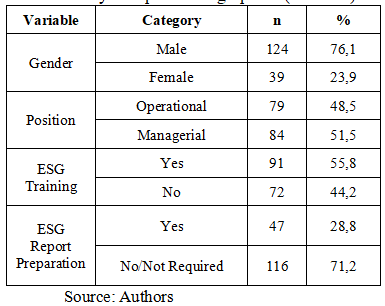
Companies primarily transported combined passengers and cargo (51,5%, n = 84), followed by cargo only (35,0%, n = 57) and passengers only (13,5%, n = 22). Routes included water (28,2%, n = 46), land (25,2%, n = 41), rail and air (14,7% each, n = 24), and combined (17,2%, n = 28). Only 28,8% (n = 47) of companies prepared ESG reports, while 50,9% (n = 83) were not required but prepared them for partners, and 20,2% (n = 33) did not prepare them (Table 1). Over half had participated in ESG training (Table 1), but 79,8% (n = 130) reported no internal ESG standards or guidelines.
Perceptions of management engagement in ESG goals were positive: 25,2% (n = 41) rated it excellent, 39,3% (n = 64) very good, 11,0% (n = 18) good, 9,8% (n = 16) satisfactory, and 14,7% (n = 24) insufficient. Company engagement in the Green Agenda was similarly rated: 27,0% (n = 44) excellent, 38,7% (n = 63) very good, 9,2% (n = 15) good, 10,4% (n = 17) satisfactory, and 14,7% (n = 24) insufficient. Personal importance of environmental aspects in ESG reports was high, with 71,2% (n = 116) deeming it very important and 28,8% (n = 47) important.
Among respondents answering environmental measurement questions (n = 109), 90,8% (n = 99) did not measure indicators like CO2 emissions, while 9,2% (n = 10) did. Customer awareness of ESG activities (n = 88) was low, with 87,5% (n = 77) believing customers were not sufficiently informed. Electricity consumption monitoring (n = 103) occurred always in 54,4% (n = 56), sometimes in 29,1% (n = 30), and never in 16,5% (n = 17). Most (95,7%, n = 66 of 69) felt electricity consumption should be included in ESG reports. Nearly all (99,4%, n = 162) supported ESG topics in employee training, and 97,5% (n = 153 of 157) believed ESG reporting improved company reputation. The environmental ESG segment was deemed most important (74,8%, n = 122), followed by social (14,7%, n = 24) and governance (10,4%, n = 17).
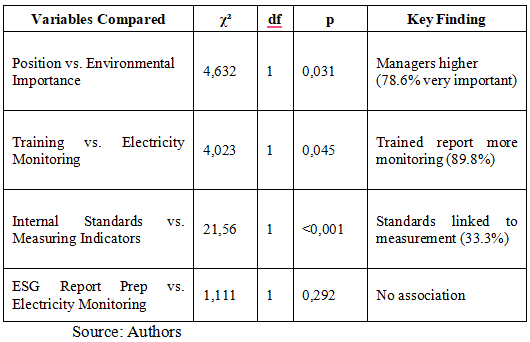
Chi-square tests revealed several significant associations. Managerial employees rated the personal importance of including environmental protection in ESG reports as very important more frequently (78,6%) than operational employees (63,3%; χ² = 4,632, df = 1, p = 0,031). However, no significant associations were found between position and opinions on including electricity consumption in ESG reports (χ² = 0,330, p = 0,566), belief in ESG reporting's reputation benefits (χ² = 1,162, p = 0,281), customer information on ESG activities (χ² = 0,924, p = 0,337), or inclusion of ESG in training (χ² = 1,068, p = 0,301) (Table 2).
ESG training participation was associated with higher reports of electricity consumption monitoring (89.8% among trained vs. 75.0% among untrained; χ² = 4,023, df = 1, p = 0,045), but not with measuring environmental indicators like CO2 emissions (χ² = 0.001, p = 0.980). The presence of internal ESG standards is strongly associated with measuring environmental indicators (33.3% with standards vs. 2,4% without; χ² = 21,557, df = 1, p < 0,001), though not with electricity monitoring (χ² = 0,051, p = 0,821) or ESG report preparation (χ² = 1,111, p = 0,292) (Table 2).
Table 2. Selected Chi-Square Associations
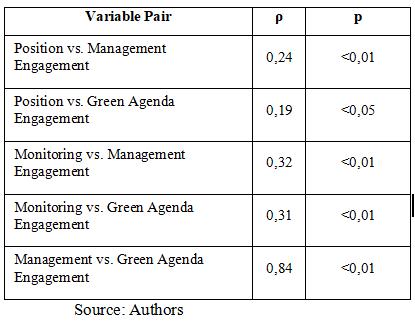
Spearman's correlations indicated weak but significant positive relationships between current position (ordinal) and management engagement in ESG goals
(ρ = 0,40, p < 0,01), as well as Green Agenda engagement (ρ = 0,191, p < 0,05). Electricity monitoring (ordinal) correlated moderately with both management engagement (ρ = 0,319, p < 0.01) and Green Agenda engagement (ρ = 0,310, p < 0,01), and strongly between the two engagement variables (ρ = 0,838, p < 0,01). Position showed a non-significant negative correlation with monitoring (ρ = -0,072, p > 0,05) (Table 3).
Table 3. Spearman's Correlations
Logistic regression models examined predictors of the perceived importance of environmental aspects. ESG training significantly predicted higher odds of rating environmental inclusion as very important (B = 2,506, SE = 0,439, Wald = 32,552, Exp(B) = 12,261, p < 0,001, 95% CI 5,183-29,005), with the model explaining 22,9%–32,7% variance (Cox & Snell R² = 0,229, Nagelkerke R² = 0,327; χ² = 42,325, p < 0,001). Similarly, managerial position increased odds (B = 0,755, SE = 0,354, Wald = 4,548, Exp(B) = 2,127, p = 0,033, 95% CI 1,063-4,255), though with lower explanatory power (Cox & Snell R² = 0,028, Nagelkerke R² = 0,040; χ² = 4,659, p = 0,031) (Table 4).
Table 4. Logistic Regression Results


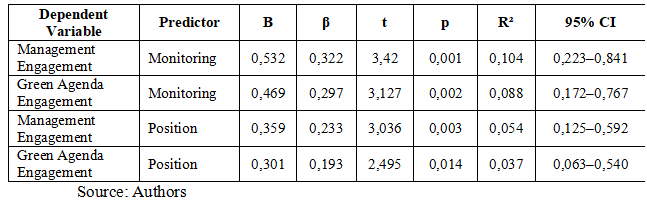
Linear regression models assessed predictors of engagement perceptions. Electricity monitoring positively predicted management engagement in ESG goals (B = 0,532, SE = 0,156, β = 0,322, t = 3,420, p = 0,001, 95% CI 0,223-0,841), explaining 10,4% variance (R² = 0,104, F = 11,694, p = 0,001). It also predicted Green Agenda engagement (B = 0,469, SE = 0,150, β = 0,297, t = 3,127, p = 0,002, 95% CI 0,172-0,767; R² = 0,088, F = 9,779, p = 0,002). Position predicted management engagement (B = 0,359, SE = 0,118, β = 0,233, t = 3,036, p = 0,003, 95% CI 0,125-0,592; R² = 0,054, F = 9,218, p = 0,003) and Green Agenda engagement (B = 0,301, SE = 0,121, β = 0,193, t = 2,495, p = 0,014, 95% CI 0,063-0,540; R² = 0,037, F = 6,226, p = 0,014). Training predicted electricity monitoring in a separate logistic model (B = 1,280, SE = 0,517, Wald = 6,125, Exp(B) = 3,597, p = 0,013, 95% CI 1,306-9,908; Cox & Snell R² = 0,057, Nagelkerke R² = 0,083; χ² = 6,217, p = 0,013) (Table 5).
Table 5. Linear Regression Results
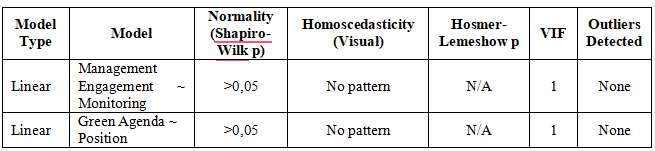
In addition to the primary regression results, diagnostic tests were conducted to verify model assumptions. For linear models, residuals were normally distributed (Shapiro-Wilk p > 0,05), with no evidence of heteroscedasticity in scatterplots. VIF values indicated no multicollinearity. For logistic models, the Hosmer-Lemeshow test supported a good fit (p > 0,05), and no outliers were detected (Table 6).
Table 6. Summary of Key Diagnostics

Discussion
The first hypothesis, positing a statistically significant relationship between employees' level of understanding of ESG reporting and their perception of its usefulness, was supported by the data. Understanding was operationalized through proxies such as participation in ESG training and the presence of internal ESG standards, while usefulness perception was measured via items like the personal importance of including environmental aspects in ESG reports, beliefs about including electricity consumption in reports, and the perceived contribution of ESG reporting to company reputation. Logistic regression analysis revealed that ESG training significantly predicted a higher likelihood of rating environmental inclusion as "very important", with trained employees 12 times more likely to hold this view than untrained employees. This model accounted for 22,9% to 32,7% of the variance, indicating a strong link between these variables.
Chi-square tests further corroborated this association. For instance, training was significantly related to reports of electricity consumption monitoring, with 89,8% of trained employees affirming monitoring, compared with 75,0% of untrained employees, suggesting that greater understanding fosters recognition of practical ESG applications. Similarly, internal standards were strongly associated with measuring environmental indicators like CO2 emissions, where 33,3% of those with standards reported measurement compared to only 2,4% without, highlighting how comprehension enhances appreciation of ESG's operational utility.
Spearman's correlations provided additional evidence, showing positive relationships between monitoring (as a marker of understanding) and perceptions of management engagement in ESG goals and Green Agenda engagement. These findings imply that as employees' grasp of non-financial reporting deepens (through training or standards), they perceive it as more useful for environmental stewardship and overall business value. However, non-significant associations, such as between training and CO2 measurement, suggest the relationship may be context-specific.
Hypothesis regarding the perception of non-financial reporting of managers and operational workers was partially accepted. Position was dichotomized into managerial versus operational, with perceptions assessed through ratings of management engagement in ESG goals, company engagement in the Green Agenda, personal importance of environmental aspects, and beliefs in ESG's reputation benefits.
Chi-square tests showed a significant association between position and the importance of environmental inclusion, with 78,6% of managers rating it "very important" compared to 63,3% of operational staff, indicating managers view ESG as more integral to reporting usefulness. Logistic regression reinforced this, with managerial position increasing the odds of a "very important" rating. Linear regressions further supported positivity in perceptions: position positively predicted higher ratings of management engagement and Green Agenda engagement, implying managers perceive greater organizational commitment to ESG. Spearman's correlations aligned, showing weak positive links between position and these engagement ratings.
However, the hypothesis is only partially accepted due to non-significant findings in other areas. For example, no differences emerged in beliefs about electricity inclusion in reports, reputation benefits, customer ESG awareness, or ESG training. Additionally, position negatively but non-significantly correlated with monitoring, suggesting operational staff may be more attuned to practical implementations.
The hypothesis that education on ESG standards positively influences the quality of perception regarding non-financial reporting was accepted based on robust evidence. Education was proxied by ESG training participation, with perception quality evaluated through informed responses on practices like measuring environmental indicators, electricity monitoring, internal standards, and overall engagement ratings.
Chi-square analyses demonstrated significant positive effects: trained employees were more likely to report electricity monitoring, indicating education improves awareness and quality of ESG practice perceptions. Internal standards, often linked to educational initiatives, were strongly associated with indicator measurement, suggesting training fosters deeper, more accurate perceptions of ESG implementation. Logistic regression provided causal insight, with training predicting higher odds of affirmative monitoring reports, explaining 5,7% to 8,3% of variance. This implies that education enhances perceptual quality by increasing recognition of ESG activities. Spearman's correlations indirectly supported this, as monitoring was positively related to high-quality perceptions of management and Green Agenda engagement, reflecting educated employees' more nuanced views.
Non-significant results, like no association between training and CO2 measurement or report preparation, do not undermine acceptance, as they may indicate education's stronger impact on accessible practices rather than all metrics. Overall, the data consistently show that education elevates perception quality.
The acceptance of the fourth hypothesis was supported by empirical links between transparency proxies and trust indicators. Transparency was measured via ESG report preparation, internal standards, and practices like indicator measurement and electricity monitoring. Trust was assessed through ratings of management engagement in ESG goals and the Green Agenda.
Linear regressions confirmed positive effects: electricity monitoring significantly predicted higher trust in management engagement and Green Agenda engagement, and Spearman's correlations reinforced this, with monitoring strongly associating with both trust measures, and a high intercorrelation between engagement variables. Internal standards enhanced the link between transparency and measurement, implying that visible reporting mechanisms foster trust. However, no direct association between report preparation and monitoring suggests transparency's impact is practice-driven rather than mere reporting. The analysis demonstrated that training indirectly boosts trust via monitoring.
Conclusion
External stakeholders (governments, regulatory bodies, investors, customers, etc.) are interested in ESG reporting not merely to “keep pace with global trends,” but because they recognize it as a key mechanism for protecting the planet and its limited resources, as well as for promoting broader responsible policies aimed at sustainable growth and development. Climate change affects the business performance of transport companies, compelling governments and their institutions to respond. Among the proposed solutions to challenges caused by climate change, governments identify corporate social responsibility in transport companies and management aligned with ESG initiatives as essential approaches.
ESG reporting represents a logical response of the profession toward enabling long-term and sustainable business operations of transport companies. Although it is currently perceived as an additional obligation imposed on local transport operators, through education and the provision of adequate information, company managers will recognize the full benefits of ESG reporting. This leads to the broader shift in awareness that all stakeholders jointly pursue - companies, academia, and regulators, based on the understanding that there is no alternative planet or environment.
Climate change, increased public awareness, and stronger regulatory frameworks require sustainable business strategies. ESG statistical practices have become an integral part of economic growth and sustainable development plans for transport companies. They contribute to the recognition of high-quality corporate governance and to increased investor confidence. Orientation toward ESG has become a source of competitive advantage, as an increasing number of consumers focus on sustainability, fully aware of the future consequences of failing to implement sustainable corporate practices.
In Serbia, sustainability reporting is currently implemented only by large enterprises (those employing more than 500 employees). This is a particularly important issue for transport companies. However, given that the European Union is the largest partner of the national economy, it is reasonable to expect that European partners will increasingly require ESG reporting from Serbian companies as a condition for strengthening mutual cooperation. Although ESG reporting in the Republic of Serbia is still in its early stages of development, it is necessary to intensify efforts to promote full-capacity ESG implementation across all sectors of the economy. Responsible persons within companies should be directed toward clearer communication across all organizational sectors, as this ensures sustainable operations, a strong business reputation, and market recognition.
Reference
2.Cho, S., Chung, C., Young, J. (2019). Study on the Relationship between CSR and Financial Performance. Sustainability, 11, 343. https://doi.org/10.3390/su11020343
3.Cvijović, J., Obradović, T., & Knežević, S. (2020). A literature survey on relationship between renewable energy consumption and economic growth. Економика пољопривреде, 67(3), 991-1010.
4.Datsii, O., Levchenko, N., Shyshkanova, G., Platonov, O., & Abuselidze, G. (2021). Creating a Regulatory Framework for the ESG-investment in the Multimodal Transportation Development. Rural Sustainability Research, 46(341), 39-52.
5.DIRECTIVE (EU) 2022/2464 OF THE EUROPEAN PARLIAMENT AND OF THE COUNCIL, Official Journal of the European Union, L 322/15, 16.12.2022. https://eur-lex.europa.eu/eli/dir/2022/2646/oj/eng
6.Đokić, N., Mirović, V., Milićević, N., Kalaš, B., & Đokić, I. (2025). Namera ponašanja prema uslugama zelenog bankarstva: moderirajući efekti ekološke svesti. Oditor, 11(2), 7-32. https://doi.org/10.59864/Oditor12502ND
7.Ferensztajn-Galardos, E., Krajewska, R., Wojciechowski, J. (2025). Opportunities for ESG reporting in railway electric power supply enterprises based on annual reports. European Research Studies Journal, 28(1), 1033-1049. https://www.um.edu.mt/library/oar/handle/123456789/135102
8.Global Sustainable Investment Alliance (GSIA, 2018). https://www.gsi-alliance.org/trends-report-2018/
9.Khursheed, A., Rao, M., John, R. (2025). Green logistics Wheels: Assessing ESG Practices and Financial Performance in Emerging Transportation Technologies. LogForum, 21(2), 153-165. https://doi.org/10.17270/J.LOG.001182
10.Kim, S., & Li, Z. (2021). Understanding the impact of ESG practices in corporate finance. Sustainability, 13(7), 3746. https://doi.org/10.3390/su13073746
11.Knežević, S. (2011). Računovodstvo zaštite životne sredine na nivou poslovnog sistema. Računovodstvo, 55(9-10), 48-56.
12.Knežević, S., Milojević, S., Mitrović, A., & Trivunac, J. B. (2024). Računovodstvo troškova kao podrška sistemu upravljanja životnom sredinom Cost accounting as a support for the environmental management system. Ecologica, 31, 58-66.
13.Kong, D., Liu, S., & Dai, Y. (2014). Environmental policy, company environment protection, and stock market performance: Evidence from China. Corporate Social Responsibility and Environmental Management, 21(2), 100-112. https://doi.org/10.1002/csr.1306
14.Lewandowski, S. (2017). Corporate carbon and financial performance: The role of emission reductions. Business Strategy and the Environment, 26(8), 1196–1211. https://doi.org/10.1002/bse.1978
15.Mackevičius, J., Šneidere, R., & Tamulevičienė, D. (2018). The waves of enterprises bankruptcy and the factors that determine them: the case of Latvia and Lithuania. Entrepreneurship and Sustainability Issues, 6(1), 100-114. http://doi.org/10.9770/jesi.2018.6.1(8)
16.Matos, P. (2020). ESG and responsible institutional investing around the world. Literature review, CFA Institute Research Foundation.
17.Miller, S. R., Eden, L., & Li, D. (2020). CSR reputation and firm performance: A dynamic approach. Journal of Business Ethics, 163(3), 619-636. https://doi.org/10.1007/s10551-018-4057-1
18.Milojević, S., Milošević, M., & Simić, M. (2025). Employees’perceptions in transport companies regarding cost management. Oditor, 11(3), 38-57.
19.Mohammad, W. M. W., & Wasiuzzaman, S. (2021). Environmental, Social and Governance (ESG) disclosure, competitive advantage and performance of firms in Malaysia. Cleaner Environmental Systems, 2, 100015. https://doi.org/10.1016/j.cesys.2021.100015
20.Naveed, K., Voinea, C. L., Ali, Z., Rauf, F., & Fratostiteanu, C. (2021). Board gender diversity and corporate social performance in different industry groups: Evidence from China. Sustainability, 13(6), 3142. https://doi.org/10.3390/su13063142
21.Pham, T. N., Tran, P. P, Le, M-H, Vo, H. N., Pham, C. D., Nguyen, H-D. (2022). The Effects of ESG Combined Score on Business Performance of Enterprises in the Transportation Industry. Sustainability, 14, 8354. https://doi.org/10.3390/su14148354
22.Rissman, J., Bataille, C., Masanet, E., Aden, N., Morrow, W.R., Zhou, N., Elliott N., Dell, R., Heeren, N., Huckestein, B., Cresco, J., Miller, S.A., Roy, J., Fennell, P., Cremmins, B., Koch Blank, T., Hone, D., Williams, E. D., de la Rue du Can, S., Sisson, B., Helseth, J. (2020). Technologies and policies to decarbonize global industry: Review and assessment of mitigation drivers through 2070, Applied Energy, 266, 114848. https://doi.org/10.1016/j.apenergy.2020.114848
23.Ruan, L., Liu, H. (2021). Environmental, Social, Governance Activities and Firm Performance: Evidence from China. Sustainability, 13, 767. https://doi.org/10.3390/su13020767
24.Savić, M., & Marjanović, T. (2025). Finansiranje zelene tranzicije: uloga banka u sprovođenju ESG standarda i upravljanju održivim rizicima. Oditor, 11(3), 109-124. https://doi.org/10.59864/Oditor72503M
25.Shakil, M. H. (2021). Environmental, social and governance performance and financial risk: Moderating role of ESG controversies and board gender diversity. Resources Policy, 72, 102144. https://doi.org/10.1016/j.resourpol.2021.102144
26.Tang, Z., Hull, C. E., & Rothenberg, S. (2012). How corporate social responsibility engagement strategy moderates the CSR–financial performance relationship. Journal of Management Studies, 49(7), 1274-1303. https://doi.org/10.1111/j.1467-6486.2012.01068.x
27.Vajjarapu, H., Verma, A. & Gulzar, S. (2019). Adaptation Policy Framework for Climate Change Impacts on Transportation Sector in Developing Countries. Transportation in Developing Economies, 5(3). https://doi.org/10.1007/s40890-019-0071-y
28.Wojciechowski, J., Ferensztajn-Galardos, E., Krajewska, R. (2022). Technical Knowledge as a Determination of ESG Implementation in the Electric Power and Transport Sectors. European Research Studies Journal, 25(3), 500-517. https://www.um.edu.mt/library/oar/handle/123456789/139211
29.Yadav, P. L., Han, S. H., & Rho, J. J. (2016). Impact of environmental performance on firm value for sustainable investment: Evidence from large US firms. Business strategy and the environment, 25(6), 402-420. https://doi.org/10.1002/bse.1883
30.Yoon, B., Lee, J. H., Byun, R. (2018). Does ESG Performance Enhance Firm Value? Evidence from Korea. Sustainability, 10, 3635. https://doi.org/10.3390/su10103635
Objavljeno u
God. 12 Br. 2 (2026)
Ključne reči
🛡️ Licenca i prava korišćenja
Ovaj rad je objavljen pod Creative Commons Attribution 4.0 International (CC BY 4.0).
Autori zadržavaju autorska prava nad svojim radom.
Dozvoljena je upotreba, distribucija i adaptacija rada, uključujući i u komercijalne svrhe, uz obavezno navođenje originalnog autora i izvora.
Zainteresovani za slična istraživanja?
Pregledaj sve članke i časopise