
VEŠTAČKA INTELIGENCIJA I OTT PLATFORME – PREDNOSTI I RIZICI

Apstrakt
Digitalne OTT (Over-The-Top) platforme, koje korisnicima nude kataloge video i audio sadržaja, kao i strimovanje linearnih kanala, primenom alata veštačke inteligencije ušle su u novu fazu tržišnog takmičenja. Međutim, usled prekomerne automatizacije procesa distribucije, gledaoci često ostaju uskraćeni za sadržaje koje bi možda želeli da pogledaju, ali im algoritamski modeli to ne omogućavaju. U ovom radu analiziraju se pozitivni i negativni aspekti savremene tehnološke faze kroz razmatranje primene AI alata, etičkih standarda, pravne regulative i korisničkog iskustva. Za potrebe ispitivanja savremenih navika i percepcije korisnika OTT platformi sprovedeno je istraživanje putem onlajn anketnog upitnika. Rezultati su potvrdili polaznu pretpostavku da korisnici izražavaju bojazan u pogledu etičnosti primene AI tehnologija, kao i da sveprisutna personalizacija sadržaja nije uvek poželjna. S druge strane, analiza poslovnih praksi najpopularnije globalne platforme za video striming, Netflixa, potvrđuje da menadžment OTT platformi posmatra veštačku inteligenciju kao ključni alat za zadržavanje postojećih i privlačenje novih pretplatnika, sa ciljem očuvanja globalnog tržišnog položaja i povećanja prihoda.
Članak
Introduction
The era when television shows were watched exclusively in real time on TV receivers is surpassed. Digital technology has brought enormous expansion and transition regarding the media space (Liu et al., 2024). Immediately after the launch of YouTube in February 2005, as Google’s video-sharing platform, the largest global OTT platforms (Over-The-Top)—Amazon Prime Video, Netflix, HBO, Disney+, Hulu, etc.—also began operating. As in the case of YouTube, their strategy was not to compete with television, but to cooperate with it in programming terms. According to data from July 2025, more than 65% of the world’s population consumes OTT content, and OTT usage has increased significantly since the pandemic. In 2020, around 4.1 billion people used OTT services, and the number of users rose to 4.95 billion in 2023. It is estimated that the number of OTT users will continue growing and that by 2029 it will reach approximately 6.33 billion of people (Gaines, 2025).
Among the first was Netflix, formerly an online DVD rental service, which launched its first streaming service in 2007. With the help of the internet, which even then offered infrastructural support for the distribution of large quantities of video content, subscribers were enabled to watch television shows and films they had missed, on demand, on their computers. These developments indicate a significant shift in correlation between television and the internet which occurred at the end of the 2000s and in the first half of the 2010s. In this era of internet expansion, the internet began to position itself as a means of delivering and experiencing TV programs, rather than as an alternative to or extension of television (Johnson, 2019).
The phenomenon of watching multiple episodes of a series continuously, even whole seasons or several seasons in a row—the so-called binge-watching—emerged in the middle of the first decade of the twenty-first century. Netflix not only recognized the existence of this phenomenon, but also had detailed insight into which types of series people prefer watching in this manner. Netflix recognized the problem with DVDs in time and moved to “streaming,” where it only further consolidated its position as an intermediary between producers and users (Bošković, 2014). Over the past almost two decades, thanks to the increase in the quantity, technical quality, and program quality of content, as well as investment in their own production on a global level, two video-streaming platforms have stood out as dominant: Netflix and Amazon Prime Video. Today, these are the two most popular video-streaming platforms with the largest number of users. According to 2024 data, Netflix leads with more than 300 million subscribers worldwide (Manfredi, 2025).
Authors researching the impact of Netflix and video-streaming services on changes in the distribution, production, and audience of television series believe that no phase in the historical development of television series and serial programming has affected the quantitative and qualitative transformation of these forms as much as video streaming led by Netflix, and that this influence has taken place globally, simultaneously everywhere. They conclude that, thanks to new distribution technologies, users’ habits, as well as the reasons why and how they watch series, have changed, and that series themselves therefore had to adapt in order to satisfy a different audience. This chain of changes is undoubtedly driven by technological progress, but its implications go far beyond the technological sphere (Milosavljević, Simeunović Bajić, 2025). Services capable of adapting and satisfying consumer preferences, while offering engaging content, have a greater chance of succeeding in today’s highly competitive environment (Pandey et al., 2024). A solution for gaining a competitive advantage in the market, driven by users’ shortened attention span, has been found in the development of new technologies and algorithmic systems. Consumer research suggests that a typical Netflix user loses interest after 60 – 90 seconds of browsing, having reviewed 10 to 20 titles (perhaps examining 3 of them in greater detail) on one or two screens (Gomez-Uribe, Hunt, 2016). Although internet television is a matter of choice, according to Gomez-Uribe and Hunt people tend to make suboptimal choices when faced with many options because they quickly become overwhelmed with content. Therefore, the basic idea is that content must be curated, and in the case of streaming shows and films, machine-learning-based recommender systems most often direct content curation (Chapman, Abraham, 2025). Algorithms cannot be inherently defined as good or bad. They work strictly according to the instructions given to them (Računarski fakultet, n.d.). A key element of these platforms’ functionality is the sophisticated use of algorithms that personalize content recommendations (Liu et al., 2024).
In the context of video-streaming platforms that have entered the era of artificial intelligence, multiple AI tools are available. Users are most exposed to algorithmic recommendations, which help them find relevant content in a personalized way. Current studies suggest that contemporary recommendation algorithms tend to exhibit a bias toward popularity in many contexts, often prioritizing widely consumed content in their recommendations (Klimashevskaia et al., 2024).
The platforms themselves have a justification for using this AI tool. For example, “How Netflix’s Recommendation System Works” is presented to users as an explanation of how the subscription service offers an innovative recommendation system designed to help them discover series, films, or games they are likely to enjoy (Netflix). Both Netflix and Prime Video offer personalized recommendations based on viewing history; however, Netflix distinguishes itself by providing percentage matches indicating how well a title aligns with a user’s profile. These two platforms also allow users to rate series and films, which should be incorporated into their algorithms (Gorringe, 2025).
One of the most promising recommendation algorithms is the so-called collaborative filtering algorithm—CF (Collaborative Filtering Algorithm). The following diagram presents an example of how this filtering works.
Figure 1. Diagram of collaborative filtering
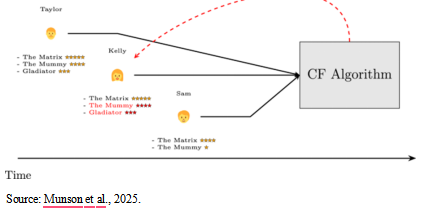
This example involves three users, their viewing choices, along with recommendations generated based on similar interests. The first user (Taylor) watched “The Matrix,” “The Mummy,” and “Gladiator”, rating them 5, 4, and 3 stars, respectively, while Kelly watched “The Matrix,” and gave it a 5-star rating, while the third user (Sam) watched “The Matrix” and “The Mummy.” The data of each of these users contribute to the CF algorithm. Based on the similarity between Taylor and Kelly (i.e., both highly rated “The Matrix”), Kelly is recommended “The Mummy” and “Gladiator”. Note: The predicted ratings for Kelly correspond to Taylor’s ratings, as only Taylor’s data were used to generate her recommendations. Sam’s preferences (i.e., that he liked “The Matrix” while “The Mummy” did not appeal to him) do not influence Kelly’s recommendations, as his data are added later in the process (Munson et al., 2025).
A further step in increasing the complexity of collaborative algorithms is offered by so-called time weighting, i.e., the calculation of time weight. In this approach, greater importance is given to more recent user ratings than to older ones, enabling the tracking of changes in user preferences over time. These algorithms are used not only in e-commerce but also in recommending content on video-streaming platforms. Even the same user has quite different preferences for different items. The algorithm proposed by a group of authors uses clustering to distinguish between different types of items. For each category of items, changes in user interest were monitored, and a personalized decay factor was introduced based on individual viewing behavior (Ding, Li, 2005).
It should be noted that the use of algorithms on video-streaming platforms does not necessarily imply the use of artificial intelligence. AI is applied across multiple levels on these platforms, extending far beyond recommendation systems (Recommendation Engine) – although these remain the most invisible and widely recognized application – where it analyzes what users watch, how long they watch, what they interrupt, when they watch, what they like or dislike, and identifies similar users. Specifically, by analyzing user data, viewing history, and individual interests, OTT platforms aim to provide a personalized viewing experience. AI also enables personalization of the user interface (User Interface Personalization) — including the arrangement of content rows on the homepage, as well as the size and positioning of posters, meaning that no two users are presented with the same homepage. Additionally, AI enables the personalization of artwork and trailers (Artwork Personalization), whereby the system selects the most appropriate poster for a given piece of content for each user from the database (e.g., a pool of around 20 posters per title). A special tool is AI-driven search optimization (AI Search Optimization), where entering a term into the search field, for example ‘drama’, the system analyses, among other things, user intent, related terms, and contextual factors (such as the user’s typical viewing behavior). The use of AI is also significant in ensuring the accessibility of video-streaming platforms for persons with disabilities through automatically generated subtitles (speech-to-text), subtitle synchronization, translations, etc. AI systems can also anticipate user behavior, such as the likelihood of skipping the intro, enable automatic playback of the next episode, and can even pause playback if it detects user inactivity. Besides this, there are also AI tools that the user does not see which are used to improve the experience, such as so-called adaptive streaming – dynamic video quality adjustment, where technical parameters are adjusted if the user has poor internet, an inadequate device, low battery, etc. All of these AI tools are intended to encourage users to spend more time on the platform, which in turn leads to greater user engagement and revenue growth. However, in addition to benefits and conveniences, this also raises ethical concerns that point out certain risks.
OTT platforms have revolutionized the way media is consumed by using artificial intelligence which provides tailored content recommendations, thereby improving the user experience and engagement. However, as AI algorithms become more sophisticated, concerns are also growing regarding data protection, algorithmic bias, and transparency (Singh et al., 2024). The dominant concern arises from the so-called “filter bubble” effect in recommender systems, that is, the question of whether they really lead to the isolation of users within certain content. According to a group of authors who carried out an extensive analysis of available studies, it has been confirmed that filter bubbles are present in recommender systems. They examined the basic causes of excessive personalization. The literature identifies algorithmic bias and cognitive bias as the primary causes of excessive personalization. Algorithmic bias arises when biases are introduced during the design and implementation of a system, while cognitive biases, such as confirmation bias, influence user interaction data (Qazi et al., 2023).
Video-streaming platforms claim that they use AI and users’ personal data exclusively to enhance the platform, particularly for content recommendation, informing users about relevant features, and personalizing content according to their interests. In such cases, content curation—that is, the deliberate selection, organization, filtering, and presentation of content to ensure that it is relevant, high-quality, and tailored to a specific audience—is performed by a “digital editor,” which determines what is worth displaying, in what order, and in what context. This is where the main problem arises. The lack of transparency of AI algorithms adds another layer of complexity to the problem of content curation on OTT platforms. Users often do not understand how recommendations are generated or why certain content is suggested to them, which leads to reduced trust in the system. In an era in which data-driven decision-making is becoming increasingly prevalent, the opacity of AI systems can foster skepticism and hinder user acceptance of the technology (Singh et al., 2024). It is precisely the relationship between user habits, expectations, and trust in AI that served as the primary motive for conducting this research.
Materials and Methods
For the purposes of this paper, a survey study entitled “Contemporary Consumerism – OTT Platforms” was conducted among the urban population that uses the internet and video-streaming platforms. The research on users’ habits and views about the use of AI algorithms on OTT platforms was conducted by means of a survey, using an online questionnaire on the Google Forms platform. Data were obtained from 405 respondents, predominantly from Belgrade. The questionnaire was completed by 63.2% female respondents (256 persons) and 36.5% male respondents (148 persons). In terms of age, respondents were aged 18–24 (29.9%, n = 121), 25–34 (15.6%, n = 63), 35–44 (21.5%, n = 87), 45–54 (23.2%, n = 95) and 55+ (9.9%, n = 40). In terms of education level, 135 respondents (33.3%) had secondary education, 152 of them (37.5%) higher education, 73 respondents (18%) master’s degree, and 55 respondents (13.6%) a doctoral degree.
Given that the research is focused on the behavior of OTT platform users in an urban environment, the sample predominantly from Belgrade is used as purposive sampling, and the results are interpreted within the framework of the urban population. The survey, conducted between 20 October and 20 November 2025, consisted of 27 questions covering demographic characteristics (four questions), OTT usage habits (six questions), content-related behavior (four questions), the application of artificial intelligence and user responses (eight questions), and attitudes toward its ethical implications (four questions).
Results
The findings of the study on user habits and perceptions among contemporary viewers indicated that, of the 405 respondents, as many as 54.1% spend between one and three hours per day on video content, 21.7% between three to five hours, 16% less than one hour, while 8.1% spend more than five hours daily. When asked which OTT platforms they use, more than half of the participants, as many as 54.6% (221 persons), reported using Netflix; 39.5% use EON (160 respondents), 34.3% HBO Max (n = 139), YouTube Premium is used by 31.9% of respondents (129), 20.2% use RTS Planeta, while the others mostly use Disney+, RTL+, and other platforms. A majority of users, 54.3% (220 of them), follow content on an OTT platform every day; 31.6% (n = 128) do so several times a week; 6.2% once a week; and 7.9% of respondents less frequently. When it comes to the device most often used to access content, smart TVs are in a slight lead, used most widely by 40.7% (n = 165) of respondents, compared with mobile phones—39% (n = 158) of respondents. These are followed by laptops or desktop computers—17.5% (n = 71) users—while tablets are used for these purposes by only 2.7% (n = 11) of users.
A third of respondents most frequently watch TV series on OTT platforms—33.6% of respondents (n = 136)—followed by films, 18.8% (n = 76 respondents), while there is relatively balanced interest in news programs—12.8%, sport 12.3%, and music 12.1%; the rest mostly watch documentaries and children’s content. Despite the considerable amount of time spent on OTT platforms, a large proportion of respondents, as many as 62.5% (253 persons), reported that they were partially satisfied with the content offer on the platforms they follow; 28.4% (n = 115) were very satisfied, while 9.1% (n = 37) were dissatisfied. As many as 85.2% (n = 345) claimed that the quality of content is the most important factor when choosing a platform; ease of use was given priority by 20.7% (n = 84) of respondents, subscription price was valued by 20% (n = 81), while 5.9% (n = 24) emphasized the importance of personalized messages and 3.2% (n = 13) the importance of local content. According to origin, only 15.6% (n = 63) said that they preferred domestic programs, 40% (n = 162) favored foreign programs, while a combination of domestic and foreign programs was most commonly chosen by 44.4% (n = 180) of respondents. In line with the previous findings, 40.2% (n = 163) of respondents consider it only moderately important whether the platform offers locally produced programs; 12.8% (n = 52) find this highly important; for 16% (n = 65) it is of little importance. The remaining responses were distributed across the intermediate points on the scale: it is considered important by 14.3% of respondents (n = 58), and not important by 16.5% (n = 67).
Since the central topic of the research is content recommendation, this concept is introduced in the questionnaire through a set of questions. Participants first had the opportunity to answer the question of how often they share their impressions or recommendations about content (e.g., on social media). 33.6% of them (n = 136) reported that they rarely share content, 30.9% (n = 125) never share it, 25.9% (n = 105) do this occasionally, while only 9.6% (n = 39) often share their impressions and recommendations. As for the recommendations offered by the application itself, as many as 65.2% (n = 264) sometimes use them, 18.5% (n = 75) do not use them at all, and 16.3% (n = 66) mostly rely on recommendations.
Four-fifths of respondents—80.2% (n = 325)—are aware that platforms use artificial intelligence to recommend content; 13.1% (n = 53) have some doubts about it, while 6.7% (n = 27) stated that they are not aware of it. A high percentage of respondents—as many as 80.5% (n = 326)—are partially satisfied with the accuracy of the recommendations they receive; 15.1% (n = 61) are very satisfied, while 4.4% (n = 18) reported being dissatisfied. When asked whether the platform understands their tastes and preferences, over half of respondents, 56% (n = 227), indicated that it generally does; 31.9% (n = 129) stated they didn’t have that impression, while 12.1% (n = 49) answered in the negative. For almost two-thirds of respondents—64.4% (n = 261)—it is not particularly important that the recommendations they receive on OTT platforms be personalized. 22.7% (n = 92) stated that personalized recommendations are very important to them, while 12.8% (n = 52) said they do not want personalization.
Around two-fifths of users—40.2% (n = 163)—feel that artificial intelligence influences what they watch (e.g., that it directs them toward certain types of content); 37.8% (n = 153) partially have that feeling, while 22% (n = 89) do not feel that artificial intelligence manipulates them by guiding them toward what they should watch. When asked whether they believe that artificial intelligence can manipulate the choice of content they watch, for example by promoting certain views or products, as many as 51.4% (n = 208) answered in the affirmative; 33.6% (n = 136) stated that it sometimes does; 8.6% (n = 35) indicated “rarely”; while 6.4% (n = 35) do not believe that AI may influence user choices.
In this regard, 66.2% (n = 286) of respondents stated that they would like greater transparency regarding how recommendations are created (e.g., why something was suggested to them), while 33.8% (n = 137) did not support this. When asked about the protection of personal data, that is, whether they are concerned about the privacy of the data the platform uses for personalization, almost one-third of respondents declared they were highly concerned—30.4% (n = 123); almost half of respondents are partially concerned—47.2% (n = 191); while 22.5% (n = 91) are not concerned at all.
Artificial intelligence also offers AI assistants in various fields. One question in this survey addressed user needs. Thus, 35.3% (n = 143) of respondents answered that it would be interesting if the platform offered an interactive AI assistant that recommends content based on their engagement with AI, 34.3% (n = 139) were not sure how they would react, while 30.4% (n = 123) would not want this form of communication.
Over half of respondents, 51.4% (n = 208), believe that platforms should clearly label content that was created or adapted by artificial intelligence; 27.9% (n = 113) would apply labeling only to fully AI-generated content; 11.9% (n = 48) believe that it is not necessary; while 8.9% (n = 36) are not sure.
For 59.8% (n = 242) of users, it is highly important that AI systems on platforms operate in an ethically responsible way, e.g., without bias, discrimination, or manipulation. Is considered important for 16% (n = 65) of users, partially important for 15.8% (n = 64), less important for 3.2% (n = 13), and unimportant for 5.2% (n = 21) of users. In terms of users’ trust that the platform uses their data ethically and exclusively for personalization purposes, almost half of them—47.9% (n = 194)—have limited trust, 33.3% (n = 135) do not have trust at all, 10.1% (n = 41) are unsure, while 8.6% (n = 35) have complete trust in it.
Taken together, 39.3% (n = 159) of respondents reported that they believe the use of artificial intelligence on platforms can affect users’ freedom of choice; 24.2% (n = 98) are unsure; 20.7% (n = 84) think that it does not have a significant impact; while 15.8% (n = 64) recognized the advantages of AI and believe that it does not restrict freedom of choice, but rather expands it.
Discussion
The conducted study, carried out on an adult urban population of OTT platform users, is consistent with current trends in shaping viewing habits. Today’s media landscape, reshaped by the rapid rise of new media, has become markedly more dynamic and complex. As a result, most media organizations perceive it as increasingly competitive, where the choice of content to be distributed plays a decisive role. In the struggle to capture the attention of viewers— modern consumers of media content —media outlets face a fundamental question: what content should be offered, and how should it be presented? The starting point lies in a thorough understanding of the audience (Ćitić, 2025).
Research conducted in Serbia, focusing on the impact of Netflix’s recommendation system in smaller markets, suggests that algorithms do more than simply adapt content to users’ preferences—they also subtly shape those preferences. This becomes particularly evident in the consistent promotion of new seasons of popular and highly rated series, even when users have not previously shown interest in that genre. Recommendations for shows such as “The Lincoln Lawyer” illustrate this tendency. However, there are two even more telling examples of this algorithm manipulation (Milosavljević, 2023). One such mechanism is the personalization of artwork (posters), tailored to individual viewing profiles. By analyzing identical content—such as the series “Lupin” and “Sex Education”—the study found that different users were shown different promotional images (artworks). For instance, a viewer inclined toward mystery and comedy might see “Lupin” represented by an image of the protagonist holding a book while facing camera, evoking intrigue. Meanwhile, an “ideal” user profile might be presented with a more cinematic scene: the character standing at a height at night, overlooking a brightly lit Paris. A viewer who prefers domestic content, however, could encounter a completely different image—one depicting the main actor holding a dog. Moreover, the study highlights that not only are popular series persistently recommended, but after just a week of diverse viewing activity across different profiles, the system begins to identify certain titles as highly compatible with all users—regardless of their initially distinct tastes (Milosavljević, 2023).
Such practices raise concerns about the so-called filter bubble effect, whereby users are repeatedly exposed to similar content, potentially creating a form of “tunnel vision” and limiting the diversity of what they consume. Ethical questions also arise regarding transparency and the extent to which users retain autonomy in choosing content from a broader range of options (Yasmeen & Hashmat, 2025). At the same time, some researchers argue that these effects can be mitigated through alternative algorithmic approaches. One such proposal is the AbIN model, an innovative framework based on opposing yet interdependent dimensions. It seeks to balance the information that algorithms typically emphasize with content that is usually overlooked, drawing on the principles of the Y− and Y+ theory (Wang et al., 2024).
According to research conducted by Deloitte in the United States, Generation Z shows greater interest in video content on social media than in binge-watching series on video streaming platforms. This shift presents a new challenge for algorithms: how to re-engage this audience, which increasingly trusts recommendations from social media influencers more than the algorithmic suggestions offered by streaming platforms themselves (Deloitte, 2025).
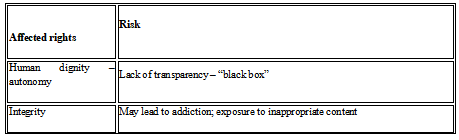
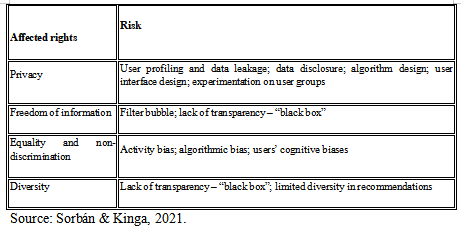
As OTT platforms attempt to strike a balance between personalization and privacy, ethical considerations are becoming increasingly prominent. The design of AI algorithms must prioritize reducing bias and enhancing fairness. Respecting user autonomy and providing users with control over their data and preferences are essential for building trust and ensuring a positive user experience (Singh et al., 2024). Existing research suggest that fundamental rights are significantly affected by AI-driven recommendation systems. In particular, concerns have been raised regarding the impact on human dignity, autonomy, integrity, privacy, freedom of information, equality, non-discrimination, and diversity (Sorbán & Kinga, 2021).
Table 1. Risk Map of AI-Based Recommendation Systems
The widespread adoption of artificial intelligence has highlighted the need for regulation and normative frameworks governing AI technologies. A significant contribution in this regard comes from a study conducted by a group of researchers who analyzed 200 documents published by institutions and companies worldwide. Their findings indicate that countries face considerable challenges in defining guidelines and regulations, largely due to the complexity of competing interests involved. They also emphasize that, for most stakeholders, the development and operation of systems and applications that affect large populations remain a “black box”—a lack of understanding of how algorithms function. All relevant actors should be informed about the internal processes that regulate and shape their environment. According to the authors, transforming today’s largely deregulated AI industry may require stronger governmental oversight, combined with a shift in the culture of AI development. Many developers are already aware of the risks and shortcomings of such technologies—shortcomings that disproportionately affect the most vulnerable groups (Corrêa et al., 2024). In addressing ethical challenges, the authors argue that a range of strategies can be employed to balance personalization and privacy. The implementation of robust data protection measures, such as anonymization and encryption, can safeguard user identity and sensitive information. An “opt-in” approach, allowing users to actively choose whether to participate in personalized recommendation systems, supports respect for user autonomy and individual boundaries (Dr. Mansi Singh, et al., 2024). Furthermore, the development of so-called explainable AI systems can provide users with transparent explanations of why specific content is recommended to them, thereby enhancing algorithmic transparency and improving users’ understanding of how these systems operate.
Conclusion
The analysis of the research results, based on a survey examining contemporary consumer behavior and OTT platforms, confirms concerns regarding the potential risks and ethical issues associated with the misuse of user data, particularly in the context of algorithmic manipulation. Since participants do not express a uniform stance toward personalized recommendations generated through algorithmic curation, it can be concluded that the use of AI tools—while not always welcomed—offers both benefits and risks. Maintaining user trust and ensuring fair practices requires addressing key challenges, including algorithmic bias, data privacy, and broader ethical considerations. Looking ahead, further advancements should prioritize transparency, interoperability, and fairness, while adopting cutting-edge AI methodologies to enhance personalization and optimize user interaction (Arshad et al., 2025). In this context, the development of OTT platforms—shaped by both market competition and the establishment of clearer regulatory frameworks—should place a strong emphasis on improving user experience, expanding content choice, and strengthening the trust and loyalty of contemporary media consumers.
Reference
2.Bošković, Vuk. (July 1th, 2014). Uspon Netflixa – revolucija u procepu između piraterije i kablovske TV. Available at: https://www.beforeafter.rs/drustvo/netflix/.
3.Chapman H.E, Abraham A. (2025) Because You Watched: How Do Streaming Services' Recommender Systems Influence Aesthetic Choice? Behav Sci (Basel).; 15(11):1544. https://doi.org/10.3390/bs15111544
4.Correa, N. K., Galvão, C., Santos, J. W., Del Pino, C., Pinto, E. P., Barbosa, C., Massmann, D., Mambrini, R., Galvão, L., Terem, E., & de Oliveira, N. (2023). Worldwide AI Ethics: A review of 200 guidelines and recommendations for AI governance. AI Robotics Ethics Society. https://doi.org/10.1016/j.patter.2023.100857
5.Ćitić, T. (2025). Young adults and viewing habits of video content. SCIENCE International Journal, 4(3), 75-80. https://doi.org/10.35120/sciencej0403074c
6.Deloitte. (March 25th, 2025). 2025 Digital Media Trends: Social platforms are becoming a dominant force in media and entertainment. Dostupno preko: https://www.deloitte.com/us/en/insights/industry/technology/digital-media-trends-consumption-habits-survey/2025.html
7.Singh, M., Sharma, K., Kaur, A., & Keshav, M. (2024). AI-enabled content curation in OTT platforms: Balancing personalisation and privacy. Futuristic Trends in Artificial Intelligence (IIP Series, Vol. 3, Book 12, Part 7, Ch. 1, pp. 213–228). https://doi.org/10.58532/V3BIAI12P7CH1
8.Gaines, B. (July, 14th 2025). OTT Statistics & Global Market Share 2025 (Data By Country). Available at: https://evoca.tv/ott-statistics
9.Gomez-Uribe, C. A., & Hunt, N. (2015). The Netflix Recommender System: Algorithms, business value, and innovation. ACM Transactions on Management Information Systems, 6(4), 1–19. https://doi.org/10.1145/2843948
10.Gorringe, J. (2025, April 17). Netflix vs Amazon Prime Video: Which streaming platform is better? Trusted Reviews. Available at: https://www.trustedreviews.com/versus/netflix-vs-amazon-prime-video-2918310
11.Johnson, C. (2019). Online TV (1st ed.). Routledge. https://doi.org/10.4324/9781315396828
12.Klimashevskaia, A., Jannach, D., Elahi, M. et al. (2024). A survey on popularity bias in recommender systems. User Model User-Adap Inter 34, 1777–1834. https://doi.org/10.1007/s11257-024-09406-0.
13.Liu, L., De Costa, M. F. S., Muhammad, M. S., Gong, S., & Liu, B. (2024). The moderating effect of algorithm literacy on Over-The-Top platform adoption. Entertainment Computing, 49, 100623. https://doi.org/10.1016/j.entcom.2023.100623
14.Manfredi, L. (21th January 2025). Netflix Tops 300 Million Subscribers Globally, Adds Record-Breaking 19 Million in Q4. Available at: https://www.thewrap.com/netflix-earnings-q4-2024/
15.Milosaljević, I. (2025). How Netflix’s Recommendation Algorithms Function in Small Markets – The Case of Serbia. AM Journal of Art and Media Studies, (36). https://doi.org/10.25038/am.v0i28.612
16.Milosavljević, I., & Simeunović Bajić, N. (2025). The impact of Netflix and video streaming services on changes in distribution, production, and audience of television series. Društvene i humanističke studije, 10(1), 763–784. https://doi.org/10.51558/2490-3647.2025.10.1.763
17.Munson, J., Cummins, B. & Zosso, D. (2025) An introduction to collaborative filtering through the lens of the Netflix Prize. Knowl Inf Syst 67, 3049–3098. https://doi.org/10.1007/s10115-024-02315-z
18.Netflix. How Netflix's recommendation system works. Dostupno preko: How Netflix’s Recommendations System Works | Netflix Help Center
19.Pandey R., & Rashid Khan, MD. (2024). The behaviour of consumers towards subscriptions to online streaming applications. Academy of Marketing Studies Journal, 28(3), 1-19. Available at: https://www.abacademies.org/articles/the-behaviour-of-consumers-towards-subscriptions-to-online-streaming-applications.pdf.
20.Qazi, M. A., Nadeem, M., Sohail, S. S., Imam, R., Doctor, F., Himeur, Y., Hussain, A., & Amira, A. (2023). Filter bubbles in recommender systems: Fact or fallacy — A systematic review. arXiv:2307.01221. arXiv. https://doi.org/10.48550/arXiv.2307.01221
21.Računarski fakultet. Šta je algoritam. Available at: https://raf.edu.rs/citaliste/sta-je-algoritam/
22.Sorbán, K. (2021). Ethical and legal implications of using AI-powered recommendation systems in streaming services. Információs Társadalom XXI, no. 2 ): 63–82. https://doi.org/10.22503/inftars.XXI.2021.2.5
23.Wang, M., Hu, Y., Wu, S., Li, W., Bai, Q., & Rupar, V. (2024). Balancing information perception with Yin–Yang: Agent-based information neutrality model for recommendation systems. arXiv:2404.04906. https://doi.org/10.48550/arXiv.2404.04906
24.Yasmeen, K., & Hashmat, S. (2025). The role of AI-driven algorithms on user engagement and media consumption trends in OTT platforms. The Research of Medical Science Review, 3(6), 9–21. DOI: https://doi.org/10.5281/zenodo.15581215
25.Ding, Y., & Li, X. (2005). Time weight collaborative filtering. Proceedings of the 14th ACM International Conference on Information and Knowledge Management (CIKM ‘05) (pp. 485–492). Association for Computing Machinery. https://doi.org/10.1145/1099554.1099689
Objavljeno u
God. 12 Br. 1 (2026)
Ključne reči
🛡️ Licenca i prava korišćenja
Ovaj rad je objavljen pod Creative Commons Attribution 4.0 International (CC BY 4.0).
Autori zadržavaju autorska prava nad svojim radom.
Dozvoljena je upotreba, distribucija i adaptacija rada, uključujući i u komercijalne svrhe, uz obavezno navođenje originalnog autora i izvora.
Zainteresovani za slična istraživanja?
Pregledaj sve članke i časopise