
CRISIS COMMUNICATION OF BRANDS ON DIGITAL PLATFORMS

Abstract
Digital platforms have transformed brand communication while increasing companies’ exposure to reputational risks. The paper analyzes crisis communication strategies used by brands to protect their reputation during and after crisis situations. A qualitative methodology based on case study analysis was applied to international brands, including Nike, Starbucks, and H&M. The analysis focused on communication through Twitter/X, Instagram, and Facebook, with particular attention to the speed, tone, transparency, and consistency of messages and public reactions. The theoretical framework includes the Situational Crisis Communication Theory (SCCT). The results indicate that timely, transparent, empathetic, and consistent communication can reduce the negative impact of crises and contribute to maintaining consumer trust and strengthening brand reputation.
Article
Introduction
The digital transformation of business in the last decade has radically changed the way brands communicate with their stakeholders. The development of social networks, content sharing platforms and mobile technologies has enabled brands to communicate directly, quickly and interactively with consumers, investors, employees and the general public. However, the same infrastructure that enabled the intensification of relations with the public simultaneously increased the vulnerability of companies to reputational risks. In the digital environment, information is spread in real time, and negative content can become viral within minutes, thus rapidly developing and escalating crisis situations. Unlike traditional media, where communication was predominantly one-way and controlled, digital platforms imply two-way communication and a high degree of user participation. Consumers today are not just recipients of messages, but active creators and distributors of content. Comments, reviews, posts and shares have the potential to shape the public's perception of a brand to a greater extent than official company announcements. This is precisely why crisis communication acquires a new dimension - it is no longer exclusively a reaction to a crisis event, but a continuous process of reputation management in the dynamic digital space.
Modern brand crises often arise or escalate precisely on digital platforms. An inappropriate advertising campaign, insensitivity to social and cultural issues, failures in the quality of products or services, as well as ethical or operational problems, can cause strong reactions from the public. Examples of companies such as Nike, Starbucks and H&M show that the way a brand communicates during a crisis can have a decisive influence on the further course of events and long-term effects on reputation. While some companies successfully managed the crisis through timely and transparent communication, others faced prolonged backlash due to insufficient empathy or an inadequate response.
In a theoretical sense, crisis communication represents an important segment of corporate communications and crisis management. The theory of situational crisis communication (Situational Crisis Communication Theory - SCCT) is particularly important, which starts from the assumption that the effectiveness of the communication strategy depends on the perception of responsibility that the public attributes to the company. In the digital context, the application of this theory acquires additional complexity, because the perception of responsibility is formed and changed under the influence of the rapid flow of information, comments and media interpretations.
The topicality of the topic is reflected in the fact that almost no modern organization is immune to digital reputational risks. The globalization of the market, growing social sensitivity to ethical and social issues, as well as the increasing transparency of business additionally reinforce the importance of a strategic approach to crisis communication. In this context, crisis communication is not only a defensive mechanism of reputation protection, but also an opportunity to reaffirm the value of the brand and strengthen relations with stakeholders.
The subject of this work is the analysis of crisis communication of brands on digital platforms, with a special focus on the strategies that companies apply to preserve their reputation during and after crisis situations. The paper seeks to examine how different communication approaches - speed of response, message tone, transparency and consistency - affect public perception and long-term effects on the brand. Through the analysis of selected case studies of international companies, the goal is to identify patterns of successful and less successful practice, as well as to offer recommendations for improving crisis communication in the digital environment.
The structure of the work is designed so that, after the introductory discussion and definition of goals and research questions, follows the theoretical framework that explains the key terms and models of crisis communication. Next, the research methodology and case study analysis are presented, after which the results are interpreted in the context of the set hypotheses. The work ends with conclusions and recommendations for practice, with the aim of contributing to a better understanding of the role of crisis communication in modern digital marketing management.
The goal and tasks of the research
The modern digital environment has significantly changed the dynamics of the relationship between brands and their stakeholders. The speed of information dissemination, interactivity and high visibility of communication contribute to the fact that crisis situations become public almost in real time. In such an environment, crisis communication goes beyond the operational level and becomes a strategic instrument of reputation management (Coombs, 2015; Fearn-Banks, 2017). Considering the growing importance of digital platforms, it is necessary to systematically examine the way communication strategies influence public perception and long-term brand image.
The main goal of the work is to examine how brand crisis communication on digital platforms affects public perception and brand reputation during and after crisis situations. This objective involves the analysis of communication strategies that companies apply in the digital space, as well as the assessment of their effect on the attitudes of consumers and the general public. In a theoretical sense, the goal of the work is to integrate modern approaches to crisis communication, especially the Situational Crisis Communication Theory (SCCT), with the specifics of the digital environment, in which transparency, speed of reaction and interactivity are key success factors (Miljković & Savić, 2018; Milenković et al., 2018). SCCT starts from the assumption that the choice of communication strategy should be aligned with the degree of responsibility that the public attributes to the organization, because the perception of responsibility directly affects reputational damage. In a practical sense, the aim of the work is to identify patterns of successful crisis communication that can serve as guidelines for brands in the digital environment. Special emphasis is placed on the analysis of case studies of companies such as Nike, Starbucks and H&M, which faced high-intensity crises in the digital space.
In accordance with the defined goal, the following research tasks were set:
1. Analysis of theoretical approaches to crisis communication in the digital environment. This task includes the systematization of relevant theoretical models, including SCCT (Mihajlović & Savić, 2024), image-restoration theory (Mihajlović et al., 2022a) and modern approaches to reputation management in digital communication conditions. Special attention is paid to the differences between traditional and digital media in the context of crisis communication (Mihajlović et al., 2022b).
2. Identifying the key characteristics of successful crisis communication. Based on theoretical assumptions and previous research, factors such as speed of reaction, transparency, empathy, taking responsibility and consistency of messages will be analyzed. Research shows that timely and empathetic communication can significantly reduce reputational damage and negative consumer attitudes (Coombs & Holladay, 2010).
3. Analysis of specific case studies of well-known companies. Within this task, the communication strategies of selected brands during specific crisis situations will be analyzed, with a focus on the content of announcements on digital platforms, the tone of communication and public reactions.
4. Comparing different communication strategies and their effects. Comparative analysis will enable the identification of differences in approaches (e.g. strategy of apology, denial, justification or value positioning) and assessment of their impact on the perception of reputation (Ivanova & Savić, 2022; Krstić et al., 2023).
5. Drawing conclusions and recommendations for practice. Based on theoretical and empirical analysis, the paper aims to offer concrete recommendations for the improvement of crisis communication of brands on digital platforms, including the development of crisis protocols, continuous monitoring of digital channels and education of communication teams.
Defined goals and objectives enable a systematic approach to researching the phenomenon of crisis communication in the digital environment, while connecting theoretical concepts and practical examples from the contemporary business context.
Research questions and hypotheses
The development of digital platforms has significantly changed the dynamics of crisis communication, making it faster, more visible and more amenable to public evaluation in real time. In such a communication environment, public perception and brand reputation become directly dependent on the way the company reacts to a crisis situation. Starting from modern theoretical approaches to crisis communication, especially situational crisis communication theory (SCCT), this chapter defines research questions and hypotheses that form the basis of the empirical part of the work.
In accordance with the subject and objective of the research, the following research questions were formulated:
- How do brands use digital platforms in crisis situations? Digital platforms enable immediate communication with a wide audience, but at the same time imply high transparency and interactivity. According to Coombs (2007), organizations in crisis situations choose communication strategies in accordance with the perception of responsibility that the public attributes to the company. In the digital environment, the choice of channel (e.g. Twitter/X, Instagram, Facebook), message tone and speed of response become key elements of strategy (Veil et al., 2011).
- Which factors of crisis communication have the greatest influence on the perception of brand reputation? Brand reputation is a long-term intangible resource of an organization (Fombrun & Van Riel, 2004). Research indicates that transparency, taking responsibility and an empathic tone of communication significantly influence public perception during a crisis (Coombs & Holladay, 2002). In the digital context, an additional factor is interactivity - the possibility of responding to comments and direct involvement in dialogue with users (Jovanović et al., 2019).
- Does the speed and tone of communication affect the consumer's reaction? The speed of reaction has become one of the most important indicators of effective crisis communication in the digital age. According to research by Liu, Austin and Jin (2011), organizations that react quickly reduce the space for negative narratives to spread. The tone of communication, especially the expression of empathy and regret, contributes to reducing negative emotions and strengthening trust (Kostić et al., 2022).
Based on the defined research questions and the theoretical framework, the following hypotheses were formulated:
H1: Timely reaction of the brand on digital platforms significantly reduces the negative impact of the crisis on the reputation.
H2: Transparent and empathetic communication during a crisis has a positive effect on consumer attitudes.
H3: Consistency of messages through different digital channels contributes to maintaining trust in the brand.
The first hypothesis starts from the assumption that the speed of reaction affects the formation of the initial perception of the public. SCCT theory emphasizes that organizations must provide timely information in order to reduce reputational damage (Savić et al., 2021). In a digital environment, a delay in communication can be interpreted as irresponsibility or ignoring the problem.
Regarding the second hypothesis, it is important to emphasize that the theory of image restoration (Savić et al., 2025a), strategies of apologies, explanations and corrective actions can contribute to the restoration of reputation. Transparency and empathy reduce perceptions of intent and moderate negative public reactions (Coombs & Holladay, 2008).
Regarding the third hypothesis, it should be emphasized that in the conditions of multi-channel communication, the inconsistency of messages can cause confusion and further damage the reputation. Integrated communication and coordination of messages across different platforms contribute to the perception of professionalism and credibility (Cornelissen, 2020).
In order to empirically test the hypotheses, the key variables were defined:
- Independent variables: speed of reaction (time from outbreak of crisis to first announcement), tone of communication (empathic, defensive, neutral), transparency (degree of taking responsibility), consistency of messages (harmony of communication on different platforms).
- Dependent variable: perception of brand reputation (expressed through sentiment analysis of comments, number of negative/positive reactions and media interpretation of the event).
- Control variables: type of crisis (ethical, reputational, operational), previous brand image and level of responsibility attributed by the public to the company.
The research questions and hypotheses posed in this way enable a systematic analysis of the impact of crisis communication on brand reputation in the digital environment, relying on relevant theoretical models and contemporary research in the field of public relations and corporate communications.
Theoretical framework
Crisis situations in the business context represent unforeseen events that can threaten the reputation, financial stability and operational functioning of the organization. According to Coombs (2015), organizational crisis is the perception of an unpredictable event that threatens important expected outcomes of stakeholders and can seriously affect organizational performance. In the digital environment, this definition takes on an additional dimension, as crises often develop and escalate in real time, influenced by online audiences and algorithmically mediated communication flows.
Crisis situations can be classified according to different criteria. One of the most common divisions relates to:
- Operational crises (e.g. product or service problems),
- Reputational crises (negative publicity, accusations of unethical business),
- Ethical crises (discrimination, corruption, irresponsible management behavior),
- Communication crises (inadequate or ill-considered public message).
A special form is represented by digital crises, which arise or escalate on social networks, forums and other online platforms. In such situations, the traditional hierarchical control of communication gives way to a decentralized model, where users generate and distribute content (Savić et al., 2025b). The virality of the content and the possibility of instant dissemination of information further increase the risk of reputational damage. According to the Situational Crisis Communication Theory (SCCT), the perception of the organization's responsibility for the resulting crisis is a key factor in choosing a communication strategy (Milanović & Gojkov, 2024). SCCT distinguishes three basic groups of crises: victim crises (the organization itself is a victim of the event), accidental crises (unplanned mistakes without intention) and preventable crises (crises that could have been avoided). The degree of attributed responsibility directly affects reputational damage and public expectations regarding the company's response.
Brand reputation represents the sum of perceptions and attitudes that stakeholders have about the organization, based on previous experiences, communication and social responsibility (Fombrun & van Riel, 2004). It is considered a strategic intangible resource that affects customer loyalty, market value and the company's competitive position. Crisis communication has a key role in protecting and restoring reputation. Benoit (1997) in his theory of image restoration (Image Restoration Theory) points out that organizations during a crisis use different rhetorical strategies, such as denial, reduction of responsibility, justification, apology or corrective action. The choice of strategy depends on the nature of the crisis and the degree of responsibility that the public attributes to the organization. SCCT extends this approach, emphasizing that the response strategy must be aligned with the perception of responsibility and the previous reputation of the organization (Zupur et al., 2023). For example, in high-responsibility cases, apology and compensation strategies are recommended, while in low-responsibility crises, information and explanation strategies can be applied. The digital environment further complicates reputation management, as communication takes place publicly and under the constant scrutiny of the online community. Consumers today expect transparency, speed and authenticity in communication (Ki & Nekmat, 2014). A lack of response or an inadequate tone of communication can lead to a secondary crisis, i.e. a worsening of the situation due to the perception of irresponsibility. Empathy and taking responsibility have proven to be key elements of successful crisis communication. Research indicates that transparent and timely communication can mitigate the negative effects of a crisis and even contribute to the long-term strengthening of reputation (Claeys, Cauberghe, & Vyncke, 2010).
Digital platforms, especially social networks, have become central channels of communication between brands and their stakeholders. Platforms like Facebook, Instagram and X enable immediate, two-way and public communication, which represents both an opportunity and a risk for organizations. On the one hand, digital platforms allow brands to respond quickly to a crisis situation, provide accurate information and communicate directly with affected groups. On the other hand, the speed of information dissemination and emotionally colored user comments can contribute to the escalation of the crisis (Jin et al., 2014). The specificity of digital platforms is reflected in the following characteristics:
- Real-time communication - immediate brand reaction is expected.
- Interactivity – users actively participate in the discussion.
- Visibility and durability of content - posts remain available and can be shared again.
- Algorithmic amplification – content with high engagement gets more visibility.
In such an environment, monitoring digital channels becomes a necessary part of crisis management. Sentiment analysis, keyword tracking and influencer identification allow organizations to react in a timely manner and adjust their communication strategy. Modern approaches emphasize the need for an integrated model of crisis communication, in which digital channels equal to traditional media (Coombs, 2015). Consistency of messages across different platforms helps maintain trust and reduce confusion among stakeholders.
Research methodology
Qualitative research methodology was applied in the work, with the aim of a deeper understanding of how brands manage crisis communication on digital platforms and how these strategies affect public perception and brand reputation. A qualitative approach enables the analysis of complex communication processes, symbolic meanings and the context in which crises develop (Obrić & Majstorović, 2023). A case study was chosen as the basic research design, since it enables a detailed examination of contemporary phenomena in a real context, especially when the boundaries between the phenomenon and the environment are unclear (Yin, 2018). This approach is particularly suitable for researching crisis communication in the digital space, where interactions are dynamic, multi-layered and publicly available.
The units of analysis are international brands that have faced crises of high publicity on digital platforms. The paper analyzes the cases of companies: Nike, Starbucks and H&M. Criteria for the selection of cases included: high degree of media and public attention, intensive communication on digital platforms during the crisis, availability of public data (posts, user reactions, media reports) and different communication strategies that enable comparative analysis. These companies were selected because they represent globally recognizable brands with a developed digital presence and significant influence on the public, which makes their crisis situations relevant for the analysis of reputational effects.
The following data collection methods were used in the research:
- A qualitative analysis of the content of brand announcements on social networks (Twitter/X, Instagram and Facebook) was conducted during crisis situations. The following were analyzed: tone of communication (neutral, defensive, empathetic, proactive), speed of response (time from the outbreak of the crisis to the first official reaction), presence of apologies and taking responsibility, and consistency of messages through different channels. Content analysis as a method enables a systematic examination of communication patterns and strategies (Krippendorff, 2018).
- In order to examine the perception of reputation, comments, the number of shares, likes, as well as the general sentiment of user reactions were analyzed. Although the work primarily relies on a qualitative approach, elements of descriptive analysis (eg dominant tone of comments) were used to observe trends in public reactions. In accordance with the theory of situational crisis communication (SCCT), the perception of responsibility and the way of attribution of guilt play a key role in the formation of reputational consequences (Vukša & Milojević, 2024).
- After the individual case analysis, a comparative analysis was conducted with the aim of identifying similarities and differences in crisis communication strategies. Special focus is placed on: speed of response, transparency and clarity of messages, degree of empathy towards affected groups and consistency of communication through different digital channels. This approach enables the identification of patterns of successful practice and the testing of hypotheses.
In order to empirically test the hypotheses, the key terms were operationalized as follows:
- Timeliness of communication - number of hours/days from the outbreak of the crisis to the first official announcement of the brand.
- Transparency - clearly stating the facts, admitting mistakes and taking responsibility.
- Empathetic communication – the presence of expressions of sympathy, understanding and support for the affected parties.
- Consistency of messages – consistency of content and tone of communication on different platforms.
- Perception of reputation – dominant tone of public reactions and media narrative after crisis communication.
This kind of operationalization enables connecting the theoretical framework with empirical analysis and checking the hypotheses H1, H2 and H3.
The research has several limitations. First, the focus on qualitative analysis of case studies limits the generalizability of the results to all industries and brands. Second, sentiment analysis is based on publicly available comments, which may not fully reflect the views of the wider population. Third, the dynamic nature of digital platforms means that perceptions of reputation can change over time, requiring longitudinal research to more fully understand the effects. Despite the mentioned limitations, the methodological framework of the work enables a systematic and relevant analysis of the crisis communication of brands in the digital environment, providing a basis for theoretical and practical implications.
Case studies of brand crisis communication on digital platforms
In order to examine the set hypotheses, this chapter analyzes three case studies of international brands that faced high publicity crises in the digital space: Nike, Starbucks and H&M. The analysis is based on the principles of situational crisis communication theory (SCCT) (Janković & Golubović, 2025) and image restoration theory (Ugrinov et al., 2025), with a focus on reaction speed, tone of communication, transparency and consistency of messages on digital platforms.
Nike - value positioning in crisis situations
One of the most significant examples of contemporary crisis communication refers to the Nike brand campaign with athlete Colin Kaepernick in 2018. The campaign caused strong polarized reactions from the public, especially on social networks, where users expressed both support and boycott of the brand. In the context of SCCT theory, the crisis can be classified as a reputational crisis with elements of value conflict, where the responsibility of the company was not direct, but stemmed from public perception (Coombs, 2007). Nike implemented a strategy of "bolstering" and reaffirming its own values, clearly positioning itself in accordance with the brand identity and target audience. Although initial reactions included negative sentiment and public destruction of the product, the long-term effects showed growth in online engagement and increased sales (Kim & Ferguson, 2019). This case confirms that consistent value communication and clear positioning can strengthen reputation in the long term, even in conditions of intense digital polarization.
Starbucks - transparency and public apology
The crisis facing Starbucks in 2018, following an incident in Philadelphia where two African-American men were arrested at one of the company's facilities, quickly escalated on social media. Videos of the incident went viral, generating strong negative publicity. In accordance with the recommendations of the SCCT theory, in situations where the public perceives a high degree of responsibility of the company, a strategy of apology and corrective actions is recommended (Đokić et al., 2025). Starbucks responded in short order, issuing a public apology through digital channels and then announcing the closure of more than 8,000 locations to conduct racial sensitivity training for employees. This approach represents a combination of apology strategies and corrective action, in accordance with the theory of image restoration (Nikolić, 2025). Transparent communication and concrete measures contributed to the mitigation of negative sentiment and the gradual recovery of the brand's reputation (Grégoire, Salle, & Tripp, 2015). This case confirms the hypothesis that timely and empathetic communication significantly reduces reputational damage.
H&M - the challenges of cultural sensitivity in the digital environment
H&M faced a serious reputational crisis in 2018 after releasing a promotional photo of a black boy wearing a hoodie with an inscription deemed racially inappropriate. The photo caused strong reactions on social media, including calls for boycotts and protests in some countries. The initial reaction of the company was assessed as slow and insufficiently empathetic, which contributed to the escalation of the crisis in the digital space. According to SCCT theory, in situations where there is a perception of organizational responsibility, an inadequate reaction can further strengthen negative attributions (Coombs, 2007). The subsequent apology and withdrawal of the controversial campaign represented an attempt to restore the image, but the digital narrative was already shaped by negative sentiment. This case illustrates the importance of speed of response and cultural sensitivity in the global digital environment, as well as the need for internal control mechanisms in communication processes (Božić & Knežević, 2025).
Comparative analysis of cases
The comparative analysis of the selected cases points to several key factors that determine the effectiveness of crisis communication on digital platforms. Although Nike, Starbucks, and H&M faced different types of crises and applied different communication approaches, their cases demonstrate the importance of reaction speed, transparency, empathy, message consistency, and corrective actions.
Table 1. Comparative Analysis of Crisis Communication Strategies of Selected Brands
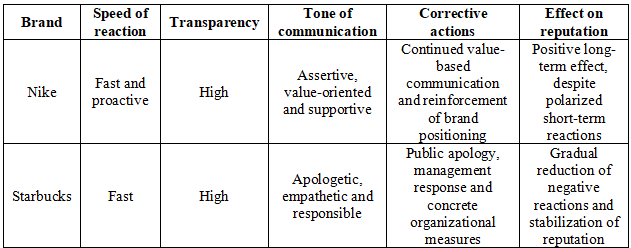
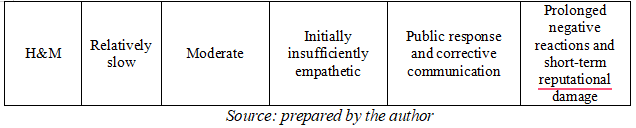
The comparison shows that speed of reaction is one of the most important elements of effective crisis communication. Timely communication reduces the space available for speculation, misinformation, and the development of negative narratives. However, speed alone is not sufficient. A rapid response that lacks transparency or empathy can further intensify public criticism.
Tone and empathy represent another important dimension. Starbucks provides an example of communication based on apology, responsibility, and empathy, which contributed to reducing negative public reactions. In contrast, the H&M case demonstrates how insufficient sensitivity to cultural and social perceptions can prolong a crisis and increase reputational damage. Nike represents a somewhat different approach, relying on a clear and consistent value-based position, which generated polarized reactions but strengthened its relationship with its core target audience.
The analysis also highlights the importance of message consistency across digital channels. In an environment characterized by rapid information dissemination, inconsistent statements can undermine credibility and create additional uncertainty among stakeholders. Consistent communication enables brands to maintain control over the central narrative and contributes to preserving consumer trust.
Finally, corrective actions are an important complement to verbal communication. Public apologies are more effective when accompanied by concrete measures demonstrating that the company is willing to address the causes and consequences of the crisis. Therefore, crisis communication should not be limited to issuing statements but should be integrated with actual organizational responses.
Overall, the comparative analysis supports the hypotheses proposed in the study. H1 is supported by the finding that timely reactions can limit the spread and intensity of negative reactions. H2 is supported by the evidence that transparent and empathetic communication contributes to more favorable public responses. H3 is supported by the importance of consistent messages across different digital channels in maintaining trust and reputational stability.
The cases further demonstrate that there is no single crisis communication strategy applicable to every situation. The appropriate response depends on the nature of the crisis, the degree of perceived responsibility, the expectations of stakeholders, and the values associated with the brand. Nevertheless, successful crisis communication on digital platforms requires proactive planning, continuous monitoring, rapid response, transparent messaging, and clearly defined crisis protocols. These elements enable brands not only to reduce reputational damage but also, under favorable circumstances, to strengthen long-term relationships with consumers.
Discussion of results
The results of the conducted qualitative analysis of the case studies indicate that the crisis communication of brands on digital platforms has a decisive influence on public perception and the preservation of reputation during and after crisis situations. The findings are in accordance with the set hypotheses and research questions, and confirm the importance of timeliness, transparency, empathy and consistency of communication. First of all, the analysis shows that the speed of reaction is one of the key factors in crisis management in the digital environment. According to the situational crisis communication theory (SCCT), the response strategy must be adapted to the degree of responsibility that the public attributes to the organization (Coombs, 2007). In cases where the brand reacts quickly and takes the initiative in communication, the space for speculation, spreading misinformation and negative narrative is reduced. This approach has been confirmed through the practice of the Starbucks company, which, after the crisis, implemented a strategy of public apology and specific corrective measures. Such a reaction contributed to softening negative perceptions and partially restoring consumer confidence.
Second, transparency and empathic communication have proven to be crucial elements in shaping public attitudes. According to research, communication that includes admitting a mistake, expressing regret and clearly explaining the next steps contributes to a more positive evaluation of the organization (Kim & Liu, 2012). In a digital environment, where users expect an immediate and authentic response, formal and distant communication can be perceived as avoiding responsibility. The H&M case study shows that insufficiently sensitized and initially defensive communication can prolong the duration of the crisis and further damage the brand's reputation.
A third important finding relates to the consistency of messages across different digital channels. In a multichannel communication environment, inconsistent messages between official announcements, social media posts, and management statements can create confusion and foster mistrust. Communication consistency contributes to the credibility and stability of the brand image (Fombrun & van Riel, 2004). In this context, the example of the Nike company shows how value-consistent communication, even in a polarized environment, can strengthen the loyalty of the target audience in the long term.
The discussion of the results confirms hypothesis H1, according to which a timely brand reaction significantly reduces the negative impact of a crisis on reputation. Also, hypothesis H2 was confirmed through the finding that transparent and empathetic communication positively affects consumer attitudes. Finally, H3 was confirmed by analyzing cases in which consistency of messages through digital channels contributed to maintaining trust.
The obtained results are in line with contemporary research that emphasizes that digital platforms change the dynamics of crisis communication, making it more interactive and less controlled by the organization (Jin, Liu, & Austin, 2014). The audience is no longer a passive recipient of messages, but an active participant shaping the course of the crisis through comments, shares and creating their own content. Therefore, crisis communication must be seen as a continuous dialogue, and not as a one-time announcement. Nevertheless, it is necessary to point out certain limitations of the research. The analysis is based on a qualitative methodology and a limited number of case studies, which may affect the generalizability of the results. Future research could include quantitative sentiment analysis of a larger number of crisis situations, as well as comparative studies between different industries and markets.
In conclusion, the discussion of the results indicates that successful crisis communication on digital platforms requires a strategic approach, clearly defined protocols and a high level of organizational readiness. Brands that understand the specifics of the digital environment and apply the principle of responsible, transparent and consistent communication have a greater chance of preserving and even improving their reputation in crisis situations.
Conclusion
Crisis communication of brands on digital platforms represents one of the key challenges of modern marketing management and corporate communications. The dynamics of the digital environment, in which information is disseminated in real time and users actively participate in the creation and distribution of content, significantly changes the way crisis situations are managed. In such circumstances, brand reputation becomes particularly vulnerable, while the ability to communicate in a timely, transparent, empathetic, and strategically consistent manner becomes crucial for minimizing reputational damage and maintaining stakeholder trust.
Based on the theoretical framework and the comparative analysis of the selected case studies of Nike, Starbucks, and H&M, it can be concluded that successful crisis communication in the digital environment depends on several interrelated factors: speed of reaction, tone of communication, transparency, consistency of messages across digital channels, and the implementation of concrete corrective actions. The analysis confirms the importance of timely communication, as delays in responding may create space for speculation, misinformation, and the development of negative narratives. Conversely, a rapid and clearly structured response demonstrates the company's willingness to acknowledge and address the problem.
The analysis also confirms the importance of transparent and empathetic communication. Brands that demonstrate responsibility, provide appropriate apologies, acknowledge stakeholders' concerns, and undertake concrete corrective measures are more likely to preserve consumer trust. Empathy contributes to the humanization of the brand and can reduce negative emotional reactions among stakeholders. At the same time, consistency of messages across different digital platforms represents an important prerequisite for maintaining credibility. Inconsistent or contradictory statements may increase uncertainty and further undermine trust in the brand.
An important finding of the study is that the effectiveness of crisis communication does not depend solely on how quickly a brand responds, but also on what it communicates, how it communicates, and whether its communication is supported by concrete actions. The comparative analysis demonstrates that different crisis contexts require different communication approaches. Nike's value-oriented communication, Starbucks' emphasis on apology and corrective action, and H&M's experience with cultural sensitivity illustrate that the appropriateness of a crisis communication strategy depends on the nature of the crisis, the level of perceived responsibility, stakeholder expectations, and the values associated with the brand.
Scientific contribution of the study
The scientific contribution of this study lies in the integration of theoretical approaches to crisis communication with a comparative analysis of real-world cases in the contemporary digital environment. The study contributes to the existing body of knowledge by identifying and systematizing several key dimensions of effective digital crisis communication—speed, transparency, empathy, message consistency, and corrective action—and by examining their relationship with brand reputation. The comparative framework developed in the study provides a structured basis for understanding how different communication strategies can produce different reputational outcomes depending on the characteristics of the crisis and the response of the brand.
Furthermore, the study emphasizes the specific role of digital platforms in contemporary crisis management. Unlike traditional communication channels, digital platforms enable immediate feedback, continuous public interaction, and rapid redistribution of both official and user-generated content. Consequently, the study highlights the need to consider digital communication not merely as an additional communication channel, but as an integral component of strategic reputation management. In this regard, the findings provide a conceptual basis for further empirical research into the relationship between digital crisis communication strategies, consumer perceptions, and long-term brand reputation.
Recommendations for practice
Based on the findings of the study, several recommendations for brand managers and communication professionals can be formulated:
- Developing predefined crisis communication protocols – Companies should establish clear crisis communication plans that define responsibilities, decision-making procedures, communication channels, and response timelines before a crisis occurs.
- Continuous monitoring of digital platforms – Systematic monitoring of social media discussions, comments, mentions, and changes in public sentiment enables companies to identify potential crises at an early stage and respond before negative narratives escalate.
- Ensuring rapid but carefully considered responses – Speed is important, but the initial response should be accurate, relevant, and consistent with the available facts. Companies should avoid both unnecessary delays and premature statements based on incomplete information.
- Promoting transparency and accountability – Brands should acknowledge legitimate concerns, accept responsibility when appropriate, and clearly communicate what actions are being taken to resolve the problem.
- Using empathetic and audience-oriented communication – Crisis messages should recognize the emotions and concerns of affected stakeholders rather than relying exclusively on formal or defensive corporate language.
- Maintaining consistency across digital channels – Messages published on different platforms should be mutually consistent while being adapted to the specific characteristics of each channel and its audience.
- Linking communication with concrete corrective actions – An apology or public statement should, whenever possible, be supported by specific measures demonstrating that the company is addressing the causes and consequences of the crisis.
- Investing in crisis communication training – Communication teams should receive regular training and participate in crisis simulations to improve their ability to respond effectively under conditions of uncertainty and time pressure.
In conclusion, crisis communication on digital platforms should not be viewed exclusively as a reactive activity, but as an integral component of strategic brand and reputation management. The findings of this study indicate that effective crisis communication requires the integration of speed, transparency, empathy, consistency, and concrete organizational action. When these elements are appropriately combined, a crisis does not necessarily result in permanent reputational damage; under certain circumstances, effective crisis management can even strengthen consumer relationships and contribute to long-term brand resilience.
At the same time, the study has certain methodological limitations. The analysis is based on a limited number of qualitative case studies and therefore does not allow for broad statistical generalization of the findings to all brands or types of crises. Future research could expand the sample of analyzed companies, incorporate quantitative measures of consumer sentiment and engagement, and examine the relationship between specific crisis communication strategies and measurable changes in brand reputation over a longer period. Such research would provide additional empirical evidence concerning the effectiveness of digital crisis communication strategies and further contribute to the development of the theoretical and practical foundations of crisis management in the digital environment.
References
2.Božić, K., & Knežević, V. (2025). Activity-based costing as a function of information support for modern management. Oditor, 11(2), 127-148. https://doi.org/10.59864/Oditor62502KB
3.Claeys, A.-S., Cauberghe, V., & Vyncke, P. (2010). Restoring reputations in times of crisis: An experimental study of the situational crisis communication theory and the moderating effects of locus of control. Public Relations Review, 36(3), 256–262. https://doi.org/10.1016/j.pubrev.2010.05.004
4.Coombs, W. T. (2007). Protecting organization reputations during a crisis: The development and application of situational crisis communication theory. Corporate Reputation Review, 10(3), 163–176. https://doi.org/10.1057/palgrave.crr.1550049
5.Coombs, W. T. (2015). Ongoing crisis communication: Planning, managing, and responding (4th ed.). Sage Publications.
6.Coombs, W. T., & Holladay, S. J. (2002). Helping crisis managers protect reputational assets. Management Communication Quarterly, 16(2), 165–186. https://doi.org/10.1177/089331802237233
7.Coombs, W. T., & Holladay, S. J. (2008). Comparing apology to equivalent crisis response strategies. Public Relations Review, 34(3), 252–257. https://doi.org/10.1016/j.pubrev.2008.04.001
8.Coombs, W. T., & Holladay, S. J. (2010). The handbook of crisis communication. Wiley-Blackwell.
9.Cornelissen, J. (2020). Corporate communication: A guide to theory and practice (6th ed.). Sage Publications.
10.Đokić, N., Mirović, V., Milićević, N., Kalaš, B., & Đokić, I. (2025). Namera ponašanja prema uslugama zelenog bankarstva: moderirajući efekti ekološke svesti. Oditor, 11(2), 7-32. https://doi.org/10.59864/Oditor12502ND
11.Fearn-Banks, K. (2017). Crisis communications: A casebook approach (5th ed.). Routledge.
12.Fombrun, C. J., & Van Riel, C. B. M. (2004). Fame & fortune: How successful companies build winning reputations. FT Prentice Hall.
13.Grégoire, Y., Salle, A., & Tripp, T. M. (2015). Managing social media crises with your customers: The good, the bad, and the ugly. Business Horizons, 58(2), 173–182. https://doi.org/10.1016/j.bushor.2014.11.001
14.Ivanova, B. & Savić, A. (2022). Teorijsko razmatranje poreza na dohodak gradjana. Casopis Ekonomski izazovi, 11 (21), 26-34. https://doi.org/10.5937/EkoIzazov2221027I
15.Janković, G., & Golubović, M. (2025). Cirkularna ekonomija kao osnova održivog razvoja danasnjice. Održivi razvoj, 7(1), 31-62. https://doi.org/10.5937/OdrRaz2501031J
16.Jin, Y., Liu, B. F., & Austin, L. L. (2014). Examining the role of social media in effective crisis management. Communication Research, 41(1), 74–94. https://doi.org/10.1177/0093650211423918
17.Jovanović, V., Savić, A., Koprivica, A. & Đukić, D. (2019). Nacionalni izvori međunarodnog privrednog prava kao osnov razvoja polјoprivrede. 9. Međunarodni polјoprivredni simpozijum „Održivi razvoj savremene polјoprivredne proizvodnje“, Palić, 123-136. ISBN 978-86-88535-20-5
18.Ki, E.-J., & Nekmat, E. (2014). Situational crisis communication and interactivity: Usage and effectiveness of Facebook for crisis management by Fortune 500 companies. Computers in Human Behavior, 35, 140–147. https://doi.org/10.1016/j.chb.2014.02.039
19.Kim, S., & Ferguson, M. A. T. (2019). The impact of strategic corporate social advocacy on consumer attitudes. Journal of Communication Management, 23(3), 230–245. https://doi.org/10.1108/JCOM-04-2018-0035
20.Kim, S., & Liu, B. F. (2012). Are all crises opportunities? A comparison of how corporate and government organizations responded to crises. Journal of Public Relations Research, 24(1), 69–85. https://doi.org/10.1080/1062726X.2012.626136
21.Kostić, R., Savić, A. & Mihajlović, M. (2022). Analiza značaja marketing miksa u elektronskoj trgovini. Megatrend revija: međunarodni časopis za privrednu ekonomiju, 1, 293-310. https://doi.org/10.5937/MegRev2201293K
22.Krippendorff, K. (2018). Content analysis: An introduction to its methodology (4th ed.). Sage Publications.
23.Krstić, S., Savić, A. & Kostić, R. (2023). System risk management policy in banking. Ekonomika, 69 (3), 57-71. https://doi.org/10.5937/ekonomika2303057K
24.Liu, B. F., Austin, L. L., & Jin, Y. (2011). How publics respond to crisis communication strategies. Public Relations Review, 37(4), 345–353. https://doi.org/10.1016/j.pubrev.2011.08.004
25.Mihajlović, M. & Savić, A. (2024). Ekonomska politika i energetska bezbednost zemalja Jugoistočne Evrope. Ekonomski signali, 19 (1). https://doi.org/10.5937/ekonsig2401047M
26.Mihajlović, M., Damnjanović, R., Savić, A. (2022b). Računovodstveno pravni aspekti izvršenja budžeta. International Journal of Economic Practice and Policy, 19 (2), 156-170. https://doi.org/10.5937/skolbiz2-41027
27.Mihajlović, M., Savić, A. & Aureo, B. (2022a). Performance audit. Journal of Entrepreneurship and Business Resilience (JEBR), 5 (2), 59-67. https://jebr.fimek.edu.rs/index.php/jebr/article/view/82/76
28.Milanović, A. & Gojkov, D. (2024). Država kao društveno-pravna tvorevina. Finansijski savetnik, 29 (1), 39-52.
29.Milenković, N., Stanojević, M. & Savić, A. (2018). Informaciona analiza finansijskih izveštaja. 8. Međunarodni naučni kongres „Revizija“, Palić, 70-77. ISBN 978-86-88535-12-0
30.Milјković, M. & Savić, A. (2018). Analiza dvostrukog ekonomskog oporezivanja i mogućnost njegove primene u finansiranju budžeta. Časopis za menadžment, finansije i pravo - Oditor, 2, 60-68. https://doi.org/10.5937/Oditor1802058M
31.Nikolić, M. (2025). Kreditni program za unapređenje energetske efikasnosti u domaćinstvima: analiza i perspektive. Oditor, 11(2), 33 - 62. https://doi.org/10.59864/Oditor22502MN
32.Obrić, B. & Majstorović, A. (2023). Principi za poboljšanje dosadašnjeg stanja interne budžetske revizije. Finansijski savetnik, 28 (1), 51-68.
33.Savić, A., Fabjan, M. & Trnavac, D. (2021). Komparativna analiza makroekonomskih pokazatelјa u procesu ekonomske tranzicije u zemlјama Centralne i Istočne Evrope. Oditor - Časopis za menadžment, finansije i pravo, 1, 23-44. http://www.cefi.edu.rs/wp-content/uploads/2021/05/2.-KOMPARATIVNA-ANALIZA-MAKROEKONOMSKIH-POKAZATELJA.pdf
34.Savić, A., Kostić, R. & Ivanova, B. (2025a). Uloga finansijskog izveštavanja u poreskoj evaziji. Megatrend revija, 22(1), 75-100. https://doi.org/10.5937/MegRev2501075S
35.Savić, A., Mihajlović, M., Kostić, R. (2025b). Reconciliation of amounts in budget execution reports and financial statements using the example of the food and agriculture organization of the United Nations. Economics of agriculture, 72 (4), 1163-1183. https://doi.org/10.59267/ekoPolj25041163S
36.Ugrinov, S., Ćoćkalo, D., & Bakator, M. (2025). Održive prakse upravljanja ljudskim resursima u pomorskim lancima snabdevanja. Održivi razvoj, 7(1), 7 - 30. https://doi.org/10.5937/OdrRaz2501007U
37.Veil, S. R., Buehner, T., & Palenchar, M. J. (2011). A work-in-progress literature review: Incorporating social media in crisis communication. Journal of Contingencies and Crisis Management, 19(2), 110–122. https://doi.org/10.1111/j.1468-5973.2011.00639.x
38.Vukša, S. & Milojević, I. (2024). Održivost računovodstva kao informacionog sistema. Održivi razvoj, 6 (2), 23-33. https://doi.org/10.5937/OdrRaz2402023V
39.Yin, R. K. (2018). Case study research and applications: Design and methods (6th ed.). Sage Publications.
40.Zupur, M., Mičić, S. & Vladisavljević, V. (2023). Analiza kao osnov za donošenje poslovnih odluka. Finansijski savetnik, 28 (1), 7-35.
Published in
Vol. 12 No. 2 (2026)
Keywords
🛡️ Licence and usage rights
This work is published under the Creative Commons Attribution 4.0 International (CC BY 4.0).
Authors retain copyright over their work.
Use, distribution, and adaptation of the work, including commercial use, is permitted with clear attribution to the original author and source.
Interested in Similar Research?
Browse All Articles and Journals