
THE INFLUENCE OF SOCIAL NETWORKS ON THE TEACHING PROCESS OF LANGUAGE LEARNING

Abstract
Owing to technological advancements, social networks have become an indispensable part of everyday life. Accordingly, their application has also become present in educational settings. This paper examines the use of social networks in language teaching. The first part of the paper presents a theoretical framework that analyzes the didactic application of social networks in foreign language teaching. The second part of the paper encompasses an empirical study whose subject is the examination of the attitudes of Spanish language teachers in Serbia toward this topic, as well as the extent to which social networks are represented in teaching practice. The aim of the research is to provide an overview of the current state of social network use in language teaching, as well as teachers’ attitudes toward this topic. The results indicate numerous advantages and highlight the need for further research and professional training in this field.
Article
Introduction
In recent years, we have witnessed rapid development and numerous achievements in the field of modern technologies that shape our everyday lives. One of the phenomena with which we have become fully integrated is social networks, without which it would be difficult to imagine daily life (Trifunović et al., 2023; Hernandez, Pereira, 2024; Mihajilović et al., 2024). Their widespread presence and frequent use in everyday life have contributed to their integration into foreign language teaching. The new digital era introduces the use of social networks such as Facebook and Twitter not only for communication purposes but also for the exchange of multimedia resources (Smith, Duggan, 2023; Liu, Zhang, 2024; Miller, Saunders, 2024; Prdić,& Kostić, 2024; Stanković, et al., 2023).
The main advantages offered by social networks in foreign language teaching include the fact that they represent highly useful free platforms for interactive learning, enable conversation in a direct manner, and allow quick access without time constraints. Social networks can be accessed via various devices, provide practical and enjoyable learning experiences, and support interculturality and social connectivity (Gutjeres, 2021; Kemp, Williams, 2023; Ercegovac & Ercegovac, 2023).
The subject of this research is the presentation and analysis of the application of social networks in language teaching. The aim of the research is to examine the current situation in the teaching of Spanish as a foreign language in Serbia, as well as Spanish teachers’ attitudes toward this topic. The hypothesis is that Spanish language teachers use social networks in teaching and that students are interested in this approach. It is also assumed that professional training in this area would be beneficial, given that this topic has been insufficiently researched in Serbia.
Literature Review
Social networks as a service enable individuals to create a public or semi-public profile within a bounded system, generate a list of other users with whom they share content, and view content created by other users within the system (Boyd & Ellison, 2007; Gutjeres, 2021; Shepherd, 2024; Dašić et al, 2024).
According to another definition (Bartlett, 2006; Vázquez & Cabero, 2015 In García, 2016: 41), social networks are “a group of applications and collaborative spaces in which social connections and information exchange exist within an online environment.”
Websites such as Facebook and Twitter represent a group of applications and collaborative spaces where social connections and information exchange occur online (Ellison & Boyd, 2023). They host content created by social network users themselves, enabling interaction across great distances. As a result, foreign language learners are provided with opportunities to practice the language on a regular basis (Mana, 2023).
Social networks enable connections based on friendship (Facebook), professional activity (LinkedIn), the use of a specific format (YouTube, Vimeo), presentations (SlideShare), photography (Flickr), or text (Google Docs). Certain social networks have become widespread among users of a specific age group (Tuenti), while others are more open and allow unrestricted presentation of content to the entire internet (Facebook or Twitter) (Moja, 2011; Hanna et al., 2004; Kaplan & Haenlein, 2023).
Given that they are free of charge and provide easy access without time limitations, social networks represent an attractive tool for language learning, particularly for individuals with limited time or those who work extensively online (Gutjeres, 2021).
Advantages of Using Social Networks in Foreign Language Teaching
Social networks have attracted the attention of foreign language teaching methodologists due to the various advantages they can offer in the dynamics of teaching and second language learning (Sera, 2019; Olsen & Thompson, 2023).
They possess characteristics that make them appealing to learners, such as the ability to view videos or photographs. They also allow users to express their opinions and perspectives on posts with a high degree of freedom of expression, which represents a significant advantage for foreign language teaching (Ruiperes & García, 2012; Stojanović et al., 2021).
Social networks strengthen interconnections among learners from different countries in real time, enabling the use of language in practice in a natural and spontaneous manner and in contact with other cultures (Gutjeres, 2021; Golonka et al., 2024).
They provide a space for the development of linguistic skills, such as written production and listening comprehension, and also encourage active participation and autonomous learning (Gutjeres, 2021).
Furthermore, social networks offer learners opportunities for immersion in real communicative situations (Gutjeres, 2021; Thorne & Black, 2023). Since the essence of foreign language learning lies in the ability to participate in real communicative situations, the application of social networks provides learners with opportunities to improve language competence precisely in this way.
Twitter allows users to follow news from native speakers on topics such as politics, economics, travel, new technologies, or even weather forecasts. Given that tweets are limited to 140 characters, sentences are easier to memorize. This facilitates vocabulary acquisition and the learning of commonly used expressions specific to everyday life, as well as sentence structures. Twitter users can practice writing concise sentences in a foreign language. Changing the interface language on Facebook is also an effective way to expose learners to foreign language input (Mana, 2023; Levy, 2024).
Interactions that take place within social network communities make them particularly suitable as supplementary learning tools. Since language on social networks is used for information exchange or social interaction, it constitutes meaning-focused language use. Additionally, situations involving clarification, correction, requests for assistance, or confirmation are frequent, thus enabling cooperative meaning construction, which should also occur in foreign language classrooms. Social networks often involve discussions on topics such as literature or gastronomy, making language use similar to that in content-based instruction (Moja, 2011).
In other words, social networks can be extremely versatile in terms of the content they allow users to share, but their true potential lies in their ability to facilitate real- time communicative situations that enable not only vocabulary acquisition and improvement but also the practice of speaking and listening comprehension (Sera, 2019; Thorne & Black, 2023). It is indisputable that social networks foster the development of communicative skills and competencies in foreign language learners, as they enable the creation of numerous real-time communicative situations from any geographical location (Sera, 2019; Mikroyannidis & Iordanou, 2023).
With regard to task-based approaches, the variety of information types and audiovisual resources that can be used on social networks is virtually unlimited. Posts on Facebook, Twitter, Instagram, or other networks may include links to documents such as books, articles, videos, and other materials (Murray, 2024; Chik & Lee, 2023). In this way, learners gain access to numerous activities through which they can practice writing, reading, speaking, and text comprehension. This range of options undoubtedly influences learners’ motivation and interest in their own learning process (Tovar & Tapia, 2019; Sera, 2019).
There is also a wide variety of social networks specialized in language learning, including Twiducate, LiveMocha, Conversation Exchange/Language Exchange, Talk, Palabea, Polyglot Club, My Happy Planet, Shared Talk, English Baby, Wordsurfing, Babble.com, and Duolingo. Despite the existence of many specialized platforms, Facebook remains one of the most widely used for this purpose. This is due to the fact that most students and young people already have access to it and use it daily, and its configuration is not overly complex (Araujo Portugal, 2014; Cabero & Marín, 2014). Consequently, the simplicity of general-purpose social networks (Facebook and Twitter) remains relevant and even essential, as does the demand from certain teachers who use them for information distribution and communication (Borromeo García, 2016; Godwin-Jones, 2023).
Social networks introduce fun, dynamism, and oral interaction into foreign language learning. However, for comprehensive learning that would enable learners to internalize syntactic, grammatical, and lexical structures, social networks do not replace traditional methods such as the learning of grammatical rules (Gutjeres, 2021). Therefore, it is essential to clearly define didactic objectives and structure the information intended to be presented through social networks.
Moreover, these platforms must be used appropriately, with due consideration for privacy, digital security, and content quality, in order to maximize pedagogical benefits and minimize potential distractions or risks (Gutjeres, 2021; García & Méndez, 2023).
Disadvantages of Using Social Networks in Language Teaching
The use of social networks for educational purposes requires a high level of caution and self-regulation if their benefits for language learning are to be fully exploited (Johnson et al., 2020). Additionally, the volume of information that students receive through social networks is immense and varies in quality; therefore, learners must be able to identify, filter, and process information in order to access appropriate resources for their learning needs (Vu & Kang, 2023; Thompson, 2022).
However, there are obstacles to their use, including the knowledge and skills required for information technology use, institutional policies, implementation planning, and social differences between teachers and learners (Borromeo García, 2016). One of the greatest barriers is the lack of training or competence among some teachers in using new technological advancements.
Research Method and Results
In order to examine the current status of social network use in Spanish language teaching in Serbia, a study was conducted among Spanish language teachers. The research method employed was a survey. The research instrument was an anonymous questionnaire created using Google Docs and administered to respondents via email. The questionnaire consisted of ten open-ended and closed-ended questions. The sample comprised 19 respondents (n = 19).
The study provides indicative information regarding teachers’ attitudes toward the use of social networks in language teaching and is intended to encourage educators to apply this innovative tool, as well as to stimulate further research on the topic. The hypothesis was that Spanish language teachers use this tool and that both teachers and students are interested in it.
Statistical data processing and analysis were conducted using IBM SPSS (Statistical Package for the Social Sciences), version 25. Descriptive statistics were applied to describe the sample, and the chi-square test was used to examine differences. The significance threshold was set at 0.05.
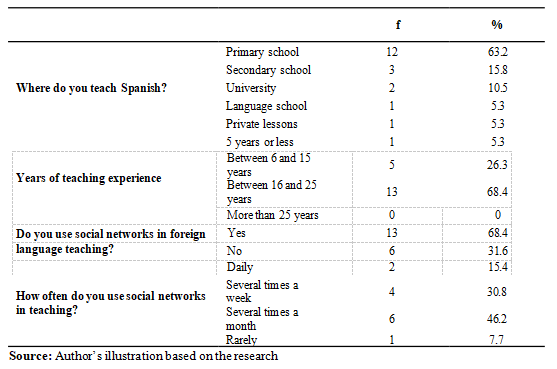
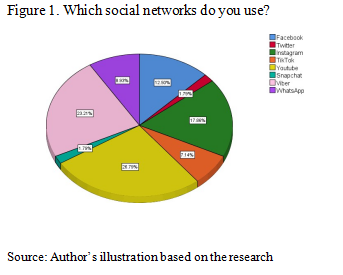
The study included 19 Spanish language teachers, predominantly working in primary schools (63.2%), with teaching experience ranging from 16 to 25 years (68.4%) (Table 1). The majority of teachers (68.4%) reported using social networks in foreign language teaching, most often several times per month (46.2%) (Table 1). Based on the results presented in Figure 1, it can be concluded that teachers most frequently use YouTube (26.79%), Viber (23.21%), and Instagram (17.86%).
Table 1. General characteristics of Spanish language teachers
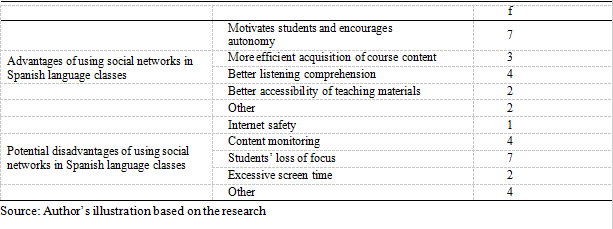
The majority of respondents (79%) believe that students are interested in this type of instruction. Likewise, most respondents (79%) believe that the use of social networks enhances the process of acquiring Spanish. As many as 63.2% of respondents believe that the use of social networks in teaching fosters learner autonomy. Overall, 68.4% of respondents stated that a seminar or training on the use of social networks would be beneficial (Table 2). The main advantage of using social networks in Spanish language teaching is student motivation and the encouragement of autonomy (38.9%), while the main disadvantages are distraction of students’ attention (38.9%) and content monitoring (22.2%) (Table 3).
Table 2. Usefulness of social networks in Spanish language classes
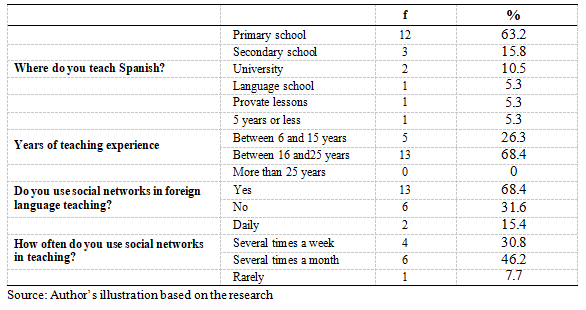
Table 3. Advantages and disadvantages of using social networks in Spanish language classes
The study examined whether there were statistically significant differences in the use of social networks in Spanish language teaching, students’ interest in this type of instruction, the improvement of Spanish language acquisition through this approach, the promotion of learner autonomy, and the usefulness of seminars and training for this type of instruction in relation to the type of Spanish language teaching. The chi- square test was applied to examine the stated differences.
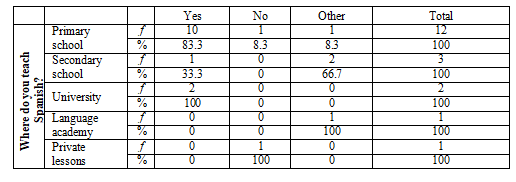
Based on the results of the chi-square test presented in Table 4, it can be concluded that a statistically significant difference exists with regard to the usefulness of seminars and training for this type of instruction in relation to the type of Spanish language teaching. On the basis of the numerical and percentage distribution shown in Table 5, it can be concluded that primary school and university teachers predominantly believe that training is necessary, whereas teachers who provide private lessons consider such training unnecessary.
Table 4. Differences with respect to the type of Spanish language instruction
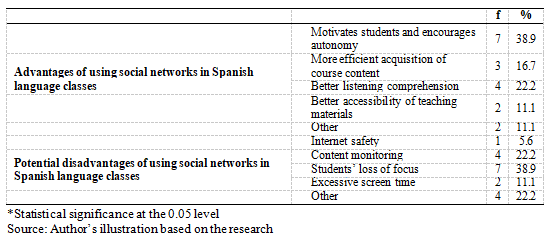
Table 5. Do you believe that training or a seminar would be beneficial for improving the use of social networks in Spanish language teaching?

The study also investigated whether there were statistically significant differences in the use of social networks in Spanish language teaching, students’ interest in this type of instruction, the improvement of Spanish language acquisition through this approach, the promotion of learner autonomy, and the usefulness of seminars and training for this type of instruction in relation to teachers’ years of experience. The chi-square test was used to examine these differences.
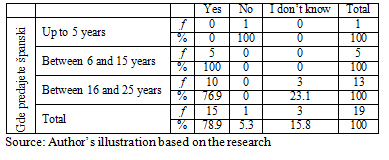
An examination of the chi-square test results presented in Table 6 indicates that a statistically significant difference exists with regard to the improvement of Spanish language acquisition through the use of social networks in teaching. Based on the numerical and percentage distribution shown in Table 7, it can be concluded that teachers with less than five years of experience believe that social networks do not enhance Spanish language acquisition, whereas teachers with more than five years of experience believe that social networks contribute to improving Spanish language acquisition.
Table 6. Differences with respect to the length of teachers’ experience
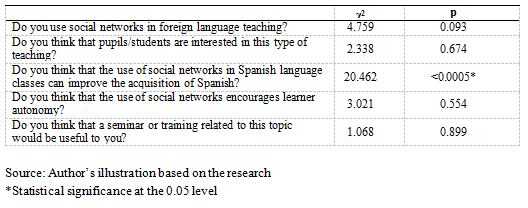
Table 7. The use of social networks improves the acquisition of Spanish
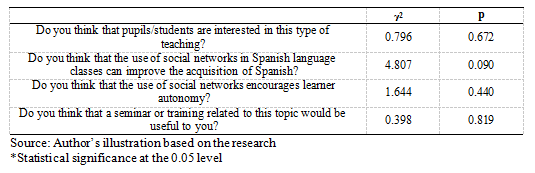
Finally, the study examined whether there were statistically significant differences in students’ interest in this type of instruction, the improvement of Spanish language acquisition through this approach, the promotion of learner autonomy, and the usefulness of seminars and training for this type of instruction in relation to the use of social networks in Spanish language teaching. The chi-square test was applied to examine these differences.
Based on the results of the chi-square test presented in Table 8, it can be concluded that no statistically significant differences exist in teachers’ responses with regard to the use of social networks in Spanish language teaching.
Table 8. Differences with respect to the use of social networks for teaching Spanish
Conclusion
Social networks have also found their place in foreign language teaching. Due to their characteristics, they represent a practical and effective tool for information exchange, thereby enhancing productive and receptive language skills. Through appropriate implementation of social networks in teaching, learners’ linguistic, sociocultural, and pragmatic competences can be improved (Godwin-Jones, 2023; Murray, 2024; Kostić, 2023).
Didactic preparation is essential when working with social networks. While social networks constitute valuable support for foreign language learning, they cannot replace formal language courses (Mana, 2023).
Based on the conducted research, it can be concluded that the majority of respondents use social networks several times per month. The most commonly used platforms are YouTube, Viber, and Instagram. Most respondents express a positive attitude toward the use of social networks in language teaching and believe that students are motivated. Distraction of students’ attention is identified as a potential drawback. Furthermore, the research results indicate a need for professional training in this area, which could contribute to increased use of social networks in teaching and enhance the effectiveness of the learning process.
References
2.Borromeo García, César Augusto (2016). Redes sociales para la enseñanza de idiomas: el caso de los profesores. Pixel-Bit. Revista de Medios y Educación, núm. 48, enero, 2016, 41-50.
3.Cabero, J. & Marín, V. (2014) Posibilidades educativas de las redes sociales y el trabajo en grupo. Percepciones de los alumnos universitarios. Comunicar. Revista Científica de Edocomunicación, 42(XXI), 165-172.
4.Chik, A., & Lee, T. (2023). Mobile Social Media and Foreign Language Learning: The Role of Informal Learning in Global Contexts. Journal of Second Language Teaching & Research, 12(4), 45-61.
5.Dašić, B., Pavlović, N., & Savić, M. (2024). Technological progress and digitization in the function of the development of e-education in Serbia. Akcionarstvo, 30(1), 257-280.
6.Ellison, N. B., & Boyd, D. M. (2023). Sociality through Social Network Sites. In The Handbook of Mobile Communication Studies, edited by J. E. Katz, 151-172.
7.Ercegovac, A., & Ercegovac, I. (2023). Istraživanje uticaja bindžovanja na oblikovanje dnevnog rasporeda i transformaciju konzumacije video sadržaja: Sveobuhvatan pregled literature. Društveni horizonti, 3(6), 49-67
8.Garcia, P., & Mendez, E. (2023). Using Social Media to Enhance Cultural Competence and Language Skills. Language and Intercultural Communication, 23(3), 251-265.
9.Godwin-Jones, R. (2023). Emerging Technologies: Language Learning and Social Media. Language Learning & Technology, 27(2), 1-17.
10.Golonka, E. M., et al. (2024). The Effectiveness of Social Media Tools in Language Learning: A Systematic Review. Language Teaching Research, 28(1), 50-75.
11.Gutjeres, G. (2021). Cela Gutiérrez, Cristina. Eficacia de las redes sociales en el aprendizaje de idiomas: el alemán como lengua extranjera, Medios digitales y metodologías docentes: Mejorar la educación desde un abordaje integral / coord. por REDINE, ISBN 978-84-124511-0-8,2021
12.Hanna, R., Rohm, A., & Crittenden, V. L. (2024). We’re All Connected: The Power of Social Media Networks. Business Horizons, 67(4), 495-506.
13.Hernandez, J., & Pereira, M. (2024). Digital Communication in the Social Media Era: From Text to Multimedia Content Sharing. Media and Communication Studies Review, 16(2), 200-214.
14.Johnson, P., Miller, A., & Roberts, S. (2020). Language use on social media: Implications for language education. Journal of Applied Linguistics, 15(3), 220-234.
15.Kaplan, A. M., & Haenlein, M. (2023). Social Media: Back to the Future. Journal of Business Research, 140, 263-274.
16.Kemp, S., & Williams, K. (2023). Social Media Trends 2023: The Growth of Multimedia Sharing Platforms. Global Media Journal, 22(1), 75-92.
17.Kostić, T. (2023). Udžbenik u elektronskom obliku u srpskom obrazovanju, za i protiv, Društveni horizonti, 69-84
18.Levy, M. (2024). Social Media as a Tool for Language Learning: Benefits, Challenges, and Opportunities. Journal of Educational Technology Systems, 52(1), 101-121.
19.Liu, J., & Zhang, Y. (2024). The Role of Social Media in the Exchange of Multimedia Content: A Global Perspective. International Journal of Communication, 18(4), 301- 318.
20.Mana (2023). Hadjaratou Mana. El impacto de las redes sociales en el aprendizaje de lenguas extranjeras Ziglôbitha, Revue des Arts, Linguistique, Littérature & Civilisations Université Peleforo Gon Coulibaly-Korhogo RA2LC n°07, Octobre2023, 5-1
21.Mihajlović, M., Marković, S., Vujanić, I., Marijanović, R. P., & Ramadhani, I. H. (2024). Knowledge and information management in the company as a strategic business resource. Oditor, 10(3), 53–67. https://doi.org/10.59864/Oditor32403MM
22.Mikroyannidis, A., & Iordanou, K. (2023). Integrating Social Media Tools into Foreign Language Classrooms: Teacher Perspectives and Student Experiences. Interactive Learning Environments, 31(2), 179-195.
23.Miller, V. & Saunders, T. (2024). Social Networks and the Digital Exchange of Media: A New Communication Paradigm. Journal of New Media & Society, 26(3), 212-229.
24.Moja, K. (2011). Las redes sociales en la enseñanza de ELE: retos y propuestas. La red y sus aplicaciones en la enseñanza-aprendizaje del español como lengua extranjera ,205-211, coord. por Carmen Hernández González, Antonio Carrasco Santana, Eva Álvarez Ramos
25.Murray, D. E. (2024). The Role of Social Media in Building Language Learner Communities. Modern Language Journal, 108(2), 263-280.
26.Olsen, M., & Thompson, R. (2023). Harnessing Social Media Tools for Educational Purposes: A Global Perspective. Educational Technology & Society, 26(1), 50-65.
Prdić, N., & Kostić, S. (2024). Uticaj društvenih mreža na radnom mestu milenijalaca. Oditor: Časopis za menadžment, finansije i pravo, volume X(3), stranice 79 -111.Edutec. Revista electrónica de tecnología educativa. 49, 1-27
28.Ruiperes, G. (2012). Aprendizaje de lenguas modernas basado en redes sociales. Estudios Sobre El Mensaje Periodístico, 18, 821-827
29.Shepherd, J. (2024). Understanding Social Media Networks: Definitions and Implications. International Journal of Communication, 18(1), 45-60.
30.Smith, A., & Duggan, M. (2023). Online Social Networks and the New Age of Communication: Trends and Implications. Journal of Digital Media & Policy, 14(2), 145-160.
31.Stanković, T., Čerović, S., & Panić, A. (2023). Role and application of information communication technologies: Significance of social networks in placement of hotel capacities in Serbia. Akcionarstvo, 29(1), 63-94
32.Stojanović, J., Nešić, Z. Bulut Bogdanović I. (2021). Digitalization of education in the function of economic development, Social horizons, Vol. 1, No.1, 2021, pp. 29- 40
33.Thompson, H. (2022). Social media and its role in modern education. International
Journal of Educational Technology, 11(1), 95-105.
34.Thorne, S. L., & Black, R. W. (2023). Social Media in Foreign Language Learning: A Review of the Research. Computer Assisted Language Learning, 36(3), 301-326.
35.Trifunović, D., Bulut Bogdanović, I., Tankosić, M., Lalić, G., Nestorović, M. (2023) Research in the use of Social Networks in Business Operations, Akcionarstvo, 1/2023
36.Vu, Kang 2023: Wu Heping, Kang Xiaoming. Utilidad de las redes sociales para el aprendizaje de idiomas en la era postpandemia, ZHONG Revista de la producción académica de China, núm. 1 2023, 61-74.
Published in
Vol. 11 No. 3 (2025)
Keywords
🛡️ Licence and usage rights
This work is published under the Creative Commons Attribution 4.0 International (CC BY 4.0).
Authors retain copyright over their work.
Use, distribution, and adaptation of the work, including commercial use, is permitted with clear attribution to the original author and source.
Interested in Similar Research?
Browse All Articles and Journals