
SMART TOURISM: SHAPING THE FUTURE OF THE TOURIST DESTINATION THROUGH SUSTAINABLE INNOVATIONS

Abstract
Smart destinations are innovative areas, both urban and rural, that harness digital technologies to enhance the tourism experience. These destinations utilize information and communication technologies (ICT) to streamline services, bolster safety, and offer personalized encounters for tourists. Key features of smart destinations include robust connectivity through high-speed internet, the use of mobile applications for providing real-time information, and the implementation of eco-friendly initiatives that support sustainable tourism practices. Cities such as Barcelona, Amsterdam, and Vienna exemplify smart destinations by employing technology to manage tourist flows effectively, reduce congestion, and improve overall visitor engagement. Through these advancements, smart destinations aim to create more efficient, sustainable, and enjoyable experiences for all visitors. The research posits that 'smart tourism' is essential for the future sustainability and competitiveness of destinations. By analyzing the feedback from 389 tourists who visited this cities in April and May 2024, the study highlights the significance of sustainable transformations towards smart tourism. The findings suggest that smart tourism is not just a future concept but is actively being realized in the present. Learning from cities like Barcelona, Amsterdam, and Vienna, Serbia can position itself as a leader in innovation within the region, ultimately enhancing the quality of life for residents and providing a seamless experience for tourists.
Article
Introduction
Smart destinations are urban or rural areas that utilize digital technologies to create more efficient, sustainable, and enjoyable experiences for tourists (Ye et al., 2025). At their core, smart destinations integrate information and communication technologies (ICT) to streamline services, enhance safety, and provide personalized experiences (Koo et al., 2025). Characteristics of smart destinations include connectivity through high-speed internet, the use of mobile applications for real-time information, and eco-friendly initiatives that promote sustainable tourism practices (Tena et al., 2024; Cimbaljević et al., 2023). Smart destinations represent a transformative approach to tourism, where digital technologies are leveraged to enhance the overall experience for visitors while simultaneously promoting sustainability and efficiency (Wang, 2024). These areas, whether urban or rural, utilize a range of information and communication technologies (ICT) to provide seamless services, ensure safety, and offer personalized experiences to tourists (Long & Chen, 2024).
One of the key characteristics of smart destinations is connectivity (Qian, 2024). High-speed internet forms the backbone of smart destinations, enabling tourists to access information and services on-the-go (Benaddi et al., 2024a). This connectivity is often supported by the widespread availability of Wi-Fi in public spaces, which allows visitors to stay connected and informed throughout their journey (Benaddi et al., 2024b). In addition to connectivity, smart destinations commonly employ mobile applications to deliver real-time information. These apps can provide tourists with a wealth of knowledge at their fingertips, such as directions, event schedules, and local recommendations (Sustacha et al., 2023).
Moreover, technology plays a crucial role in managing tourist flows and reducing congestion in smart destinations (Tavitiyaman et al., 2021; Nieves-Pavón et al., 2024). Visitor engagement is greatly improved in smart destinations through interactive technologies (Collado-Agudo et al., 2023). Augmented reality (AR) and virtual reality (VR) experiences allow tourists to immerse themselves in the local culture and history in innovative ways (Shin et al., 2023). According to Lee & Jan (2023), museums and historical sites might offer AR tours that bring exhibits to life, providing a richer and more engaging learning experience (Gong & Schroeder, 2022).
In the realm of smart tourism, the integration of big data and AI-driven recommendations collaborates to deliver travel experiences that are highly tailored to individual preferences (Kim & Kim, 2023). Information is gathered from diverse sources, notably social media interactions, where posts, check-ins, hashtags, and reviews disclose prevailing trends and favored destinations (Huda et al., 2023). Within smart cities, sensors monitor real-time data such as foot traffic, air quality, noise levels, and crowd density, offering crucial insights into the movement of tourists within urban environments. According to Ngeoywijit et al., (2022) transactional data derived from hotel reservations, transportation services, and event ticket purchases aids in forecasting visitor behaviors, while the utilization of mobile applications provides insights into preferences through search history, saved locations, and in-app activities (Gelter et al., 2022; Okonta & Vukovic, 2024).
Upon the collection of this data, artificial intelligence is employed to examine patterns and deliver tailored recommendations (Oliveira et al., 2022; Liu & Wu, 2023). These recommendation engines propose activities, attractions, restaurants, and events that align with individual preferences and past behaviors (Lu et al., 2021). Utilizing historical data, predictive analytics project future trends, including optimal times for visiting popular locations based on crowd densities or weather conditions (Mandić & Kennell, 2021). Additionally, natural language processing facilitates chatbots and virtual assistants, providing real-time multilingual assistance and aiding tourists in navigating unfamiliar environments effortlessly (Kontogianni et al., 2022). In application, this technology revolutionizes the interactions between cities and their visitors (Mantero, 2023).
Cities like Barcelona, Amsterdam and Wienna serve as prime examples of smart destinations, where technology is employed to manage tourist flows, reduce congestion, and improve visitor engagement. According to Grimaldi & Fernandez (2017), in Barcelona, visitors can use apps to navigate through the city's rich cultural heritage sites, find dining options, and even locate the nearest public transportation options. Barcelona’s intelligent city infrastructure utilizes real-time data to direct tourists toward areas with lower congestion, employing dynamic digital signage and mobile alerts that adjust according to prevailing circumstances (Shmelev & Shmeleva, 2025). Eco-friendly initiatives are another hallmark of smart destinations. These initiatives are designed to promote sustainable tourism practices that minimize environmental impact. According to Noori et al., (2025), Amsterdam has been at the forefront of sustainable tourism by encouraging the use of bicycles and public transportation, thereby reducing the carbon footprint associated with tourist activities. The city also implements smart waste management systems that enhance recycling efforts and reduce waste production. Amsterdam’s city card application not only offers discounts but also suggests lesser-known attractions, promoting a more balanced flow of tourist activity throughout the city (Yigitcanlar et al., 2019; Putra & van der Knaap, 2019). In Vienna, according to Roblek (2019), data analytics and smart signage systems are used to direct tourists away from crowded areas, distributing visitor traffic more evenly across the city. This not only enhances the visitor experience by reducing wait times and overcrowding but also helps preserve the integrity of cultural and historical sites (Fernandez-Anez et al., 2018). The tourism application in Vienna delivers customized walking tours tailored to individual preferences such as history, architecture, or culinary experiences.
These examples illustrate the pivotal role of technology in not only enriching tourist experiences but also in fostering sustainable tourism practices. The research started from the initial hypothesis that "smart tourism" is the future of tourism towards which destinations must turn if they want to remain sustainable and competitive. These examples of good practice were intended to point out the importance of sustainable transformations in the direction of "smart tourism". The paper used the opinions of 389 tourists who visited Barcelona, Amsterdam and Vienna in April and May 2024 and based on their experience gave their opinion on the development of destination tourism. It was concluded that smart tourism is the future that happens in the present time.
Methodology
Research was conducted among 389 travelers of several travel agencies from Novi Sad that took tourists to Barcelona, Vienna and Amsterdam in April and May 2024. In question are travelers who have traveled to one or even all three cities and thus were adequate to give an assessment of the state of smart tourism in these cities. They were asked a group of questions related to Smart Public Transport in the City, Digital City Services & Smart Tourism and Eco-Friendly & Sustainable Tourism Innovations. Tourists answered the questions on a five-point Likert scale (Strongly Disagree - Disagree - Neutral - Agree - Strongly Agree). The questions were sent via a link, and they answered via their mobile phones or computers.
Smart Public Transport in City
1. The availability of real-time public transport updates (e.g., mobile apps, digital screens) made it easier to navigate city.
2. I found the contactless ticketing system (e.g., mobile tickets, smart cards) convenient and efficient.
3. The public transport system in city was well-integrated and easy to use.
4. I felt safe using smart public transport services (e.g., surveillance, emergency features, well-lit stations).
5. The availability of multilingual digital transport information improved my travel experience in city.
6. The public transport system provided a seamless connection between tourist attractions.
Digital City Services & Smart Tourism
7. The official city tourism app or website provided accurate and useful information.
8. I found the availability of digital guides, interactive maps, and AI chatbots helpful for exploring the city.
9. The city’s free Wi-Fi availability helped me access smart tourism services easily.
10. Digital signage and interactive kiosks provided relevant and up-to-date tourism information.
11. I felt that city’s digital services reduced my need for printed travel materials.
12. The ability to book city experiences (e.g., museums, concerts, guided tours) online improved my visit.
Eco-Friendly & Sustainable Tourism Innovations
13. City’s smart tourism initiatives promoted environmentally friendly travel options.
14. I noticed and appreciated the city's efforts in reducing carbon emissions through smart transport and green initiatives.
15. The availability of e-scooters, bike-sharing, and pedestrian-friendly streets made it easy to explore city sustainably.
16. Smart waste management and recycling stations in public areas made me more environmentally conscious during my visit.
17. I would recommend Barcelona, Amsterdam and Vienna to others as a model for sustainable and smart tourism.
18. My experience with city’s eco-friendly tourism initiatives would influence me to choose similarly sustainable destinations in the future.
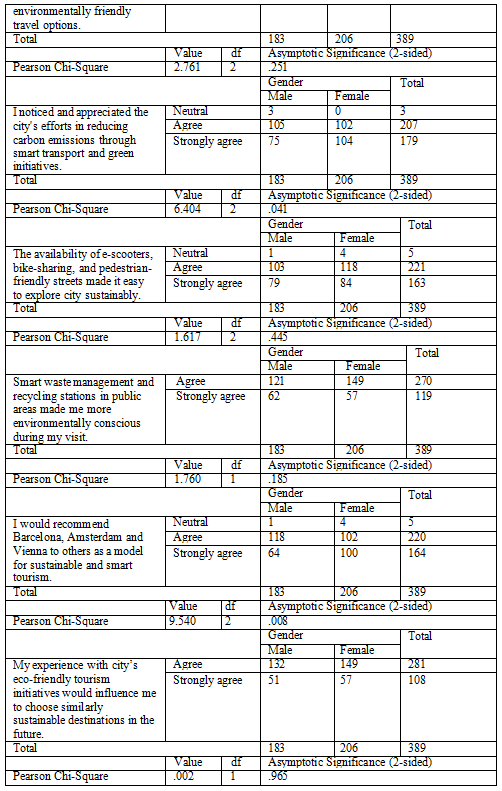
To compare the responses provided by the respondents based on gender, a Pearson Chi-Square test was applied. Discrepancies in responses that are of statistical significance are considered at a p-value of less than 0.05. With greater values, it can be stated that there lies no statistical significance.
Results and Discussion
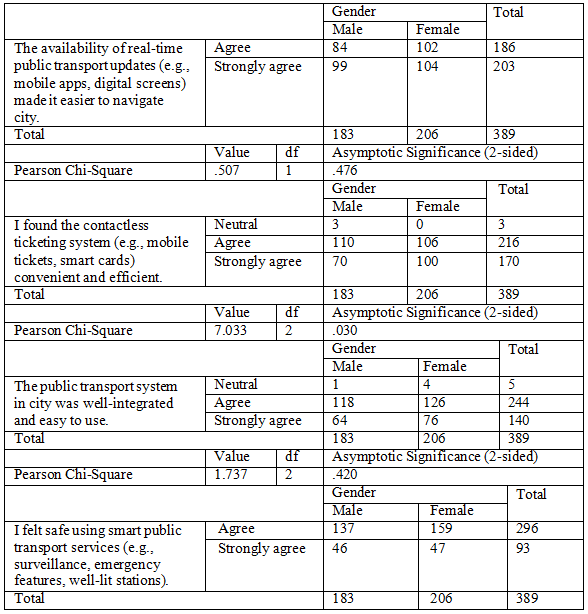
Number of 183 male respondents and 206 female respondents participated in the research. The answers regarding smart public transport are given in table 1. Intelligent public transportation systems serve as essential facilitators of urban mobility and significantly contribute to the advancement of smart tourism through enhanced accessibility, sustainability, and visitor experience. Based on the table 1, it can be concluded the following: Real-time updates: (If the average ratings for real- time updates are high, it suggests that passengers frequently receive accurate and timely information about arrivals, departures, delays, and route changes. This improves the overall travel experience by helping users plan their journeys more efficiently.); Contactless ticketing: (High ratings in this category indicate that the contactless ticketing system is both convenient and user-friendly. This reduces the need for physical tickets or cash, speeding up boarding times and making the system more accessible for both locals and tourists.); Integration and ease of use: (When scores are high here, it reflects that different transport modes (like buses, trams, metro, and bike-sharing) are seamlessly connected. This makes navigating the city easier for users, especially tourists unfamiliar with the transport network.); Safety: (High safety ratings suggest that users feel secure while using the transport services, which is critical for both local commuters and tourists. It can refer to physical safety, cleanliness, and the presence of surveillance or security personnel.); Multilingual information: (If this category scores highly, it indicates that information (such as signage, announcements, and digital app interfaces) is available in multiple languages, making it easier for international visitors to use the system without language barriers.); Connectivity to tourist attractions: (High scores here imply that the public transport system offers direct or convenient routes to major tourist attractions, enhancing the overall tourism experience by making popular sites more accessible without needing private transport).
Table 1. Smart Public Transport in Barcelona, Amsterdam and Vienna
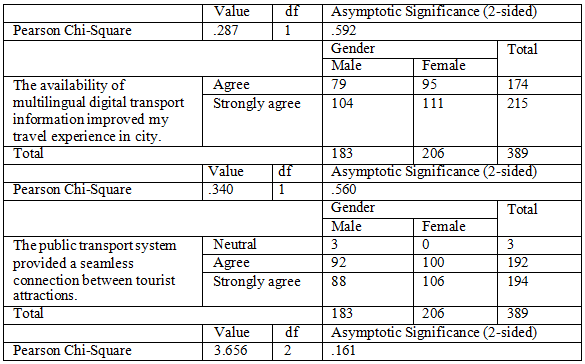
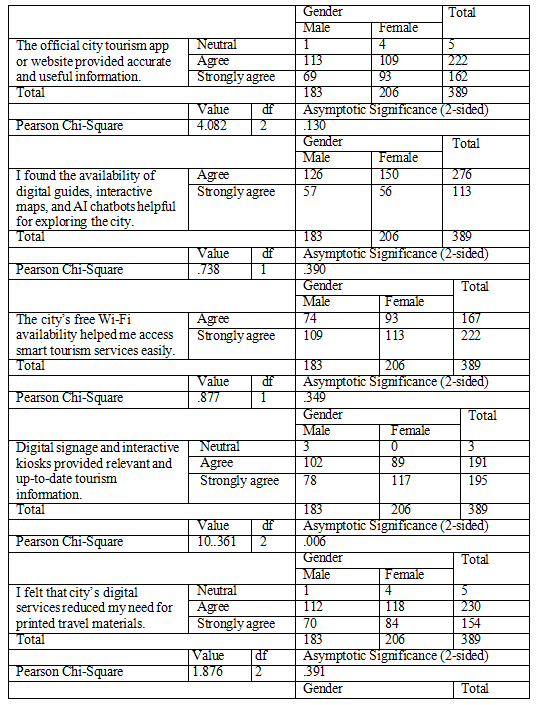
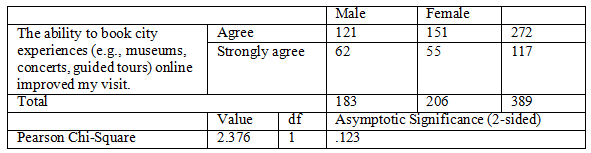
High scores for the items in Table 2 indicate a positive perception of digital city services and smart tourism among respondents. Specifically, it suggests that a significant number of participants "Strongly Agree" or "Agree" with statements regarding the effectiveness and usefulness of digital services provided by cities. The table 2 includes responses to various aspects of digital city services and their impact on tourism. Official City Tourism App or Website: (respondents generally found the official city tourism apps or websites to be accurate and useful. These platforms serve as comprehensive guides, offering essential information on attractions, accommodations, dining, and local events. The availability of real-time updates and easy navigation further enhances their utility); Digital Guides, Interactive Maps, and AI Chatbots: (The presence of digital guides, interactive maps, and AI chatbots is highly beneficial for tourists. These tools enable visitors to explore the city more efficiently by providing instant information, route suggestions, and personalized recommendations. AI chatbots, in particular, offer 24/7 assistance, making it easier to address queries or resolve issues during travel); Free Wi-Fi Availability: (The availability of free Wi-Fi significantly contributes to the accessibility of smart tourism services. It allows tourists to stay connected, access online resources, and utilize various digital tools without incurring additional costs. This connectivity is crucial for seamless navigation and staying informed about local happenings); Digital Signage and Interactive Kiosks: (Digital signage and interactive kiosks offer up-to-date tourism information and are strategically placed at key locations throughout the city. These installations provide insights into local attractions, event schedules, and transportation options, enhancing the overall visitor experience); Reduction in Need for Printed Materials: (The widespread availability of digital services reduces the need for printed travel materials. Tourists can access all necessary information digitally, which is not only convenient but also environmentally friendly. This shift towards digital resources aligns with sustainable tourism practices); Online Booking for City Experiences: (The ability to book city experiences online, such as museum visits, concerts, and guided tours, significantly enhances the tourism experience. Online booking platforms offer convenience and flexibility, allowing tourists to plan their itineraries in advance and avoid long queues).
Table 2. Digital City Services & Smart Tourism in Barcelona, Amsterdam and Vienna
High scores in the context of the items in the table 3 indicate a strong level of agreement or satisfaction among respondents regarding Eco-Friendly & Sustainable Tourism Innovations. Here's a breakdown of what high scores mean for each item. Environmentally Friendly Travel Options: (Cities like Barcelona, Amsterdam, and Vienna have made significant strides in promoting smart tourism initiatives that encourage environmentally friendly travel. These initiatives include the development of efficient public transportation networks and incentives for using low-emission vehicles); Reduction of Carbon Emissions: (Efforts to reduce carbon emissions are evident through smart transport solutions and green initiatives. For instance, the integration of electric buses and the promotion of renewable energy sources for public transport systems contribute to a decrease in the overall carbon footprint); E- Scooters, Bike-Sharing, and Pedestrian-Friendly Streets: (The availability of e- scooters, bike-sharing programs, and pedestrian-friendly streets facilitates sustainable exploration of the city. These options not only reduce reliance on cars but also promote healthier lifestyles and reduce traffic congestion); Smart Waste Management and Recycling Stations: (Public areas in these cities are equipped with smart waste management systems and recycling stations. These installations encourage tourists to dispose of waste responsibly and increase awareness about environmental conservation); Recommendation as Models for Sustainable Tourism: (Due to these successful initiatives, Barcelona, Amsterdam, and Vienna serve as exemplary models for sustainable and smart tourism. Their commitment to green practices and technological integration sets a benchmark for other cities); Influence on Future Travel Choices: (The positive experiences with eco-friendly tourism initiatives in these cities are likely to influence travelers to choose similarly sustainable destinations in the future. The emphasis on sustainability enhances the overall travel experience, making it more fulfilling and responsible). These cities' dedication to eco-friendly innovations not only improves the quality of life for residents but also enriches the experience for visitors, creating a win-win scenario for sustainability and tourism.
Table 3. Eco-Friendly & Sustainable Tourism Innovations in Barcelona, Amsterdam and Vienna

Conclusion
Smart destinations leverage digital technologies to enhance the tourism experience while promoting sustainability and efficiency. These areas, whether urban or rural, utilize information and communication technologies (ICT) to provide seamless services, improve safety, and offer personalized experiences for tourists. Key characteristics of smart destinations include high-speed internet connectivity, mobile applications for real-time information, and eco-friendly initiatives, as exemplified by cities like Barcelona, Amsterdam, and Vienna, which implement smart public transport systems, digital city services, and sustainable tourism practices to create a more enjoyable and responsible travel experience. Each city demonstrates how leveraging Information and Communication Technologies (ICT) can create a seamless, efficient, and sustainable travel experience for both residents and visitors. The integration of real-time updates, contactless ticketing, and multilingual information services enhances the convenience and accessibility of public transportation, directly improving user satisfaction and making these cities more attractive to international tourists. Additionally, these systems reduce tourists' reliance on traditional printed materials, promote eco-friendly travel behaviors, and contribute to overall sustainability goals. Barcelona’s focus on IoT-based mobility solutions, Amsterdam’s pioneering efforts in Mobility-as-a-Service (MaaS), and Vienna’s commitment to real-time data integration each offer unique examples of how cities can innovate to meet the evolving needs of modern travelers. These advancements not only improve transportation efficiency but also foster a safer, more inclusive, and personalized tourism experience.
Smart destinations represent a forward-thinking approach to tourism, where technology is harnessed to create more efficient, sustainable, and enjoyable experiences for visitors. By integrating high-speed internet, mobile applications, eco- friendly initiatives, and interactive technologies, these areas are setting new standards for how cities and rural areas can cater to the needs of modern tourists while also safeguarding their natural and cultural resources for future generations.
For Serbia, implementing analogous strategies may yield substantial advantages, particularly as the nation seeks to enhance its status as a compelling and competitive tourist destination within the Balkans. By adhering to these best practices, urban mobility and the overall experience for visitors in cities such as Belgrade, Novi Sad, and Niš can be significantly improved. The incorporation of real-time information systems, contactless ticketing, and multilingual digital services would enhance the accessibility and convenience of Serbian cities for international visitors. Such advancements could enable Serbia to draw a wider array of tourists, particularly from the EU and other regions. Moreover, the introduction of sustainable transportation options, including electric buses, bike-sharing initiatives, and pedestrian-friendly areas, would position Serbia in accordance with global sustainability movements. This alignment is especially crucial as environmentally conscious tourism increasingly becomes a priority for travelers around the globe. Investing in high- speed internet access within public areas, as well as implementing digital ticketing and mobile applications for real-time navigation, has the potential to improve tourist satisfaction and elevate the quality of life for local residents. The burgeoning technology sector in Serbia offers a robust basis for the incorporation of these digital advancements into urban infrastructure. By embracing smart city initiatives, Serbia can establish itself as a frontrunner in the Western Balkans in terms of innovation related to urban mobility and tourism development. Such an approach would not only distinguish Serbia in a competitive regional tourism landscape but also facilitate collaborations with prominent cities across Europe.
Serbia can draw valuable lessons from the experiences of Barcelona, Amsterdam, and Vienna. By embracing smart public transport systems and integrating sustainable, digital solutions, Serbian cities can enhance their global competitiveness, improve the quality of urban life, and ensure a more seamless, eco- friendly experience for future generations of tourists.
This research is supported by the Ministry of Science, Technological Development and Innovation of the Republic of Serbia by the Decision on the scientific research funding for teaching staff at the accredited higher education institutions in 2025 (No. 451-03-137/2025-03/200375 of February 4, 2025).
References
2.Benaddi, L., Souha, A., Ouaddi, C., Jakimi, A., & Ouchao, B. (2024a). Towards a unified metamodel for developing the conversational agents for smart tourism. Procedia Computer Science, 236, 241-247, https://doi.org/10.1016/j.procs.2024.05.027.
3.Cimbaljević, M., Pantelić, M., Kovačić, S., & Vukosav, S. (2023). Destination competitiveness and sustainability indicators: Implementation of the European Tourism Indicator System (ETIS) in Serbia. Hotel and Tourism Management, 11(2), 27–43. https://doi.org/10.5937/menhottur2302027C
4.Collado-Agudo, J., Herrero-Crespo, A., & San Martín-Gutiérrez, H. (2023). The adoption of a smart destination model by tourism companies: An ecosystem approach. Journal of Destination Marketing & Management, 28, 100783, https://doi.org/10.1016/j.jdmm.2023.100783.
5.Fernandez-Anez, V., Fernández-Güell, J.M., & Giffinger, R. (2018). Smart
City implementation and discourses: An integrated conceptual model. The case of Vienna. Cities, 78, 4-16, https://doi.org/10.1016/j.cities.2017.12.004.
6.Gelter, J., Fuchs, M., & Lexhagen, M. (2022). Making sense of smart tourism destinations: A qualitative text analysis from Sweden. Journal of Destination Marketing & Management, 23, 100690, https://doi.org/10.1016/j.jdmm.2022.100690.
7.Gong, Y., & Schroeder, A. (2022). A systematic literature review of data privacy and security research on smart tourism. Tourism Management Perspectives, 44, 101019, https://doi.org/10.1016/j.tmp.2022.101019.
8.Grimaldi, D., & Fernandez, V. (2017). The alignment of University curricula with the building of a Smart City: A case study from Barcelona. Technological Forecasting and Social Change, 123, 298-306, https://doi.org/10.1016/j.techfore.2016.03.011.
9.Huda, C., Gaol, L.F., Warnars, H.L.H.S., & Soewito, B. (2023). Software Size Measurement of Smart Digital Tourism Project based on Use Case Point. Procedia Computer Science, 227, 902-911, https://doi.org/10.1016/j.procs.2023.10.597.
10.Kim, C., & Kim, J. (2023). Spatial spillovers of sport industry clusters and community resilience: Bridging a spatial lens to building a smart tourism city. Information Processing & Management, 60(3), 103266, https://doi.org/10.1016/j.ipm.2023.103266.
11.Kontogianni, A., Alepis, E., & Patsakis, C. (2022). Promoting smart tourism personalised services via a combination of deep learning techniques. Expert Systems with Applications, 187, 115964, https://doi.org/10.1016/j.eswa.2021.115964.
12.Koo, I., Zaman, U., Ha, H., & Nawaz, S. (2025). Assessing the interplay of trust dynamics, personalization, ethical AI practices, and tourist behavior in the adoption of AI-driven smart tourism technologies. Journal of Open Innovation: Technology, Market, and Complexity, 11(1), 100455, https://doi.org/10.1016/j.joitmc.2024.100455.
13.Lee, H.T., & Jan, H.F. (2023). How do smart tourism experiences affect visitors’ environmentally responsible behavior? Influence analysis of nature- based tourists in Taiwan. Journal of Hospitality and Tourism Management, 55, 1-10, https://doi.org/10.1016/j.jhtm.2023.02.016.
14.Liu, S., & Wu, H. (2023). Analysis of the application of path finding system based on efficiency improvement in smart tourism. Intelligent Systems with Applications, 20, 200265, https://doi.org/10.1016/j.iswa.2023.200265.
Long, X., & Chen, W. (2024). Construction framework of smart tourism big data mining model driven by blockchain technology. Heliyon, 10(14), e34159, https://doi.org/10.1016/j.heliyon.2024.e34159.16.Lu, C.W., Huang, J.C., Chen, C., Shu, M.H., Hsu, C.W., Bapu, B.R.T.
(2021). An energy-efficient smart city for sustainable green tourism industry. Sustainable Energy Technologies and Assessments, 47, 101494, https://doi.org/10.1016/j.seta.2021.101494.
17.Mandić, A., & Kennell, J. (2021). Smart governance for heritage tourism destinations: Contextual factors and destination management organization perspectives. Tourism Management Perspectives, 39, 100862, https://doi.org/10.1016/j.tmp.2021.100862.
18.Mantero, C. (2023). Sustainable, Smart and Safe mobility at the core of sustainable tourism in six European islands. Transportation Research Procedia, 72, 635-641, https://doi.org/10.1016/j.trpro.2023.11.449.
19.Ngeoywijit, S., Kruasom, T., Ugsornwongand, K., Pitakaso, R., Sirirak, W., Nanthasamroeng, N., Kotmongkol, T., Srichok, T., Khonjun, S., & Kaewta,
C. (2022). Open Innovations for Tourism Logistics Design: A Case Study of a Smart Bus Route Design for the Medical Tourist in the City of Greater Mekong Subregion. Journal of Open Innovation: Technology, Market, and Complexity, 8(4), 173, https://doi.org/10.3390/joitmc8040173.
20.Nieves-Pavón, S., López-Mosquera, N., & Jiménez-Naranjo, H. (2024). The role emotions play in loyalty and WOM intention in a Smart Tourism Destination Management. Cities, 145, 104681, https://doi.org/10.1016/j.cities.2023.104681.
21.Noori, N., Hoppe, T., van der Werf, I., & Janssen,M. (2025). A framework to analyze inclusion in smart energy city development: The case of Smart City Amsterdam. Cities, 158, 105710, https://doi.org/10.1016/j.cities.2025.105710.
22.Okonta, D.E., & Vukovic, V. (2024). Smart cities software applications for sustainability and resilience. Heliyon, 10(12), e32654, https://doi.org/10.1016/j.heliyon.2024.e32654.
23.Oliveira, L. (2022). Sensory and Emotional Smart Cultural Tourism: a conceptual paper, Procedia Computer Science, 204, 283-287, https://doi.org/10.1016/j.procs.2022.08.034.
24.Putra, Z.D.W., & van der Knaap, W. (2019). 6 - A smart city needs more than just technology: Amsterdam’s Energy Atlas project, Editor(s): Leonidas Anthopoulos, Smart City Emergence, Elsevier, 129-147, https://doi.org/10.1016/B978-0-12-816169-2.00006-7.
25.Qian, W. (2024). Application of e-learning and interactive business experience based on edge computing in smart city tourism management. Entertainment Computing, 50, 100681, https://doi.org/10.1016/j.entcom.2024.100681.
26.Roblek, R. (2019). 5 - The smart city of Vienna, Editor(s): Leonidas
Anthopoulos, Smart City Emergence, Elsevier, 105-127, https://doi.org/10.1016/B978-0-12-816169-2.00005-5.
27.Shin, H.H., Kim, J., & Jeong, M. (2023). Memorable tourism experience at smart tourism destinations: Do travelers' residential tourism clusters matter? Tourism Management Perspectives, 46, 101103, https://doi.org/10.1016/j.tmp.2023.101103.
28.Shmelev, E.S., & Shmeleva, I.A. (2025). Smart and sustainable benchmarking of cities and regions in Europe: The application of multicriteria assessment. Cities, 156, 105533, https://doi.org/10.1016/j.cities.2024.105533.
29.Sustacha,I., Baños-Pino, F.J., & Del Valle, E. (2023). The role of technology in enhancing the tourism experience in smart destinations: A meta-analysis. Journal of Destination Marketing & Management, 30, 100817, https://doi.org/10.1016/j.jdmm.2023.100817.
30.Tavitiyaman, P., Qu, H., Tsang, W.L. Lam, C.R. (2021). The influence of smart tourism applications on perceived destination image and behavioral intention: The moderating role of information search behaviour. Journal of Hospitality and Tourism Management, 46, 476-487, https://doi.org/10.1016/j.jhtm.2021.02.003.
31.Tena, M.A.M., Artola, R.M.R., Callarisa-Fiol, L.J., & Algueró-Boronat, M. (2024). Local Government Tourism Officer satisfaction with the Smart Destination model: A case study with the Kano method. Journal of Destination Marketing & Management, 34, 100951, https://doi.org/10.1016/j.jdmm.2024.100951.
32.Wang, X. (2024). Construction of smart tourism system integrating tourist needs and scene characteristics. Systems and Soft Computing, 6, 200168, https://doi.org/10.1016/j.sasc.2024.200168.
33.Ye, S., Shi, L., Feng, Z., & Hyuk, G. (2025). Toward a Smarter, Sustainable and Satisfying Life:Exploring the Mechanism of Smart Rural Tourism Construction Empowering Rural Revitalization in the Area of Yangtze River Delta. Heliyon, e42704, https://doi.org/10.1016/j.heliyon.2025.e42704.
34.Yigitcanlar, T., Han, H., Kamruzzaman, Md., Ioppolo, G., Sabatini-Marques,
J. (2019). The making of smart cities: Are Songdo, Masdar, Amsterdam, San Francisco and Brisbane the best we could build? Land Use Policy, 88, 104187, https://doi.org/10.1016/j.landusepol.2019.104187.
Published in
Vol. 11 No. 3 (2025)
Keywords
🛡️ Licence and usage rights
This work is published under the Creative Commons Attribution 4.0 International (CC BY 4.0).
Authors retain copyright over their work.
Use, distribution, and adaptation of the work, including commercial use, is permitted with clear attribution to the original author and source.
Interested in Similar Research?
Browse All Articles and Journals