
ASSESSING PROGRESS OF RURAL TOURISM DEVELOPMENT: IMPACT OF THE COMPLEXITY OF SOCIAL SUSTAINABILITY INDICATORS

Abstract
This scientific paper explores the intricate dynamics of rural tourism development, focusing on the social sustainability indicators that influence the progress of rural communities Focusing on Western Serbia, this research delves into the social sustainability indicators influenced by rural tourism. This study relied on structured surveys conducted among residents of the popular ethno villages – Koštunići, Vraneša, Sunčana reka, and Sirogojno. Utilizing a Likert scale, participants rated their perceptions on social sustainability indicators and gender-related dynamics. Statistical analyses, including Chi-Square Tests, were utilized to explore associations between social indicators and the gender of the participants. Examining family conflicts, trust, generosity, personal appearance, information use, social responsibility, confidence, and women's health, the study uncovers positive shifts in community well-being. The study emphasizes the pivotal role of social sustainability in evaluating the impact of rural tourism on community well-being and underscores the need for a comprehensive understanding of social dynamics to ensure the success of sustainable rural tourism initiatives.
Article
Introduction
The dynamism of contemporary societies has propelled rural tourism to the forefront of sustainable development discussions. As urban landscapes grapple with challenges such as congestion, environmental degradation, and the strain on resources, rural areas have become focal points for alternative and sustainable development strategies. As it becomes a more influential industry, Jasrotia & Gangotia (2018) highlight its significant importance within the economic and social realms of most destinations. Tourism, particularly in rural settings, is a multifaceted instrument capable of stimulating economic growth, preserving cultural heritage, and fostering community well-being. However, the success of rural tourism ventures depends not only on economic factors but also on the intricate web of social dynamics that shape the fabric of local communities.
Within the realm of tourism, rural tourism emerges as a pivotal contributor to the social progress of rural communities (Bouzarjomehri et al., 2022). As rural tourism development continues to gain momentum as a driver of sustainable development, understanding its impact on social sustainability becomes imperative. Social sustainability, which Hussain et al. (2023) clarify that it pertains to principles such as equal opportunities, elevated quality of life, and the advancement of sustainable human development. In other words, it can be seen as an indispensable dimension of the overall sustainability paradigm and encompasses a spectrum of factors that collectively contribute to the well-being of individuals and communities. According to Pérez et al. (2017), indicators for sustainable rural tourism development should encompass aspects of social sustainability, focusing on enhancing the quality of life for residents and communities. Examining social indicators, as suggested by Yuedi et al. (2023), provides insights into residents' sentiments toward tourism, facilitating the development of tourism in a way that prioritizes the safety of residents and avoids disrupting their everyday lives. Hwang et al. (2012) highlight that it is essential to address the issue of emigration and enhance the social sustainability of the community. The confirmation of this may be found in the findings of Soltani Moqadas & Taleshi (2020) who conclude that among the various aspects of social sustainability, maintaining a stable population is of utmost importance, especially considering the job opportunities emerging from the tourism sector. Campón- Cerro et al. (2017) emphasize that preserving and nurturing the local traditional culture is crucial, as rural tourism has the potential to harm it, and doing so promotes social sustainability. Understanding the intricacies of social sustainability is imperative for evaluating the progress and impact of rural tourism development initiatives. Yu et al. (2023) understand social factors as factors that comprise a range of human activities, encompassing aspects such as sanitation, the quality of living environments, educational settings, and overall living conditions. On the other hand, Bouzarjomehri et al. (2022) see social development as a possibility for enhancing the social well-being of rural women. Another dimension of social indicators is presented by Firza et al. (2023) who observe and introduce the indicators of social well-being of the destination encompassing the availability of a range of local services. Kang et al. (2012) add that indicators for sustainable rural tourism development should encompass aspects of social sustainability, focusing on enhancing the quality of life for residents and communities, while Utami et al. (2023) see the benefits of cooperation of the local residents in creating entrepreneurship opportunities in rural area. Finally, social sustainability indicators serve as crucial metrics for evaluating the impact of rural tourism development on the well-being of individuals and communities and it would serve as a main motive of examination in this paper.
In this study, we delve into the complexities of social sustainability through an examination of specific indicators, namely family conflicts, trust in people, generosity, personal appearance, information use, social responsibility, confidence, and women's health. The main focus of the study will be the examination of relationships between gender and the abovementioned social sustainability indicators, unraveling the complexities that underlie the dynamics of rural tourism development.
This paper focuses on Western Serbia, an area renowned for its picturesque landscapes, traditional way of life, and rural scenery. Western Serbia presents a distinctive combination of natural beauty, cultural heritage, and the warm hospitality of rural communities. The region boasts geographical diversity, featuring rolling hills, fertile plains, and pristine rivers that serve as a vibrant backdrop for various rural tourism activities such as hiking, fishing, agrotourism, and cultural events. Additionally, its proximity to national parks and protected areas enhances its allure as a rural tourism destination. The study area encompasses four tourist villages: Koštunići, Vraneša, Sunčana reka, and Sirogojno. These villages have embraced tourism as a means to diversify their economies while safeguarding their cultural and natural heritage. Visitors to these villages can engage in authentic experiences, explore traditional craftsmanship, and immerse themselves in the local way of life. The study aims to analyze the dynamics of rural tourism in these villages and evaluate its impact on the quality of life for the local communities.
The research findings indicate that in the observed rural areas of Western Serbia, tourist activities have yielded positive social effects on the lives of the local population. Furthermore, the changes brought about by the development of tourism have significantly influenced social conditions, perspectives, and established practices among the residents.
Methodology
Study area
The research area comprises four tourist villages in western Serbia: Koštunići, Vraneša, Sunčana reka, and Sirogojno.
By observing the same area Panić et al. 2024) provided more insights about the selected villages. Koštunići, positioned 32 kilometers northwest of Gornji Milanovac, is a rural settlement primarily dedicated to cattle breeding, with a dispersed layout. Situated on the southern inclines of Suvobor, a summit with an elevation of 866 meters, as documented by Čulić 2006). Notably, it stands out as the most extensive rural settlement in the Gornji Milanovac municipality in terms of land area Pavlović, 2016). The village is surrounded by four mountain rivers, providing habitats for diverse river fish and crab species Milošević, 2006). Known for its outstanding ecological and scenic attributes, Jovanović Tončev 2016) additionally points out features of valleys in Koštunići with well- defined agrarian, forest, and meadow ecosystems, making it the sole ecological village in Serbia.
Vraneša, located in the Zlatibor region near the town of Nova Varoš, is an ethno- eco village situated within a coniferous forest. The village with traditional bungalow-style accommodation, at an elevation of 943 meters, offers picturesque views of Zlatar Lake Svojić, 2015). Constructed in adherence to traditional Serbian village architecture, using environmentally friendly materials like black pine and stone, Vraneša is surrounded by lush greenery, rolling hills, and pristine rivers. According to Svojić 2015), it is a favored destination for outdoor enthusiasts seeking natural beauty, trekking, and immersion in local culture.
Sunčana Reka, situated on the banks of the Drina River near Loznica, offers a picturesque setting surrounded by natural beauties like Banja Koviljača and the historically significant Gučevo mountain. According to Stepanović 2015), the tourist complex comprises seven accommodation settlements with various facilities, including sports and recreational activities such as horseback riding, ball sports, and Drina-based recreational activities.
Sirogojno, located on Zlatibor, operates as an open-air museum named "Staro selo" Old Village). Showcasing the life of Serbian peasants and forgotten crafts and skills through its unique construction architecture and interior decoration, Sirogojno covers an area of 5 hectares and includes approximately 50 buildings relocated from surrounding Zlatibor villages Đenić, 2008). Positioned near one of the largest Serbian mountaineering centers, Ranko 1987) emphasizes the fact that Sirogojno offers a glimpse into the hilly and mountainous areas of the Dinaric region.
Sources of data
In this research, we relied on the perspectives of the local community to evaluate the sustainable social impacts of tourism on their quality of life. The choice to focus on the social aspect of the research is driven by the recognition that tourism, particularly in rural areas, has profound implications for local communities beyond economic considerations. Understanding and addressing the social dimensions are crucial for ensuring sustainable and responsible tourism development. Social sustainability encompasses factors such as community well-being, cultural preservation, and the equitable distribution of benefits among residents.
We adapted our research methodology from Monterrubio et al. 2020), who sought insights from the local population regarding the primary effects of tourism development in rural areas. Our objective was to convey the local community's viewpoints on the repercussions of tourism development, specifically the transformation of ethnic villages and objects into tourist attractions, on the quality of life in the surrounding villages. With a specific emphasis on gender roles and their influence on overall quality of life, positive outcomes were anticipated. Spanning from May 2022 to May 2023, our study encompassed the local population of eco-ethno villages in Western Serbia— Koštunići, Vraneša, Sunčana reka, and Sirogojno. A total of 469 participants took part, providing ratings on a 1-5 ordinal scale, where 1 represented the most negative impact, 5 the most positive, and 3 indicated no change. A Likert scale was utilized to measure the gradation of attitudes.
The primary goal of the study was to evaluate the significance of specific attitudes within social dimensions, aiming to mitigate negative aspects and highlight positive elements in the development of rural destinations. Our focus centered on variables presumed to exert the most substantial influence on the quality of life for the local population. The examined dependent variable was economic impacts Family conflicts, trust in people, generosity, personal appearance, information used, confidence, social responsibility and women’s health). Among the independent variables, "Gender" was integrated into the study. Chi-Square Tests were employed to explore potential associations between variables and the likelihood of connection. The initial assumption posited that there would be no disparity in responses based on the gender of the participants, and statistically significant differences were defined as those with p- values less than 0.05.
From this point, the following primary and supporting hypotheses can be formulated:
H1: The economic development of ethno villages in Western Serbia is significantly influenced by key social indicators, including family conflicts, trust in people, generosity, personal appearance, information used, confidence, social responsibility, and women’s health
H2: Women’s health has been significantly improved as a result of more women’s involvement in the entrepreneurship life of rural tourism.
Results
The largest number of respondents noticed a decrease in the number of family conflicts Table 1). Constant stress caused by economic pressure ultimately results in family conflicts, disorder, and unstable relationships Fine & Fincham, 2013). Nevertheless, these results indicate that with the increase in economic well-being that comes as a result of the creation of a direct or indirect tourist offer, the level of stress and family conflicts decreases.
Table 1. Family conflicts
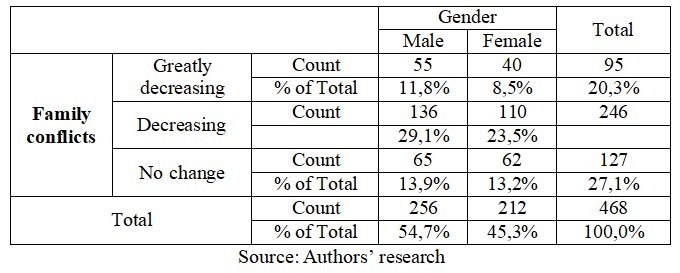
The Chi-Square Test for family conflicts and gender produced a p-value of 0.589, indicating no significant relationship Table 2). This means that the results presented in the previous table are equally distributed according to gender, that is, that both genders react equally to changes related to the aspect of family conflicts.
Table 2. Pearson Chi-Square Test

Both males and females reported an increase in trust in people 72.2% (Table 3), with a slightly higher representation of males. Rural tourism development has led to a notable increase in trust among people, fostering a stronger sense of community and cooperation within rural areas. In addition to the trust that is increasingly developing between the representatives of the tourist offer and tourists, the trust that these results can indicate is also related to tourism institutions. Having trust in individuals underscores the importance of tourism organizations in the advancement of tourist villages through the dissemination of comprehensive and transparent information to the entire community regarding the management of tourism (Prayitno et al., 2023).
Table 3. Trust in people
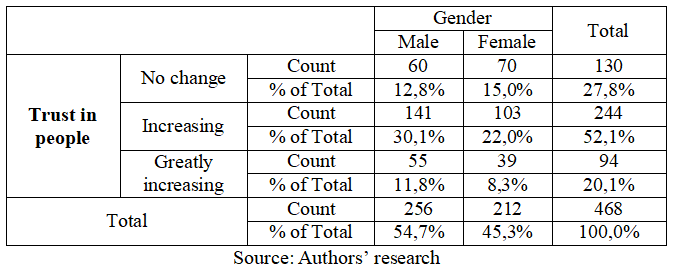
P-value of 0.070, indicating no significant relationship between gender and trust in people (Table 4). This means that both genders equally develop trust in people under the influence of tourist activities and experiences.
Table 4. Pearson Chi-Square Test

Both males and females reported an increase in generosity (74,8%), with a slightly higher representation of males. The income generated from tourism often gets reinvested in the community, supporting various local initiatives and community projects. That includes home renovations, emergencies, helping others, etc. (Passafaro et al., 2017). Rural tourism, therefore, not only revitalizes these areas but also brings about a cultural renaissance, instilling a greater sense of generosity and welcoming spirit among the local population.
Table 5. Generosity
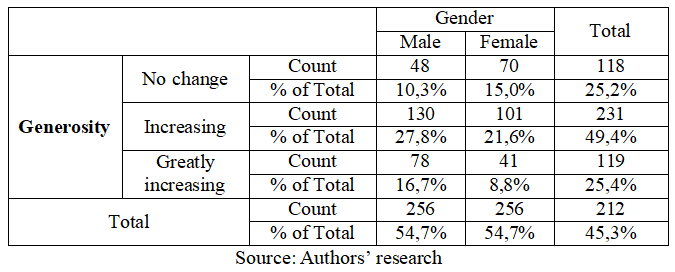
The results of the Chi-Square Test indicate that there is a statistically significant relationship between gender and the reported level of generosity (Table 6). This means that the level of generosity differs significantly between males and females in the sample. Based on the results of the Chi-Square Test, it appears that females tend to be more generous than males. A significantly larger number of women did not notice the difference in this aspect with the advent of rural tourism, unlike men.
Table 6. Pearson Chi-Square Test

Despite similar opinions by both genders, a slightly higher proportion of males reported an increase in personal appearance perceptions compared to females (Table 7). Respondents commonly attribute the flourishing tourism industry to their enhanced sense of personal appearance, as they are eager to present the rich cultural heritage of their region to the world. In addition, local respondents frequently highlight the positive impact of rural tourism on their self-esteem and overall well-being. For example, some research highlights the emphasis for residents in an Eastern European setting lies more in the pride and self-esteem gained from psychological empowerment and the sense of improved community cohesion, rather than the economic promises presented by tourism (Strzelecka et al., 2017).
Table 7. Personal appearance
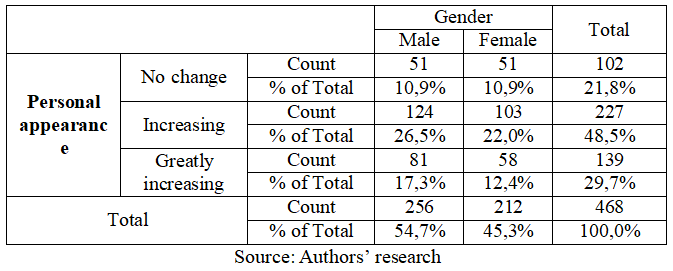
The Chi-Square Test (Table 8) for personal appearance and gender produced a value of 1.626 with a p-value of 0.444, indicating no significant relationship between gender and personal appearance perceptions.
Table 8. Pearson Chi-Square Test

In the context of "other" social impacts, rural tourism has a significant impact, with a notable gender difference favoring males (Table 9). This data tells us that the development of rural tourism has contributed to a better experience of the local population in those sociological aspects that were not individually analyzed previously. Other social aspects may include linking stakeholders, safeguarding and passing on knowledge, protecting cultural heritage, reinforcing identity, promoting intergenerational communication, and more (Topole, et al., 2021).
Table 9. Information use
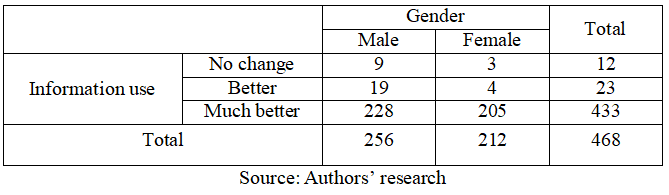
The Chi-Square Test (Table 10) examining the relationship between gender and information use shows significance in this relationship. The low p-value of 0.007 suggests that the observed relationship is unlikely to have occurred by random chance alone, providing evidence of a significant association between gender and information used in the analyzed dataset. In today's digital age where the Internet plays a central role in information dissemination, it becomes important to explore the frequency of internet usage across different genders. Some research, as outlined by Wasserman & Richmond‐ Abbott (2005), indicates that women tend to visit fewer websites and use the Internet less frequently than men. This difference is believed to be even more emphasized in rural areas given the traditional roles between the genders.
Table 10. Pearson Chi-Square Test

In terms of social responsibility, results (Table 11) show much better conditions in this domain among both genders after the emergence of rural tourism activity in the observed destinations. This applies not only to individuals from the local environment but also to the way of relationships in the business environment, especially among local entrepreneurs. Those phenomena are noted also by Cheng & Fallon (2023), who highlighted that entrepreneurs can contribute through a variety of advantages, offering not just economic but also cultural, environmental, and social benefits to communities.
Table 11. Social responsibility
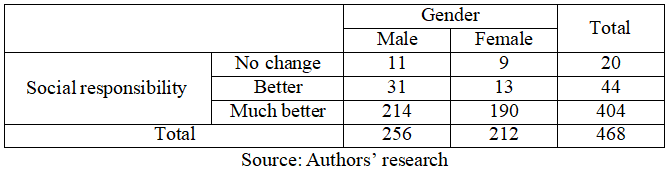
According to the results of the Chi-Square Test (Table 12), there is no statistical significance when it comes to the relationship between gender and social responsibility. It indicates that both genders equally perceive differences in the positive change of social responsibility among the local population due to the development of rural tourism.
Table 12. Pearson Chi-Square Test

The local population is more confident in its capabilities and potential after rural tourism is imposed in the observed areas (Table 13). According to Yan (2021), the core of regional characteristics forms the bedrock for the self-assurance of local culture, enhancing the cultural allure and cohesiveness of rural life landscapes. Moreover, the same author (Yan, 2021) adds that it plays a pivotal role in bolstering the local culture's confidence and acts as a driving force, prompting young individuals to return to their hometowns for constructive engagement.
Table 13. Confidence
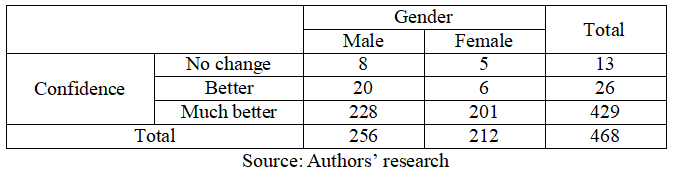
According to the results of Table 14, there is no statistically significant relationship between the increase in confidence and gender. The reason for that may be found in the fact that both men and women evaluate and perceive their level of confidence based on the success of their local businesses. Some authors, including Sofer et al. (2023) notice that smaller enterprises, including micro- businesses and small businesses, were less prone to express 'high confidence' in business survival when compared to their larger counterparts.
Table 14. Pearson Chi-Square Test

When talking about the issue of women's health among the local population, the research results (Table 15) indicate a significantly better state of women's health after rural tourism became an important factor in the local economy of the observed destinations. Jobs in the tourism sector, according to Alrwajfah et al. (2020) are appropriate for women and should not compromise their health or dignity. The issue of mental health is particularly important. Females exhibit a greater number of depressive symptoms than males (Nikpour et al., 2018), but having more opportunities for self-actualization while working in the tourism sector their level of stress and depression might decrease.
Table 15. Women's Health
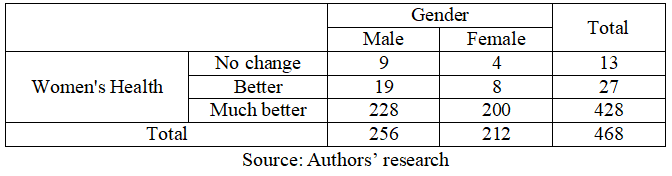
Although women experience a disproportionate impact on their health profiles, displaying lower overall health indicators compared to men, particularly in rural areas (Giri, 2023), the Chi-Square Test shows no statistical significance between gender and women’s health. It shows that not only women, but men as well understand the importance and realize the difference in women’s health conditions before and after rural tourism became established.
Table 16. Pearson Chi-Square Test

Discussion and Conclusion
In conclusion, the contemporary dynamism of societies has positioned rural tourism as a pivotal component in discussions surrounding sustainable development. As urban areas grapple with challenges such as congestion, environmental degradation, and resource strain, rural locales have emerged as focal points for alternative and sustainable development strategies. Rural tourism, especially in such settings, emerges as a versatile instrument capable of not only driving economic growth but also preserving cultural heritage and enhancing community well-being. Nevertheless, the success of rural tourism ventures is contingent not only upon economic factors but also on the intricate web of social dynamics shaping the fabric of local communities.
Social sustainability, an indispensable facet of the broader sustainability paradigm, encompasses a spectrum of factors contributing collectively to the well- being of individuals and communities. A nuanced understanding of social sustainability is imperative for evaluating the progress and impact of rural tourism development initiatives. This paper has delved into the intricate relationship between gender and various social sustainability indicators, unraveling the complexities underlying the dynamics of rural tourism development.
As rural tourism gains traction, it is essential to critically examine its impact on the social fabric of host communities. This requires an exploration of the intricate interplay between various social dimensions, including familial relations, interpersonal trust, individual attitudes, and health considerations. The lens through which these dimensions are assessed is not uniform but varies based on the social and cultural context of each community. Therefore, a comprehensive evaluation of rural tourism development necessitates a nuanced understanding of the diverse factors contributing to social sustainability.
Social sustainability indicators serve as crucial metrics for evaluating the impact of rural tourism development on the well-being of individuals and communities. These indicators encompass a broad spectrum of elements that capture the essence of social life, ranging from interpersonal relationships to personal well-being. In this study, we delved into the complexities of social sustainability through an examination of specific indicators, namely family conflicts, trust in people, generosity, personal appearance, information use, social responsibility, confidence, and women's health.
In the context of rural tourism development as a driver of sustainable progress, understanding its impact on social sustainability becomes imperative. By scrutinizing family conflicts, trust in people, generosity, personal appearance, information use, social responsibility, confidence, and women's health, we aim to provide a nuanced understanding of the intricate web of social dynamics influenced by tourism activities. The inclusion of gender as an independent variable adds a layer of complexity to our analysis, recognizing the diverse experiences and roles of men and women in rural communities.
Analyzing the results, a notable decrease in family conflicts was observed, underscoring the potential of rural tourism to alleviate economic stress and enhance family stability. Trust in people increased significantly, fostering a stronger sense of community and cooperation. Generosity also rose, indicating that income generated from tourism often reinvests in the community, supporting local initiatives. Personal appearance perceptions saw a slight increase, attributed to the positive impact of rural tourism on self-esteem and overall well-being.
The results underscore the positive impact of rural tourism on social responsibility, confidence, and women's health. Social responsibility conditions improved after the emergence of rural tourism, indicating a positive shift in individual and business relationships within the community. The local population exhibited increased confidence in its capabilities and potential, contributing to cultural allure and cohesiveness. Notably, women's health showed a significantly better state after the integration of rural tourism, emphasizing the positive impact on mental health and well-being.
The findings of our study provide substantial evidence supporting Hypothesis 1. The economic development of ethno villages in Western Serbia is indeed significantly influenced by key social indicators. Family conflicts, as indicated by respondents, exhibited a notable decrease, aligning with the assumption that reduced conflict positively impacts economic development. Increased trust in people and generosity, particularly among males, suggests that the communal support fostered by these social indicators contributes positively to economic growth.
The slight increase in personal appearance perceptions among respondents further supports the hypothesis, emphasizing that a positive self-image can be linked to economic well-being. Additionally, the positive impact of rural tourism on social responsibility and confidence aligns with the notion that these factors contribute to the economic development of ethno villages. Women's health, a crucial aspect of social indicators, showed a significantly better state after the integration of rural tourism, indicating a positive correlation between women's health and economic development.
The outcomes of our study provide robust support for Hypothesis 2. Women's health exhibited a significantly better state after the integration of rural tourism as a vital factor in the local economy. The study indicates a positive association between women's increased involvement in the entrepreneurship aspects of rural tourism and improved health conditions. This aligns with existing literature emphasizing the appropriateness of jobs in the tourism sector for women, promoting their well-being and dignity.
While the results showcase positive outcomes, it is important to note that gender differences were observed in certain aspects. The level of generosity differed significantly between males and females, with women tending to be more generous. However, no significant relationship was found between gender and personal appearance perceptions, trust in people or social responsibility. Moreover, the study revealed that both genders equally perceived differences in positive changes related to family conflicts, confidence, and women's health.
In conclusion, rural tourism development holds promise as a catalyst for positive social change. The findings suggest that it not only contributes to economic growth but also fosters social sustainability by improving various indicators related to interpersonal relationships, community well-being, and individual health. However, the nuanced nature of these impacts, as influenced by gender and other contextual factors, necessitates ongoing research and tailored strategies to ensure that rural tourism development is inclusive and beneficial for all members of the community. This study contributes to the growing body of knowledge on the intricate dynamics of rural tourism and its role in promoting sustainable development from a social perspective.
References
2.Campón-Cerro, A. M., Hernández-Mogollón, J. M., & Alves, H. 2017. Sustainable improvement of competitiveness in rural tourism destinations: The quest for tourist loyalty in Spain. Journal of Destination Marketing & Management, 63: 252-266.
3.Cheng, Y., & Fallon, J. 2023. Developing an Integrated Rural Tourism Model for Stakeholders in Yuanjia Village, China. ABAC Journal, 434: 205-222.
4.Čulić, L. 2006. Marketing strategija Suvoborske regije sa posebnim osvrtom na destinaciju Koštunići. Departman za geografiju, turizam I hotelijerstvo, Novi Sad. 181 (in Serbian).
5.Đenić, Z. 2008. Seoski turizam Zlatiborskog kraja. Departman za geografiju, turizam I hotelijerstvo, Novi Sad. 54. (in Serbian).
6.Fine, M. A., & Fincham, F. D. Eds.. 2013. Handbook of family theories: A content-based approach. Routledge.
7.Firza, N., Antonucci, L., Crocetta, C., d’Ovidio, F. D., & Monaco, A. 2023. Spatial Analysis to Investigate the Relationship Between Tourism and Wellbeing in Italy. Social Indicators Research, 1-17.
8.Giri, R. 2023. ROLE OF MICRO FINANCE ON WOMEN'S
EMPOWERMENT. Doctoral dissertation, Department of Economics, TU Birendra Multiple Campus.
9.Hussain, S., Ahonen, V., Karasu, T., & Leviäkangas, P. 2023. Sustainability of smart rural mobility and tourism: A key performance indicators-based approach. Technology in Society. 102287.
10.Hwang, D., Stewart, W. P., & Ko, D. W. 2012. Community behavior and sustainable rural tourism development. Journal of Travel research. 513: 328- 341.
11.Jasrotia, A., & Gangotia, A. 2018. Smart cities to smart tourism destinations: A review paper. Journal of tourism intelligence and smartness. 11: 47-56.
12.Jovanović Tončev, M. 2016. The importance of sustainable rural tourism development in Serbia. In Sinteza 2016-International Scientific Conference
on ICT and E-Business Related Research. 575-581. Singidunum University.
13.Kang, S. K., Lee, C. K., Yoon, Y., & Long, P. T. 2008. Resident perception of the impact of limited-stakes community-based casino gaming in mature gaming communities. Tourism management. 294: 681-694.
14.Milošević, S. 2006. Seoski turizam u selu Koštunići. Departman za geografiju, turizam I hotelijerstvo, Novi Sad. 55. (in Serbian).
15.Nikpour, A., Rezghi, F., & Rineh, M. S. 2018. Spatial Analysis of Urban Form based on Building Density, Babol. Geographical Urban Planning Research. 62: 1-4
16.Panić, A., Vujko, A. & Knežević, M. 2024 (Accepted for publishing in vol. 2, 2024). Rural tourism impact on the life quality of the local community: a case study of Western Serbia. Economic of Agriculture.
17.Passafaro, P., Mura, M., Albanese, A., & Bocci, E. 2017. Potential preferences for alternative forms of sustainable tourism: The case of rural and intergenerational tourism. In Ecotourism and Sustainable Tourism: Management, Opportunities and Challenges. 29-84. Nova Science Publishers, Inc.
18.Pavlović, S. 2016. Elements of tourist destinations: Example of Tourist- recreation centre in Koštunići. Zbornik radova-Geografski fakultet Univerziteta u Beogradu. 64: 453-480.
19.Pérez, V. E., Santoyo, A. H., Guerrero, F., León, M. A., da Silva, C. L., & Caballero, R. 2017. Measuring the sustainability of Cuban tourism destinations considering stakeholders' perceptions. International Journal of Tourism Research. 193: 318-328.
20.Prayitno, G., Dinanti, D., Wisnu Adrianto, D., Rahmawati, R., Auliah, A., & Eka Wardhani, L. 2023. The influence of social capital in improving the quality of life of the community in sidomulyo tourism village, Indonesia. GeoJournal of Tourism and Geosites. 461: 208-217.
21.Ranko, F. 1987. Zlatiborska brvnara i muzej narodnog graditeljstva "Staro selo" u Sirogojnu. Beograd, Republički zavod za zaštitu spomenika kulture.
67. (in Serbian).
22.Sofer, M., Shmuel, I., Amit-Cohen, I., Tchetchik, A., Shiff, S., & Michael, Y. 2023. COVID-19 and the impact on cultural tourism: The case of Beit She’an Valley, Israel. Tourism Culture & Communication.
23.Stepanović, M. 2013. Turistička valorizacija opštine Loznica. Departman za geografiju, turizam I hotelijerstvo, Novi Sad, 33, in Serbian.
24.Strzelecka, M., Boley, B. B., & Strzelecka, C. 2017. Empowerment and resident support for tourism in rural Central and Eastern Europe CEE: The case of Pomerania, Poland. Journal of Sustainable Tourism, 254: 554-572.
25.Svojić, D. 2015. Analiza poslovanja etno eko sela Vraneša. Departman za geografiju, turizam I hotelijerstvo, Novi Sad. 100. (in Serbian).
26.Topole, M., Pipan, P., Gašperič, P., Geršič, M., & Kumer, P. 2021. Culinary events in the Slovenian countryside: Visitors’ motives, satisfaction, and views on sustainability. Acta geographica Slovenica. 611: 107-125.
27.Utami, D. D., Dhewanto, W., & Lestari, Y. D. 2023. Rural tourism entrepreneurship success factors for sustainable tourism village: Evidence from Indonesia. Cogent Business & Management. 101. 2180845.
28.Wasserman, I. M., & Richmond‐ Abbott, M. 2005. Gender and the Internet: Causes of variation in access, level, and scope of use. Social science quarterly. 861: 252-270.
29.Yan, W. 2021. Exploring the Traditional Farming Culture and Improving the Local Cultural Confidence: Solving the Problem of Rural Tourism Homogenization. In E3S Web of Conferences. 275: 02063. EDP Sciences.
30.Yu, J., Yang, J., Li, J., Lin, L., & Ren, Y. 2023. The Role of Tourism in Promoting the Urbanization of Ethnic Border Areas: A Case Study of Xishuangbanna. Sustainability. 15 20: 15119.
31.Yuedi, H., Sanagustín-Fons, V., Coronil, A. G., & Moseñe-Fierro, J. A. 2023. Analysis of tourism sustainability synthetic indicators. A case study of Aragon. Heliyon. 94.
Published in
Vol. 11 No. 1 (2025)
Keywords
🛡️ Licence and usage rights
This work is published under the Creative Commons Attribution 4.0 International (CC BY 4.0).
Authors retain copyright over their work.
Use, distribution, and adaptation of the work, including commercial use, is permitted with clear attribution to the original author and source.
Interested in Similar Research?
Browse All Articles and Journals