
PREDICTION OF ACADEMIC SUCCESS BASED ON PERSONALITY CHARACTERISTICS, SELF-EFFICACY AND ACHIEVEMENT MOTIVATION AMONG STUDENTS IN SERBIA

Abstract
The subject of research in this paper is the connection between personality characteristic according to the HEXACO model, self-efficacy and dimensions of achievement motives on the one hand and academic success on the other hand among students in Serbia. The aim is to determine to what extent personality traits, achievement motive and self-efficacy influence academic success. The average in the last year of study, the overall average at the faculty and satisfaction with academic achievement were determined as indicators of the student's academic success. The research sample consisted of 269 respondents; statistical data processing was carried out using the IBM SPSS Statistics 21 program. Descriptive statistics (AS, SD), Pearson's correlation coefficient and multiple linear regression analysis were used in data processing. The results showed statistically significant correlations of honesty, conscientiousness, self- efficacy, all dimensions as well as overall achievement motive on the one hand and indicators of academic achievement on the other hand. This study provides a better understanding of the personality traits, beliefs, and motivations of students that contribute to academic achievement.
Article
Introduction
Individual variation exists in every aspect of thinking, feeling, and behaving. Modeling the fundamental components of personality structure represented a revolutionary discovery in the study and understanding of individual variation. These theories explain what individual differences are in terms of personality traits and how these differences can be succinctly but thoroughly summarized in terms of basic personality dimensions. In general, personality traits are relatively stable patterns of thinking, mood, and behavior that indicate a tendency to act in a certain way when faced with certain situations (Zettler, et al., 2020).
Predicting students’ performance can help identify the students who are at risk of failure and thus management can provide timely help and take essential steps to coach the student to improve his performance. Today academic success of students of any professional Institution has become the major issue for the management. An early prediction of students at risk of poor performance helps the management take timely action to improve their performance through extra coaching and counseling (Mishra, et al., 2014). Predictive modeling, profiling and segmentation, which are tools used for portfolio risk management and targeted marketing in the financial industry, are now utilized to monitor student’s academic progress and to customize programs for student academic engagement (Ornelas, Ordonez, 2017).
The general field of educational data mining for predicting student success has drawn considerable attention from the research community. Education's primary aim has always been to boost student academic performance (Gundogan, Radulović: 2023). Many studies have been performed over the years by researchers and educators to assess the factors that affect (positively or negatively) student achievement in their academic track. Early prediction of student success in the correct manner would enhance both student retention and the assessment methods used by the students. This approach would also support educators and education officials by providing them with more knowledge about their students' learning abilities as well as how to better assist students who are falling behind in a given set (Viswanathan, Vengatesh, 2021).
Models of basic personality structure are among the most widely used frameworks in psychology and beyond, and have significantly advanced the understanding of individual differences in a host of consequential outcomes. Over the past decades, two such models have become most widely used: the Five Factor Model (FFM) or Big Five, respectively, and the HEXACO Model of Personality (Thielmann, et al., 2021). Since 2004, when the first version of the HEXACO model was published (Lee & Ashton, 2004), the number of studies using the HEXACO model has grown rapidly (de Vries, et al., 2019).
Literature review
In the last two decades of the 20th century, the Big Five model developed into a dominant theoretical and research paradigm when it comes to the structure of basic personality traits (Goldberg, 1990; John, Naumann, Soto, 2008; Costa, McCrae, 2008, Mata et al., 2021). According to this model, personality is structured from five basic, mutually orthogonal traits: neuroticism, extraversion, openness, cooperation and conscientiousness. However, studies conducted in the late 1990s provided indications that a six-factor structure of latent dimensions should be examined. Probably the best-known operationalization of the revised lexical model of personality is the HEXACO structure (Ashton, Lee, 2007; Lee, Ashton, 2008; Ashton, Lee, De Vries, 2014; De Raad, et., al 2014; Anglim, et al., 2018 ), whose name is an acronym for the dimensions represented in it: H – Honesty/Humility, E – Emotionality, X – eXtraversion, A – Agreeableness, C – Conscientiousness and O – Openness.
The trait of honesty is characterized by qualities such as honesty, modesty and avoidance of greed as opposed to conceit and greed. People with a high level of this dimension are not prone to cheating and manipulation, nor are they motivated by material gain or social status. Conversely, individuals who are low on the honesty dimension tend to break the rules, are motivated by material gain, and have a strong sense of self-confidence (Camps, et al., 2016). Timidity, anxiety, dependence on others, and sentimentality versus fearlessness, independence, and unemotionality are the basic descriptions of the dimension of emotionality. Highly emotional people are more likely to experience fear and anxiety, and have a need for close relationships and for receiving emotional support. On the other hand, people with low emotionality have no worries or fears, even in stressful or dangerous situations, and they do not share their emotions with others (Pilch, 2023). The extraversion characteristics of this dimension are sociability, liveliness, social boldness and self-esteem as opposed to shyness and passivity. People with high extraversion feel positive in their own skin, enjoy company and interactions with people, and experience positive feelings of enthusiasm and energy. Conversely, people on the opposite side of the dimension feel uncomfortable in social situations, that is, they are more shy and passive in their relationships with others and are indifferent to social activities and feel less optimistic (Li, et al., 2022). Patience, gentleness, flexibility and forgiveness are associated with agreeableness. Gentle nature and tolerance is specific for individuals who have a high expression of agreeableness, as well as willingness to compromise and cooperate with others, and temper control. The opposite sex is characterized by a sudden temperament, irritability, criticality and a tendency to argue. The traits that define conscientiousness are diligence, organization, prudence, and perfectionism versus sloppiness, carelessness, irresponsibility, and laziness. Dedication to work, striving for perfection and caution when making decisions are characteristics of a person with a high degree of conscientiousness (Shu, et al., 2017; Anglim, O’conno, 2019). On the other hand, people with a low level of conscientiousness avoid difficult and demanding tasks, and make decisions impulsively or with little thought. The dimension of openness to experiences consists of curiosity, appreciation of aesthetics, creativity and unconventionality as opposed to unimaginativeness and conventionality. Creativity, imagination, originality and intellectual curiosity and interest in unusual people and ideas are specific to people who have a high degree of openness to experiences. People with a low expression of this dimension are not intellectually curious, so they are not attracted to unconventional ideas (Hakimi, et al., 2011).
The concept of self-efficacy was constructed by Albert Bandura in the seventies of the 20th century. Bandura (1977) defined self-efficacy as an individual's belief about his own abilities to organize and perform certain activities that are essential in order to realize a set goal. Self-efficacy represents the subjective experience of personal competencies related to the achievement of various tasks (Miletić, 2022). According to this theory, self-efficacy increases with success, vicarious experience, verbal persuasion, and emotional arousal. It is important to emphasize that success is the most important of the mentioned factors. Success raises expectations of future success, and failure lowers those expectations. When a strong sense of self-efficacy is developed after repeated successes, occasional failures will have no significant impact (Kpolovie, et al., 2014; Sokić, et al., 2021).
The achievement motive is reflected in a person's need to achieve significant success in an activity and to excel in relation to other people. Murray (1938) defines the achievement motive as a complex need that manifests itself in the desire to achieve something that is difficult to achieve; to master things, people and ideas; to overcome obstacles and achieve something that is highly valued; to compete with others, to excel in front of others and to surpass others; to make a great effort to achieve something that is difficult. Therefore, the motive for achievement represents a complex motive consisting of several simple ones, among which the motive for fighting, the motive for dominance, the motive for prestige, self-actualization, the level of aspiration, etc. stand out. The achievement motive represents a person's constant attempts to compete with "standards of excellence" such as success, victory, overcoming existing results (other people's results, own, imagined).
Material and Method Sample and research instruments
The research sample consisted of 269 respondents, of which 89 were male students and 180 female students, with an average age of 21.38 years (SD=2.17). Students from the Faculty of Sport, Faculty of Law, Security and Management in Niš, University of "UNION-Nikola Tesla", Faculty of Political Sciences of the University of Belgrade (majoring in communication), Faculty of Philosophy, University of Belgrade, and Faculty of Hotel Management and Tourism in Vrnjačka Banja, University of Kragujevac were interviewed. The sample consisted of students attending the second (109 respondents), third (58) and fourth
(102) years of study. Most of the respondents come from complete families (233), while 30 respondents live only with their mother (30), and 6 only with their father.
HEXACO basic personality traits were measured with the HEXACO-60 instrument (Ashton & Lee, 2009). That instrument, which is an operationalization of the HECACO model of personality structure, measures six broad personality domains: honesty, extraversion, emotionality, agreeableness, conscientiousness, and openness to experience. The HEXACO-60 questionnaire contains a total of 60 statements that measure those 6 domains (10 for each factor). Respondents on a scale of 1 to 5 (from do not agree at all to completely agree) express their degree of agreement with each of the 60 statements. Examples of items of measured dimensions are: for the dimension of honesty "I would never accept a bribe, even a very large one", for emotionality "Sometimes I can't help but worry about little things", for the dimension of extraversion "I prefer jobs that involve contact with people rather jobs where I would work alone", for pleasantness "I usually don't get angry with people, even those who hurt me badly", for the dimension of conscientiousness "I plan in advance and organize myself in order to avoid finishing something at the last minute" and end for openness "I like people who have unconventional views." The calculated reliabilities (Krombach's alpha coefficient) on the scale of this instrument are high (honesty α=0.81; emotionality α=0.76; extraversion α=0.80; agreeableness α=0.64; conscientiousness α=0.81; openness α=0.73).
The General Self-Efficacy Scale (GSE, Schwarzer, Jerusalem, 1995) questionnaire was used to examine self-efficacy. The questionnaire contains 10 items ("Even when I'm in trouble, I can usually think of a solution"). Respondents indicate their agreement with a certain statement on a four-point Likert-type scale. The coefficient of internal consistency is 86.
MOP 2002 (Franceško, Mihić and Bala, 2002) is intended to measure achievement motives. The instrument consists of 55 statements with five-point Likert-type answering scales. This instrument consists of four subscales that measure general achievement motive factors. These are, first of all, competition with others, a factor that is determined by statements that point to a person's tendency to stand out in front of others and be more successful than others (an example of the statement is: "Competition with others is the biggest incentive for me"). The second subscale is persistence in achieving goals, i.e. a factor determined by statements describing persistence (an example of a statement is: "At any cost, I must achieve success in the activities I am engaged in"). The third subscale is the achievement of goals as a source of satisfaction, which consists of statements related to the tendency to achieve goals, the fulfillment of which is perceived as a reward (an example of the statement is: "A successfully completed job is the greatest reward for me"). The fourth subscale is orientation towards planning, and it is determined by statements that describe a person's tendency to plan activities in order to fulfill set goals (an example statement is: "I plan everything in advance in order to achieve better results"). In this paper, the internal consistency reliability for the scale as a whole is α=0.95. The reliability of the subscale competition with others is α=0.92, the subscale persistence in achieving goals α=0.89, the subscale achievement of goals as a source of satisfaction α=0.87 and the subscale orientation towards planning α=0.87.
For the purposes of this research, a questionnaire was created that contained the following variables: gender, age, year of study, faculty the student attends, parents' education, work status (employed or unemployed) of the parents, completeness of the family in which the student grows up (whether the respondent lives only with one or both parents), satisfaction with academic achievement, the average in the last year of study as well as the overall average at the university. The research was conducted in November and December 2023. Respondents were informed about the purpose of the research, anonymity and the method of data use. Filling out the questionnaire took an average of 25 minutes. Statistical data processing was carried out using the IBM SPSS Statistics 21 program. Descriptive statistics (AS, SD), Pearson's correlation coefficient and multiple linear regression analysis were used in data processing.
Objectives of the Study
1) Examine the connection between HEXACO personality traits, self-efficacy and dimensions and the overall achievement motive on the one hand and the average in the last year of studies on the other hand
2) Examine the connection between HEXACO personality traits, self-efficacy and dimensions and the overall achievement motive on the one hand and the overall average at the university on the other hand
3) Examine the connection between HEXACO personality traits, self-efficacy and dimensions and the overall achievement motive on the one hand and satisfaction with academic achievement on the other hand
4) Examine the prediction of the average prediction in the last year of studies based on HEXACO personality traits, self-efficacy and achievement motive dimensions
5) Examine the prediction of the overall average at the university based on HEXACO personality traits, self-efficacy and achievement motive dimensions
1) Examine the prediction of academic achievement satisfaction based on HEXACO personality traits, self-efficacy and achievement motive dimensions.
Result and discussion
The paper first presents the results of descriptive statistics, then the correlations of the basic research variables (HEXACO personality traits, self-efficacy and dimensions and overall achievement motive) on the one hand and the average in the last year of study on the other hand for the entire sample. The established correlations of the basic research variables (HEXACO personality traits, self- efficacy and dimensions and overall achievement motive) on the one hand and the overall average at the faculty on the other hand are also shown. It is important to note that the mentioned correlations were obtained on a sample of third and fourth year students. Therefore, these correlations were not obtained in the sample of second-year students because they only have the average in the last year of study as an indicator of academic achievement. Then the correlations of basic variables and satisfaction with academic achievement are presented. The results of a linear regression analysis, which was carried out with the aim of predicting the average in the last year of studies based on HEXACO personality traits, self-efficacy and achievement motive dimensions, are presented for the entire sample. Then the results of the regression analysis are presented, in which the criterion is the overall average at the university and the HEXACO predictors are personality traits, self- efficacy and the dimensions of the achievement motive on a sample of third- and fourth-year students. Finally, the results of a linear regression analysis were presented, which was conducted with the aim of predicting satisfaction with academic achievement based on HEXACO personality traits, self-efficacy and achievement motive dimensions on the entire sample.
Table 1. Descriptive statistics of basic variables

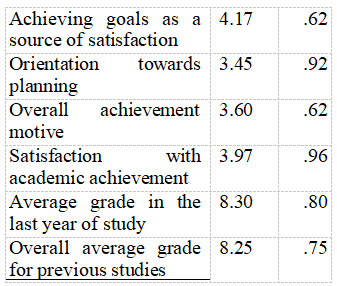
Table 1 presents the determined correlations of the basic research variables (HEXACO personality traits, self-efficacy and dimensions and overall achievement motive) on the one hand and the average in the last year of studies on the other hand.
Table 2. Correlations of the basic research variables on the one hand and the average in the last year of studies on the other hand
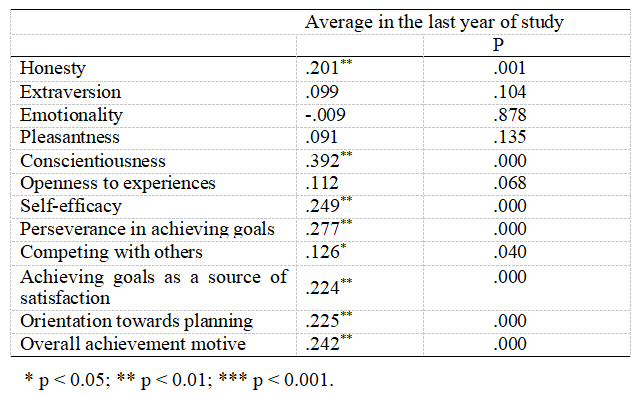
Based on the results in Table 2, we observe statistically significant positive correlations of the traits of honesty and conscientiousness on the one hand and the average in the last year of studies on the other hand. The traits of extraversion, emotionality, agreeableness and openness to new experiences are not related to the average in the last year of study. Furthermore, there is a statistically significant positive correlation of self-efficacy and average in the last year of studies. Statistically significant positive correlations of all dimensions as well as the overall motive of achievement on the one hand and the average in the last year of studies on the other hand were established.
Table 3. Correlations of the basic variables of the research on the one hand and the overall average on the studies on the other hand
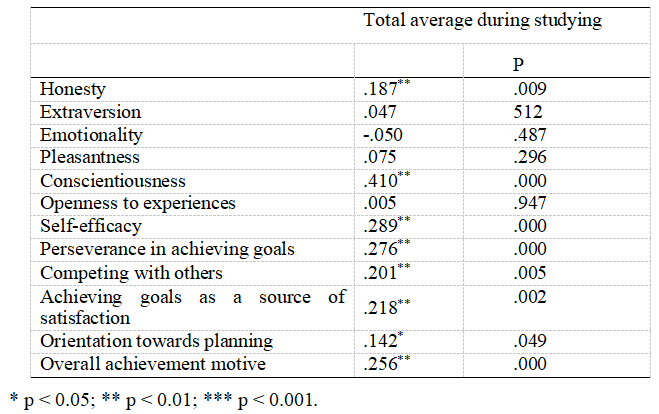
Note: the correlations in Table 3 were obtained on a sample of third- and fourth- year students, given that the average in the last year of second-year students is the same as the total average in the studies.
The data in Table 3 indicate that statistically significant positive correlations were found between the traits of honesty and conscientiousness on the one hand and the overall average across the studies on the other hand. Furthermore, the traits of extraversion, emotionality, agreeableness and openness to new experiences are not related to the overall average in the studies. The results showed a statistically significant positive correlation of self-efficacy and the overall average in studies.
Statistically significant positive correlations of all dimensions as well as the overall motive of achievement on the one hand and the overall average on the studies on the other hand were also determined.
Table 4. Correlations of basic research variables and satisfaction with academic achievement

The results showed statistically significant positive correlations of the traits of honesty, extraversion and conscientiousness on the one hand and satisfaction with academic achievement on the other. The traits of emotionality, agreeableness, and openness to new experiences are not related to satisfaction with academic achievement. Furthermore, there is a statistically significant positive correlation of self-efficacy and satisfaction with academic achievement. Statistically significant positive correlations of all dimensions as well as the overall motive of achievement on the one hand and satisfaction with academic achievement on the other hand were established.
In the continuation of this paper, the results of three regression analyzes are presented. First, a multiple regression analysis was presented, which was carried out with the aim of predicting the average in the last year of studies based on a set of predictors of personality traits, self-efficacy and achievement motive dimensions on the entire sample. Then the results of the prediction of the overall average at the university based on a set of predictors (HEXACO personality traits, selfefficacy and achievement motive dimensions) were presented. It is important to note that the second regression analysis was performed on a sample of third- and fourth-year students. This analysis did not include second-year students because they only had the average in the last year of study as an indicator of academic achievement. And finally, the results of the third linear regression analysis, which was carried out with the aim of predicting satisfaction with academic achievement based on HEXACO personality traits, self-efficacy and dimensions of achievement motives on the entire sample, are presented.
Table 5. Prediction of the average in the last year of studies based on a set of predictors of personality traits, self-efficacy and achievement motive dimensions

The multiple correlation coefficient (R= 0.445) is statistically significant (F (11) =5.713; Sig = .000). It was found that 19% of the variability (R Square = 0.198) of the average in the last year of studies can be explained on the basis of a set of predictors of personality traits, self-efficacy and achievement motive dimensions. The results showed that the only statistically significant predictor of the average in the last year of studies is conscientiousness. Other predictors are not statistically significant.
Table 6. Prediction of the overall average in the studies based on a set of predictors of personality traits, self-efficacy and achievement motive dimensions
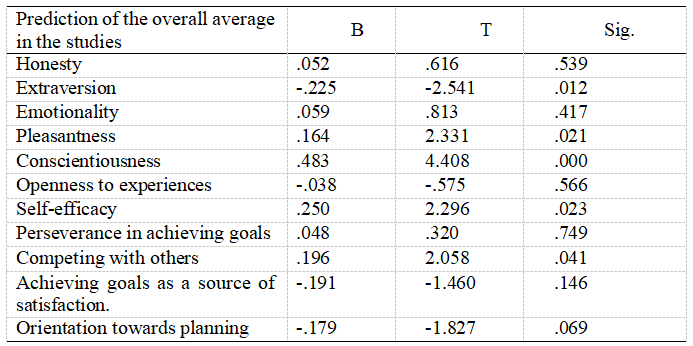
Note: the correlations in Table 3 were obtained on a sample of third- and fourth- year students, given that the average in the last year of second-year students is the same as the overall average in the studies
The results showed that the coefficient of multiple correlation (R= .514) is statistically significant (F (11) =5.910; Sig = 0.000). Of the total variability of the criteria, 26% of the variability (R Square = 0.26) can be explained on the basis of a set of predictors of personality traits, self-efficacy and achievement motive dimensions. By looking at the partial standardized regression coefficients, it is concluded that extraversion, agreeableness, conscientiousness, self-efficacy and competition with others have a statistically significant partial contribution to the explanation of individual differences in the overall average of the studies. Other predictors are not statistically significant.
Table 7. Prediction of satisfaction with academic success based on a set of predictors of personality traits, self-efficacy and achievement motive dimensions

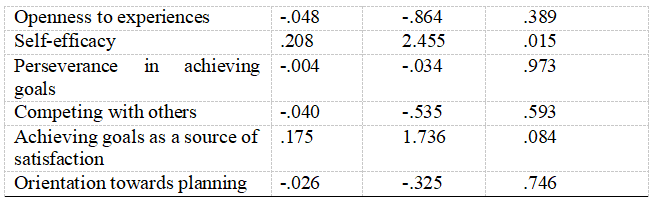
The multiple correlation coefficient (R= 0.541) is statistically significant (F (11) =9.617; Sig = .000). It was found that 26% of the variability (R Square = 0.263) of satisfaction with academic success can be explained based on a set of predictors of personality traits, self-efficacy and achievement motive dimensions. The results showed that honesty and self-efficacy are statistically significant predictors of satisfaction with academic success. Other predictors are not statistically significant.
The obtained findings are significant, not only for researchers in order to better understand the academic achievement of students, but also for psychologists, pedagogues, professors, and students themselves. The research results show that personality traits, achievement motive and self-efficacy are significant predictors of academic achievement, which suggests that they must be taken into account when creating interventions to increase academic success. It is important that psychologists, pedagogues and professors in their work with students get to know their characteristics, beliefs and motives and based on that develop ways and strategies to increase academic achievement. This study provided a better understanding of the personality traits, beliefs, and motives of students that contribute to academic achievement.
Conclusion
In this paper, statistically significant positive correlations of the traits of honesty and conscientiousness on the one hand and indicators of academic success on the other hand were established. The correlation between the trait of conscientiousness and academic success has been consistently shown in numerous studies (Conard, 2006, Wan, Liu, Wang, Wang, 2023; John, John, Zia-ur-Rehman Rao, 2020). Students who have a pronounced trait of conscientiousness are characterized by self-control, discipline, and effort in achieving goals. Such students put a lot of effort into learning, which results in greater confidence in their own abilities and greater success. On the other hand, students with lower conscientiousness are to a greater extent irresponsible, unscrupulous, lazy and do not invest continuous effort in their development, do not believe in their competence and do not have high self-confidence and achieve lower academic success. Furthermore, the results showed statistically significant correlations between honesty and indicators of academic performance. Students with a more pronounced dimension of honesty are fairer and more virtuous as well as more academically successful. In contrast, students who tend to break the rules, are greedy, and are motivated solely by material gain have less achievement in college. Furthermore, the traits of extraversion, emotionality, agreeableness, and openness to new experiences are not related to indicators of academic success.
There is a statistically significant positive correlation of self-efficacy and indicators of academic success. Students with higher self-efficacy are more persistent in learning and achieving goals, invest more effort and work in fulfilling their obligations, and also have less violent emotional reactions when faced with difficulties. On the other hand, students who do not believe in their competence and efficiency may avoid putting in effort or experiencing discomfort in case of failure. Therefore, students with lower self-efficacy, in situations where they face difficulties, reduce their efforts and give up quickly, which reflects on their success. These results are consistent with previous research (Honicke, Broadbent, Fuller-Tyszkiewicz, 2023; Hayat, Shateri, Amini, Shokrpour, 2020).
Statistically significant positive correlations of all dimensions as well as the overall achievement motive on the one hand and academic success indicators on the other were established. Students who are persistent in achieving their goals and want to stand out in front of others have higher academic success. Also, students who plan their activities to achieve goals and feel satisfaction when they achieve them have higher academic achievement. On the other hand, students with a low achievement motive, are not persistent in achieving their goals, do not find satisfaction in their fulfillment, and have little academic achievement. It is the same with students who do not plan to fulfill their obligations at the university and do not try to stand out in front of others; they have lower academic performance.
This research also determined the correlations of basic variables and satisfaction with academic achievement. The results showed statistically significant positive correlations of the traits of honesty, extraversion and conscientiousness on the one hand and satisfaction with academic achievement on the other. Research (Lievens, Ones, Dilchert, 2009) established the connection between extraversion and conscientiousness on the one hand and academic achievement on the other. Students who are more social, optimistic and have higher self-esteem achieve higher academic success. Conversely, students who are more pessimistic, shy and passive in their relationships with others have lower academic achievement. Furthermore, the traits of emotionality, agreeableness, and openness to new experiences were not related to satisfaction with academic achievement. Also, there is a statistically significant positive correlation of self-efficacy and satisfaction with academic achievement. Statistically significant positive correlations of all dimensions as well as the overall motive of achievement on the one hand and satisfaction with academic achievement on the other hand were established.
Three regression analyzes were conducted with the aim of predicting academic success based on HEXACO personality traits, self-efficacy and achievement motive dimensions. In the first, the results showed that 19% of the variability of the average in the last year of studies can be explained on the basis of a set of predictors of personality traits, self-efficacy and achievement motive dimensions. Conscientiousness is the only statistically significant predictor of average in the last year of study. Other predictors are not statistically significant. In the second, an insight into the partial standardized regression coefficients concludes that extraversion, agreeableness, conscientiousness, self-efficacy and competition with others have a statistically significant partial contribution to the explanation of individual differences in the overall average of the studies. Other predictors are not statistically significant. And finally, the third linear regression analysis showed that 26% of the variability of satisfaction with academic success can be explained based on a set of predictors of personality traits, self-efficacy and achievement motive dimensions. Honesty and self-efficacy were found to be statistically significant predictors of satisfaction with academic success.
Recommendations and limitations of this study
One of the shortcomings in the interpretation of research results is the number of respondents. Next, the study sample was convenient because it consisted of students who attend lectures consistently, who are assumed to have more significant academic achievement than those who do not attend classes regularly. Further limitations arise from the sole reliance on self-report. More reliable data on academic performance would be obtained from student services. Analysis of the results of this study allows suggesting future directions of similar research. For example, future research should include a larger number of students from multiple faculties. In the context of predicting academic success, it would be more adequate to use the academic self-efficacy questionnaire, which is intended exclusively for students. Further research in this area could include variables such as intelligence, self-confidence, resilience, academic motivation, anxiety, stress coping strategies, etc. as predictors.
References
2.Ashton, M., & Lee, K. (2009). The HEXACO – 60: A Short Measure of the Major Dimensions of Personality. Journal of Personality Assessment, 91(4), 340–345. DOI: 10.1080/00223890902935878
3.Ashton, M., Lee, K., & De Vries, R. (2014). The HEXACO Honesty- Humility, Agreeableness, and Emotionality Factors: A Review of Research and Theory, Personality and Social Psychology Review, 18(2) 139–152. DOI: 10.1177/1088868314523838
4.Anglim, J., Lievens, F., Everton, L., Grant, S. L., & Marty, A. (2018). HEXACO personality predicts counterproductive work behavior and organizational citizenship behavior in low‐stakes and job applicant contexts. Journal of Research in Personality, 77, 11–20. https://doi.org/10.1016/j.jrp.2018.09.003
5.Anglim, J. & O’conno, P. (2019) Measurement and research using the Big Five, HEXACO, and narrow traits: A primer for researchers and practitioners. Australian Journal of Psychology, Volume 71, - Issue 1. https://doi.org/10.1111/ajpy.12202
6.Bandura, A. (1977). Self – efficacy; Toward a unifying theory of behavioral change. Psychologycal Review, 84, 191-215.
7.Bandura, A. (1997). Self-Efficacy: The Exercise of Control. New York: Freeman.
8.Costa, P. T. & McCrae, R. R. (2008). The revised neo personality inventory (NEOPI- R). In: G. J. Boyle., G. Matthews, D. H. Saklofske (Eds.), The SAGE handbook of personality theory and assessment. Personality measurement and testing (179– 198). Thousand Oaks, CA: Sage.
9.Camps, J., Stouten, J., & Euwema, M. (2016). The relation between supervisors’ big five personality traits and employees’ experiences of abusive supervision. Front. Psychol. 7:112. doi: 10.3389/fpsyg.2016.00112
10.de Vries, R. E., Ashton, M. C. & Lee, K. (2019) New Developments in HEXACO Personality Research. Zeitschrift für Psychologie, 227(3), 163–
165. https://doi.org/10.1027/2151-2604/a000374
de Raad, B., Barelds, D., Timmerman, M. E., De Roover, K., Mlačić, B., & Church, A.T. (2014) Towards A Pan–Cultural Personality Structure: Input from 11 Psycholexical Studies. European Journal of Personality. Volume 28, Issue 5. https://doi.org/10.1002/per.1953
12.Franceško, M., Mihić, V. &i Bala, G. (2002). Struktura motiva postignuća merena skalom MOP2002. Novi Sad: Zbornik Odseka za psihologiju Filozofskog fakulteta u Novom Sadu, str. 134‒143.
13.Goldberg, A. (2005). Sports slump busting: 10 steps to mental toughness and peak performance. Coral Springs, FL: Llumina Press.
14.Gundogan, D., Radulović, M. (2023) A relation between high-school students’ achievement and their socio-economic status in post-yugoslav countries and western europe. Sociologija, Vol. LXV, N° 4,610-624, DOI: https://doi.org/10.2298/SOC2304610G
15.Hakimi, S., Hejazi, E., & Lavasani, M. G. (2011). The relationships between personality traits and students’ academic achievement. Procedia Soc. Behav. Sci. 29, 836–845. doi: 10.1016/j.sbspro.2011.11.312
16.John, O. P., Naumann, L. P., & Soto, C. J. (2008). Paradigm shift to the integrative Big Five trait taxonomy: History, measurement, and conceptual issues. In: O. P. John, R. W. Robins, L. A. Pervin (Eds.), Handbook of personality: Theory and research (114–158). New York City: The Guilford Press.
17.Kpolovie, P.J., Joe, A.I., & Okoto T. (2014) Academic Achievement Prediction: Role of Interest in Learning and Attitude towards School. International Journal of Humanities Social Sciences and Education (IJHSSE) Volume 1, Issue 11, 73-100.
https://www.arcjournals.org/pdfs/ijhsse/v1-i11/10.pdf
18.Lee, K. & Ashton, M. C. (2008). The HEXACO personality factors in the indigenous personality lexicons of English and 11 other languages. Journal of Personality, 76 (5), 1001–1054. DOI: 10.1111/j.1467- 6494.2008.00512.x
19.Li G, Wu Y, Wen H, Zhang F, Yan D., (2022) Influence of Intellectual- cultural Orientation as Family Culture on Chinese College Students’ Subjective Well-being: A Moderation Model. INQUIRY: The Journal of Health Care Organization, Provision, and Financing Volume 59: 1–9. doi:10.1177/00469580221103924
20.Mishra, T., Kumar, D. and Gupta, S. (2014) Mining Students' Data for Prediction Performance, 2014 Fourth International Conference on Advanced Computing & Communication Technologies, Rohtak, India, pp. 255-262, doi: 10.1109/ACCT.2014.105.
21.Murray, H.A. (1938). Explorations in personality. New York: Oxford Univ. Press.
22.Miletić, S., & Radić, S. (2022). Evolucija prakse upravljanja dobitkom - nova pretnja kvalitetu finansijskih izveštaja. Oditor, 8(3), 117-142. https://doi.org/10.5937/Oditor2203117M
23.Mata, M. N., Anees, S. S. T., Martins, J. M., Haider, S. A., Jabeen, S., Correia, A. B., et al. (2021). Impact of non-monetary factors on retention of higher education institues teachers through mediating role of motivation. Acad. Strateg. Manag. J. 20, 1–17.
24.Ornelas, F., & Ordonez, C. (2017) Predicting Student Success: A Naïve Bayesian Application to Community College Data. Tech Know Learn 22, 299–315. DOI: 10.1007/s10758-017-9334-z
25.Pilch, I. (2023) Comparison of the Big Five and the HEXACO Models of Personality in the Prediction of Emotional Wellbeing: an Experience Sampling Study. Trends in Psychology, Springer, https://doi.org/10.1007/s43076-023-00311-w
26.Schwarzer, R., & Jerusalem, M. (1995). General Self-Efficacy Scale (GSE), APA PsycTests. https://doi.org/10.1037/t00393-000
27.Sokić, K., Qureshi, F. H. & Khawaja, S. (2021) Predicting Academic Procrastination and Academic Achievement in Private Higher Education With the HEXACO Model of Personality and Psychological Distress. International Research in Higher Education Vol. 6, No. 4. , 29-39. https://doi.org/10.5430/irhe.v6n4p29
28.Shu, F., McAbee, S.T., & Ayman, A. (2017)The HEXACO personality traits, cultural intelligence, and international student adjustment. Personality and Individual Differences. Volume 106, Pages 21-25. https://doi.org/10.1016/j.paid.2016.10.024
29.Thielmann, I., Moshagen, M., Hilbig, B.E. & Zettler, I. (2021) On the Comparability of Basic Personality Models: Meta-Analytic Correspondence, Scope, and Orthogonality of the Big Five and HEXACO Dimensions. European Journal of Personality. DOI: 10.1177/08902070211026793
30.Viswanathan, S., & Vengatesh K. S. (2021) Study Of Students’ Performance Prediction Models Using Machine LearningTurkish Journal of Computer and Mathematics Education Vol.12 No.2 (2021), 3085 – 3091.
https://www.proquest.com/docview/2624698995?sourcetype=Scholarly%2 0Journals
Zettler, I., Thielmann, I., Hilbig, B,E., & Moshagen, M. (2020) The Nomological Net of the HEXACO Model of Personality: A Large-Scale
Meta-Analytic Investigation. Perspectives on Psychological Science, Vol. 15(3) 723–760. DOI: 10.1177/1745691619895036
32.Conard, M. (2006). Aptitude is not enough: how personality and behavior predict academic performance. Journal of research in personality, 40, 339-
346. https://doi.org/10.1016/j.jrp.2004.10.003
33.Honicke, T., Broadbent, J., & Fuller-Tyszkiewicz, M. (2023). The self- efficacy and academic performance reciprocal relationship: the influence of task difficulty and baseline achievement on learner trajectory, Higher Education Research & Development, 42:8, 1936-
1953, DOI: 10.1080/07294360.2023.2197194
34.Hayat, A., Shateri, K., Amini, M., & Shokrpour, N. (2020). Relationships between academic self-efficacy, learning-related emotions, and metacognitive learning strategies with academic performance in medical students: a structural equation model, BMC Medical Education, 20, https://doi.org/10.1186/s12909-020-01995-9
35.Wang H, Liu Y, Wang Z, & Wang T. (2023). The influences of the Big Five personality traits on academic achievements: Chain mediating effect based on major identity and self-efficacy. Front Psychol., doi: 10.3389/fpsyg.2023.1065554.
36.John, R., John, R., & Zia-ur-Rehman Rao, Z. (2020). The Big Five Personality Traits And Academic Performance, Journal of Law & Social Studies. 2 (1), 10-19, Doi.org/10.52279/jlss.02.01.1019
Published in
Vol. 10 No. 3 (2024)
Keywords
🛡️ Licence and usage rights
This work is published under the Creative Commons Attribution 4.0 International (CC BY 4.0).
Authors retain copyright over their work.
Use, distribution, and adaptation of the work, including commercial use, is permitted with clear attribution to the original author and source.
Interested in Similar Research?
Browse All Articles and Journals